Monday, April 9, 2012

The Pigman by Paul Zindel


The Pigman was published in 1968, but it’s one of those YA books like The Outsiders or Catcher in the Rye or A Separate Peace that kind of retains everything relevant about it, a direct style that doesn’t seem so much like a classic even fifty years later. In The Pigman, teenage protagonists John and Lorraine hold telephone marathons, calling up houses as a joke and pretending to be an organization, a charity, or some made up imaginary person. They explain what they do in the first few pages by way of talking about the Marshmallow Kid, a social outcast ever since he got caught stealing a bag of marshmallows from the grocery store. Lorraine explains,

“Anyway, [the Marshmallow Kid’s] the one who started cheating in the telephone marathons we were having. After Dennis had rung up that staggering record about having his nose bitten off, Norton started getting smart, and when it was his turn to pick out a phone number, he’d peek a little and try to make his finger land on a woman’s number rather than a man’s. You could always make a woman talk twice as long as a man. I used to ignore it because in his case it didn’t matter whom he spoke to on the phone. They all hung up.”

Lorraine ends up peeking herself and chooses a number off of Howard Avenue, a street just a couple of blocks away from her house. She ends up getting Mr. Angelo Pignati who “sounded like such a nice old man, but terribly lonely. He was just dying to talk.” He agrees to donate money to the made up “Lorraine and John Fund” and right away Lorraine and John start feeling bad about taking advantage of an old man that they got on the phone. When they go over to his house to collect the money, he invites them in, and reveals the reason that they dub him “The Pigman” – he has a room filled with pig figurines and

“It was a real dump except for the table and shelves at the far end of it. The table had pigs all over it. And the shelves had pigs all over them. There were pigs all over the place. It was ridiculous. I never saw so many pigs. I don’t mean the live kind; these were phony pigs. There were glass pigs and clay pigs and marble pigs.”

What begins as a joke – calling up the Pigman as part of a telephone marathon – continues as a nuanced game, as Lorraine and John visit the Mr. Pignati regularly, spending time at his house, taking him to the zoo, and the department store. The uncomfortable nature of their relationship is revealed by their unwillingness to always let the Pigman buy them wine and snacks and expensive meals at restaurants, and while their relationship is more than the game that it starts out as, it remains tinged with an imbalance. When strangers ask John and Lorraine if they are the Pigman’s son and daughter, both notice the Pigman’s face fall when they admit that they are not. Seeing his distress, Lorraine amends her answer by saying, “I’m his niece.”

Both John and Lorraine are high school sophomores, and the novel alternates from both of their perspectives as they tell the story of the Pigman. Both come from homes and family situations that are less than ideal, and it becomes clear that while the Pigman isn’t exactly normal himself, he does offer both of them a stable second home. Lorraine’s mother’s “got a real hang-up about men and boys” and, as a live-in nurse, “borrows” food from her client’s pantry. She is suspicious of Lorraine’s friendship with John, and monitors their conversations on the phone. John’s dad “the Bore” isn’t a whole lot better. While on the phone Lorraine asks him,

            “What’s all that yelling in the background?”
            “It’s just the Bore.”
            “What did you do now?”
He raised his voice. “They’re trying to accuse me of gluing the telephone lock. They don’t trust me around here.”

But it runs deeper than that, as John’s perspective in the novel shows his home life, where his older brother Kenny is venerated while John is put down and ignored. His dad always “got a big kick out of it when I was about ten years old, and I’d go around emptying all the beer glasses lying around the house.” But the disconnect between John and his brother is even there, as he says, “It was about the only thing I ever did that got any attention. My brother was the one everybody really liked – Kenny, the smart college kid. The only thing I did better than him was drink beer.” The Pigman gives Lorraine and John a reprieve from family, and opens up his house to both of them.

Things fall apart slowly, and then all at once. It’s a quiet book that hits you all at once with its small moments – of Lorraine dressing up in Mr. Pignati’s wife’s clothing, of John leaving a lit cigarette between the fingers of a department store mannequin, of the Pigman feeding animals at the zoo. It was published more than fifty years ago, but it’s so relevant and gets the voices of John and Lorraine so right through their relationship with a stranger, especially as they skate on their roller skates in the department store, the three of them in a line and

“All John was doing was opening his arms and in his own way saying: ‘Look at me, world! Look at my life and energy and how glad I am to be alive!’ We must have looked just like three monkeys. The Pigman, John, and me – three funny little monkeys.”

Friday, April 6, 2012

The Underneath by Kathi Appelt

I had a thing for animal-character books when I was younger, something that has sort of continued (the “Talking Animals Movies” category will sometimes be recommended by Netflix). Redwall by Brain Jacques, Kenneth Oppel’s Silverwing, David Clement-Davies’ Fire-Bringer, and Kate diCamillo’s The Tale of Despereaux were all some of my favorite books. But Kathi Appelt’s The Underneath, published in 2008, took that category to an entire other level and showed just how much exceptional writing is happening in books for adolescents and young adults (and the fact that the book is illustrated by David Small, whose memoir Stitches is an incredible book, shows how exceptional art is also present in books for adolescents and young adults). Appelt followed this book for adolescents (she has a slew of picture books written for younger readers) with Keeper a book about a blue moon, mermaids, BD (Best Dog), and a seagull called Captain. It’s a whimsical, beautiful book that drops the reader right into the story, and together, both books show Appelt to be one of the best writers for children right now.

The Underneath begins with the lines, “There is nothing lonelier than a cat who has been loved, at least for a while, and then abandoned on the side of the road. A small calico cat. Her family, the one she lived with, has left her in this old and forgotten forest, the forest where the rain is soaking into her soft fur.” The calico cat is about to have kittens, a daughter named Sabine, and a son named Puck, and she searches for a place that she can go to rest.

The cat meets with a dog named Ranger, an old hound chained out front of a house, who sings songs in blues and jazz, mournful and aching with a sound that “sounded exactly how she [the calico cat] felt.” Ranger invites the cat to live in “The Underneath,” the dark space beneath the porch where she will not be found. Ranger belongs to Gar-Face, an old man who grew up steeped in hatred, who left home at an early age, and collected cruelty. The author warns the reader,

“For twenty-five years, while the old loblolly pine shed its branches and bark into the Little Sorrowful Creek and watched them drift toward the sea, Gar Face had roamed this hidden forest. Here, underneath the canopy of the watching willow and birches and ash. Over this past quarter century, the years have softened the old pine. No so Gar Face. Do not cross his angry path. Do not.”

Ranger’s hard life under Gar Face is told in remarkable detail, including the bullet still lodged in his leg from when his owner shot him. When Gar face discovers the cat and kittens under the porch, he sets a chain of events in motion that carry the novel to its conclusion.

And beyond these intersecting stories is something very old, buried in a jar underneath the ground, that is waking up again.

Appelt tells the story of the old hound, the calico cat, and two small kittens in this lyrical, poetic novel. The refrain of “Stay in the Underneath. You’ll be safe in the Underneath” echoes throughout, as the animals are caught between overwhelming love and hate, and navigate the space between.

Tuesday, March 27, 2012

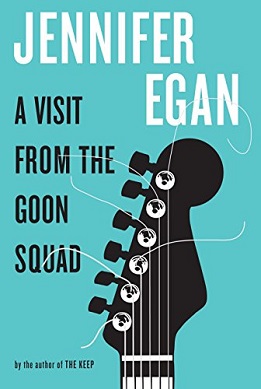
A Visit From the Goon Squad by Jennifer Egan

I read Jennifer Egan’s A Visit From the Goon Squad about a year ago, a collection of loosely tied short stories that won the Pullitzer Prize in 2011. The construction of this book is similar to Tom Rachman’s The Imperfectionists, which I reviewed a few months ago, but this one has even less of a connecting factor between stories (Rachman’s novel was tied together by an English-language newspaper based in Rome). Most of the stories can be read as stand-alone, and each does feature a different character, but the fact that they exist side-by-side in the same collection makes it possible to search for connection and frequently find it.

Many of the stories have been published before in both literary journals and edited collections, and when I read “Selling the General” in this collection I realized that I had read it before, in a collection called This is Not Chick Lit edited by Elizabeth Merrick, when I was working at a secondhand bookstore. After that I read every story with a sort of anticipation, an “is-this-the-second-time-reading-this-or-the-first?”

There is one story in the collection that I knew overwhelmingly that I hadn’t read before, “Great Rock and Roll Pauses by Alison Blake.” It’s one of the stories highlighted in every review of A Visit From the Goon Squad that I’ve read, because writing an entire chapter/short story in PowerPoint is pretty noticeable. The slides are printed page to page, with a mixture of Venn diagrams, flow charts, and arrows constructing narratives. There is something about the limited structure, the fitting of story into small boxes and circles that makes this the most affecting chapter of the book. Egan chooses her words carefully, and this lends a lyrical, poetic quality to the story.

All of this is doubled by the subject matter of this story, about a boy trying to communicate with his father through the pauses in rock and roll songs. Alison, the narrator of the story (which she records in her “slide journal”), has a brother named Lincoln, who notes the length of the pauses in songs and then maps them with his comments. Two songs and his comments:

“Foxey Lady,” by Jimi Hendrix
“Another great early pause: 2 seconds long, coming 2:23 seconds into a 3:19-minute-long song. But this one isn’t total silence; we can hear Jimi breathing in the background.”

“Young Americans,” by David Bowie
“This is a lost opportunity. Hell, it would’ve been so easy to draw out the pause after ‘…break down and cry…’ to a full second, or 2, or even 3, but Bowie must’ve chickened out for some reason.”

He loops the pauses sometimes, leaving big spaces of silence in the house. His dad doesn’t understand and gets frustrated with Lincoln’s obsession with pauses, and when he loses his temper with Lincoln, his wife says very carefully, “The pause makes you think the song will end. And then the song isn’t over, so you’re relieved. But then the song does actually end, because every song ends, obviously, and THAT. TIME. THE. END. IS. FOR. REAL.”

And all of that is floating in bubbles and shapes and arrows against the outline of a PowerPoint slide. It’s all of this emotion pressurized and compacted and made small.

“Great Rock and Roll Pauses by Alison Blake” is only one of the stories in this collection that has been picked up for adaptation by HBO. It is a collection worth reading, especially for this chapter. 

Tuesday, March 20, 2012

Chasing Redbird by Sharon Creech

I used to read Sharon Creech’s Chasing Redbird EVERY YEAR for a really long time. Every time I picked it up, it seemed like a new story, one that I hadn’t ever read before, even though I knew that just around Spring every year I’d start itching to read it again. And Chasing Redbird is a companion novel to Walk Two Moons, where characters from one book leech into the world of the next.

Chasing Redbird is about Zinny Taylor, one of a “slew of brothers and sisters” living on a farm with her parents in Bybanks, Kentucky. They live next door to their Uncle Nate and Aunt Jessie, “the two houses yoked together like one.” Zinny describes her house as a place that she can get lost in, and forget who she is, and crossing over to the other house takes her to the “Quiet Zone,” where she can rediscover her identity.

When Zinny finds an overgrown trail behind her house, she decides to clear it stone by stone, even after finding out that it is twenty miles long. The path becomes an obsession, and a way to deal with her Aunt Jessie’s sudden death, one that Zinny feels is her fault. Although most of the novel is set during the summer that Zinny tackles the trail, flashbacks explain her relationship with her aunt, and the family mysteries that are still left to be unraveled.  And then there’s Jake Boone, who’s a lot different than Zinny remembers (the last time she saw him, he was “as skinny as six o’clock”).

One thing that I love about this book is how quick Creech sets up Bybanks and the Taylor family and old trail at the back of the house. There is a feeling about the book that is instantly transferred within the first few pages, and it’s immediate and instant. The place where the novel starts is much different from where it goes – from a kitchen to a trail in the middle of the woods – and Creech eases the reader, guiding them along the same path.

Like Zinny says, “These were trivial things my find focused on, and I knew it, but they kept me from thinking about the bigger things that were lurking behind this clutter. I felt that if I didn’t keep busy, a million, million scenes were going to burst out of my head all at once. Part of me was curious to see what was in there, but I wanted to see them slowly, one at a time.” Creech does just that for her reader, keeping those “million, million scenes” just in the background, slowly coming into focus. 

Saturday, March 10, 2012

Your Voice in My Head by Emma Forrest

Books sometimes come at exactly the right time. I picked and read Emma Forrest’s Your Voice in My Head last night and read it in a couple of hours. But last spring, I picked up the book at a bookstore, sort of mulled over it, and put it back. And I’m so glad I did. Except for the fact that the hardcover cover art is amazing in comparison to the Vintage Canada copy I bought, I’m so glad I waited to pick it up. There are a lot of books that seem like they can almost have a missed potential depending on when you read them, or the circumstances under which you read them, or the circumstance that you could make for yourself to give a book an entryway to be what it could be, instead of the skim-the-plot-and-skip-the-rest. And for some reason, this was the right time to read this book.

At the heart of Forrest’s memoir is her relationship with her psychiatrist, Dr R, a man who impacted her life so deeply. One day when she tries to call his office to make an appointment, she finds out that he has passed away unexpectedly, and it is this event that allows for her retrospection and consideration of the events that brought her to Dr R, her time in his care and conversation, and what follows after his death. She talks frankly about her own destructive behavior, including unhealthy relationships, self-harm and cutting, and bulimia. Her experience is scaffolded by some of the most reflective and beautiful writing I’ve read, and I was already reading and re-reading passages throughout this first read.

But along with Dr R is her highly publicized relationship with her “Gypsy Husband,” and although she never refers to him by any other name, this man seems to be actor Colin Farrell, who she was with a few years ago. Susan Sarandon, Heath Ledger, and Robert Downey Junior also make appearances in the novel (Forrest sends Downy Junior mix tapes when he is in jail). The careful way that Forrest constructs this memoir is what makes it so affecting, a movement between far past and near past that shapes her recovery and daily living with manic depression.

Forrest’s writing style wraps up these new ways of saying familiar things in whimsical, almost bewitching language. Any passage from the book could be highlighted below, but these were some of my favorites:

1. “It’s almost always pills with women. It’s a gentle seeping out women seek, like on a classic soul record, when the volume on Otis Redding just slowly gets turned down until he’s gone. What happens after the fade-out? What are the musicians doing now in that room? Take me there. Take me there.”

2. “On my third or fourth day there, they bring in a homeless boy who has, like many patients, been picked up from the streets. He has a swastika carved into his forehead because voices told him to do it. I am extremely scared of him, do I force myself to make conversation. He asks what I’m listening to on my Walkman and, ashamed, I say ‘George Michael.’ ‘I like George Michael,’ he says, furious at me for making it seem shameful. Never use pop culture as delineator with someone who hears voices. You don’t know what they hear between the melodies. On my last day, I leave him my Walkman and all my music. I wonder if it’s easier to navigate a stay in a psychiatric hospital now iPods exist, or if it impedes progress.”

3. “At our hotel, a red-faced yelling man wakes us at 6 a.m. with his red face and yelling. The tray of breakfast we’d ordered is not nearly as sodden as his demands that GH cast his kids in the movie. I link any problem I have had since then directly to the foul yelling man, as if he were the sorceress entering the ball on my wedding night.”

I absolutely loved this book for its honesty, poignancy, and frankness, and I know I'll be picking up her other novels soon.