Monday, March 9, 2020

Books Read December 2019-March 2020


The Female Persuasion by Meg Wolitzer
Disappearing Earth by Julia Phillips
Rabbits for Food by Binnie Kirshenbaum
Trust Exercise by Susan Choi
The Yellow House by Sarah M. Broom
Olive, Again by Elizabeth Strout
Will My Cat Eat My Eyeballs by Caitlin Doughty
The Institute by Stephen King
Magnetic North by Jenna Butler
Children of Blood and Bone by Tomi Adeyemi
The Education of an Idealist by Samantha Power
Friday Black by Nana Kwame Adjei-Brenyah
Small Fry by Lisa Brennan-Jobs
The Incendiaries by R. O. Kwon
Bunny by Mona Awad
Catch and Kill by Ronan Farrow
French Milk by Lucy Knisley
An Age of License by Lucy Knisley
Displacement by Lucy Knisley

Wednesday, July 6, 2016

Every Exquisite Thing by Matthew Quick

Nanette O'Hare is the protagonist of Matthew Quick's newest YA novel, Every Exquisite Thing (near the end of the novel, the title is revealed to be a quote from The Picture of Dorian Gray), and the novel begins when her favourite teacher gives her a copy of the out-of-print cult-classic The Bubblegum Reaper by Nigel Booker. After devouring the book, Nanette reaches out to Booker, discovering that he lives only a few blocks away from her. She is quickly folded into Booker's life, and introduced to other Booker acolytes, including teenage poet Alex (his poems are scattered throughout the novel). Booker gets them together for dinner and then immediately disappears into his house, causing Nanette and Alex to have the following exchange:
I said, "Do you think it's weird that Booker tricked us into going on a blind date and yet neither of us seems mad or upset? I'm not upset. Are you? I mean, you could be pretending. But you seem pretty okay with tonight."
He blinked a few times as if he was surprised by my words, and then the sentences that came out of his mouth were both wonderful and sad. "Honestly? This is the best night I've had in years. Maybe in my entire lifetime."
The book at the heart of Every Exquisite Thing is fictional, and the way it influences and impacts Nanette's life is reminiscent of Hazel's reading of An Imperial Affliction in John Green's The Fault in Our Stars. But while I had absolutely no interest in the plot or characters in Green's fictional book, I read Every Exquisite Thing wishing there was a way to read the parallel narrative, and that The Bubblegum Reaper was a real book, rather than one invented to suit the purposes of the novel (although the fictional cover art for The Bubblegum Reaper exists under the dust jacket, and it will be interesting to see how the paperback release incorporates that art into a redesign). What I mean to say is that The Bubblegum Reaper makes a much more compelling fictional book than An Imperial Affliction. There's even a nod to Carlos Ruiz Zafon's The Shadow of the Wind, a book about an author who buys up all of his books to keep anyone from reading them; there's a rumour that Booker does that, too.

The novel explores the way that books can impact teenagers' lives, especially the ones they find in high school. While Alex is impacted utterly by the protagonist of The Bubblegum Reaper, a Holden Caulfield-esque character named Wrigley, Nanette's life is changed in more subtle ways. Wrigley's repetition of wanting to quit (Nanette isn't sure what he wants to quit, exactly) is the permission and insistence she needs to quit her high school soccer team, even if it could lead to a scholarship and college acceptance. 

I think Every Exquisite Thing is my new favourite Matthew Quick book. It offers compelling and flawed characters trying to find their place in the world, even if their choices aren't conventional or expected; even if they are both of those things. 

Monday, July 4, 2016

Dumplin' by Julie Murphy


Willowdean Dickson, the protagonist of Dumplin', met her best friend Ellen because of Dolly Parton, back when they were kids. Will's aunt Lucy - a Dolly Parton devotee - bonded with Ellen's mom, Mrs. Dryver - a Dolly Parton impersonator - and now Dolly Parton is like the connective tissue of their friendship. Even Will's car is reflective of this theme: it's a 1998 cherry-red Pontiac Grand Prix named Jolene. The book begins with a Dolly Parton quote and describes Will to a T: "Find out who you are and do it on purpose." Will lives her life confidently and fearlessly.

Will lives with her mom, a health care aide by day who is devoted to running and organizing the Miss Teen Blue Bonnet Pageant every year, which has been running since the 1930s. Will's aunt Lucy - her mom's sister - used to live with them, too, but now her room is being cleaned out and Will feels lost without her favourite person in the house.

Will works at a local fast food restaurant called Harpy's, and her classmates crowd in most weekend nights just before midnight to order fries and burgers. She works with Bo, the incredibly attractive guy in the back kitchen. She reflects, "I've had this hideous crush on Bo since the first time we met. His unsettled brown hair swirls into a perfect mess at the top of his head. And he looks ridiculous in his red and white uniform. Like a bear in a tutu." This summer, Bo kisses her outside of the restaurant one night, and they spend the next few months secretly driving to an abandoned parking lot to make out. But Will is increasingly uncomfortable with the way that Bo is keeping her a secret. And Will, who describes herself as a fat girl, hates the feeling of his hands on her body, afraid that he can feel her skin spilling over the sides of her clothing. She breaks it off, and eventually quits her job at Harpy's to cross the street to get a job at the local chilli place.

Fast forward to the beginning of the school year, and Will finds out that Bo has left his private school and now attends her public school, and this time, Will's not the only person who is interested in him. When she decides to enter into the Miss Teen Blue Bonnet Pageant, her friendship with Ellen begins to change, and she finds herself more alone than she has ever been before.

Enter three other girls who are inspired to enter the pageant alongside Will - Millie ("Millie is that girl, the one I am ashamed to admit that I've spent my whole life looking at and thinking, Things could be worse"); Amanda; and Hannah. They become a group worth rooting for as acclaimed author Julie Murphy weaves an incredibly funny, real, and fabulous story with a heaping scoop of romance.

Friday, July 1, 2016

More Happy Than Not by Adam Silvera


Adam Silvera's debut novel More Happy Than Not is billed as a cross between the movie Eternal Sunshine of the Spotless Mind and Aristotle and Dante Discover the Secrets of the Universe by Benjamin Alire Saenz. Protagonist Aaron Soto lives in a one-room apartment in the Bronx with his mom and brother Eric. There's little privacy in the living room that Aaron and Eric share for a bedroom, especially when Eric is up all night playing video games. Aaron spends most of his time in the street with his friends, playing games like Manhunt, which involves chasing each other up and down staircases, through buildings, and down alleys. 

The novel starts when Aaron's painter girlfriend Genevieve decides to go away for a three-week art camp during the summer, leaving him alone. Genevieve has been Aaron's life line, getting him through the period after his father committed suicide, and after he got his own happy-face shaped scar on his wrist. 

Even though Aaron has a group of friends on his block, his sort-of-best-friend, Brendan, is busy with other things this summer. Enter Thomas, a kid who lives nearby, who walks into Aaron's life and causes him to question his happiness, and the in-between state he's been living in. Thomas fills an important gap in Aaron's life when his girlfriend is away, and they're inseparable even when she's back. One of the highlights of the novel is the concept of "Trade Dates." Aaron describes them as something Genevieve came up with: she takes him to a place that she knows he'll like, and he takes her to a place that he knows she'll like. Aaron's place is a local comic book store, Comic Book Asylum, which exists behind a door painted to look like a telephone booth. Aaron and Thomas do something like a "Trade Date," too; but because they don't know each other as well, they each show the other a place that matters to them immensely. 

As Aaron and Thomas grow closer, Aaron discovers things about himself that make it very difficult to continue to date Genevieve, and to be only just-friends with Thomas. Aaron decides that there are two sides to this discovery: Side A is that he likes guys instead of girls and Side B is that he likes one guy in particular - Thomas. 

When things fall apart - first with Genevieve, and then with Thomas - Aaron seriously considers getting a new memory treatment offered by the Leteo Institute. It guarantees erasing certain memories that are too difficult. Aaron even knows someone who has had it done. But is it possible to erase Thomas? And what does Aaron lose by excising those memories and pieces of himself?

More Happy Than Not pairs a fascinating idea - the existence of the Leteo Institute, whose services are similar to those offered in Eternal Sunshine of a Spotless Mind - with deft character development. The book continues to built towards Aaron's decision before pausing in the narrative, and exploring where Aaron has been before, and the choices he has made. I read More Happy Than Not almost in one sitting - it's incredibly hard to put down. I highly recommend Adam Silvera's debut novel, and appreciated the preview of his next novel, History is All You Left Me, that is added to the back of the paperback edition. 

Wednesday, June 29, 2016

Everything, Everything by Nicola Yoon


Nicola Yoon’s Everything, Everything focuses on eighteen-year-old Madeline Whittier. She has severe combined immunodeficiency (SCIDS, for short. She describes herself as being on SCID row), meaning she is allergic to the outside world. The house she shares with her mother and her nurse is her entire world, and an illustration that depicts her as an astronaut floating above the earth (81) is one of the most affecting in the novel. Everything, Everything is illustrated by Yoon's husband, David Yoon, who creates hand drawn illustrations of various size throughout the novel. The novel also includes graphs that chart her hourly breaths per minute, IM transcripts, website screenshots, and ticket stubs. 

When new neighbours move in next door to Madeline's house, she begins to want more than her small world provides her with. This is specifically influenced by her neighbour Olly, a teenage boy her age who teaches her that life is more than what she can read about in books. Madeline reads often and reads widely. Because she is homeschooled, her reading list is mostly self-selected. Yet, she still chooses to read the types of books that we would define as canonical, including titles such as William Golding’s The Lord of the Flies, Lewis Carroll’s Alice’s Adventures in Wonderland, Daniel Keyes’s Flowers for Algernon, Ralph Ellison’s Invisible Man, Albert Camus’s The Stranger, Samuel Beckett’s Waiting for Godot, and Nausea by Jean-Paul Sartre. She writes short, one-sentence reviews of these books under the caption “Life is Short: Spoiler Reviews by Madeline,” which reviews Invisible Man as “Spoiler Alert: You don’t exist if no one can see you” (246). Like in Stephen Chbosky's The Perks of Being a Wallflower and Jon van de Ruit's Spud, the books she reads (and her interpretations of them) mirror events in her life, and provide her with a literary lens through which to interpret her experiences.

The text itself also engages with a different kind of focus on graphics and images, one less explicit that that provided by David Yoon's illustrations. This occurs specifically when Madeline describes the silence between her and Olly in the following way: “We are awkward together for a few moments unsure what to say. The silence would be much less noticeable over IM. We could chalk it up to any number of distractions. But right now, in real life, it feels like we both have blank thought balloons over our heads” (73).

Everything, Everything follows Madeline's self-discovery, and especially her journey to live her life to its fullest .

Monday, June 27, 2016

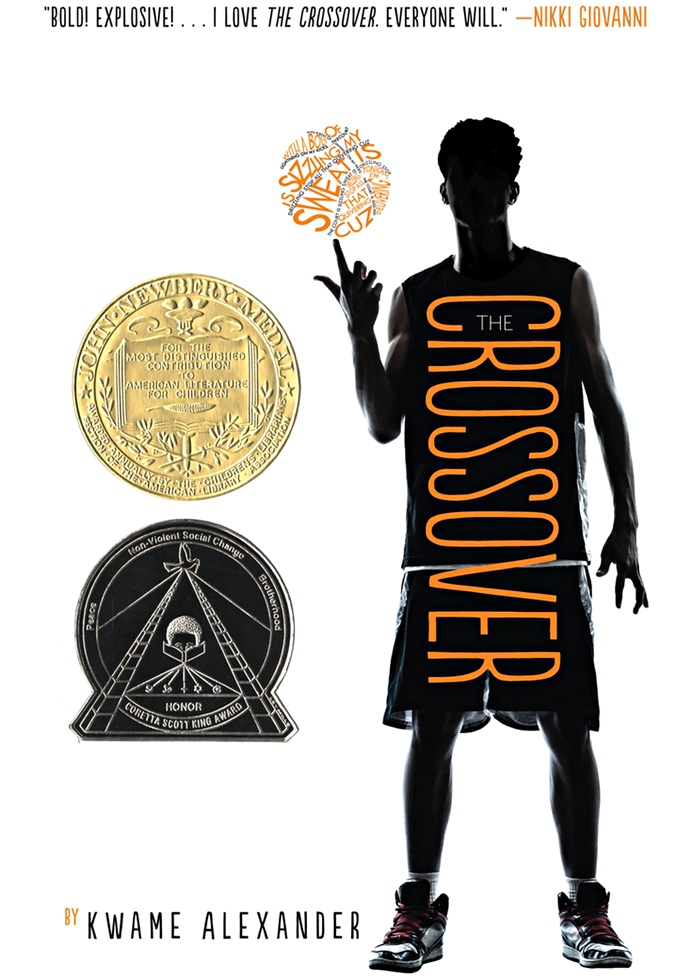
The Crossover by Kwame Alexander


The Crossover (2014) by Kwame Alexander is a Newbery-Award winning novel told in verse that experiments with typography and visual poetry. 12-year-old Josh Bell is a junior high basketball superstar, and he plays alongside his twin brother Jordan on the school team. Like Sharon Creech's Love that Dog, Karen Hesse's Out of the Dust, or Jacqueline Woodson's Brown Girl Dreaming, the novel is communicated in short, poetic sections, some of which rely on internal rhymes and other times on end rhyme. 

When Josh plays basketball, the pages of the novel come to life and animate, immersing readers in the movements of basketball. Rhymes are emphasized by changes in typography: words are capitalized, indented, falling diagonally across the page. The rhythm and motion of the game is physically explored on the page. This animation occurs only when Josh plays basketball, when the language really comes alive: "He dribbles / fakes / then takes / the ROCK to the / glass, fast, and on BLAST" (10). 

The novel focuses on Josh and his twin brother Jordan - JB - as they have to navigate their changing relationship in junior high. The dynamics largely shift when JB starts dating Alexis, who Josh nicknames "Miss Sweet Tea." Josh finds himself alone, and after a moment of frustration on the court, suspended from the basketball team. Complicating this already difficult year of school is the emerging health condition their father is now exhibiting signs of. He's a former basketball superstar who has nurtured his sons' talents. These tensions thread through the novel, the poetic language moving them from background to forefront as it progresses. 

I've had a copy of The Crossover for a few years, and read in advance of picking up Alexander's latest novel Booked. The language practically vibrates off the page, and I intend to pick up the audiobook version of The Crossover next. 

Monday, June 13, 2016

The Fireman by Joe Hill


Joe Hill begins The Fireman by citing J. K. Rowling as an influence on the novel, stating that her "stories showed me how to write this one." Certainly it's not a Harry Potter novel, but I read it like one - I bought it on release day and read it almost all the way through. 

I've written about all of Joe Hill's books on this blog before, notably his Locke & Key comics series, and novels Heart-Shaped Box, Horns, and N0S4A2. I also recently picked up and read his short story collection 21st Century Ghosts, and the first story, "Best New Horror," ranks high as one of the most terrifying short stories I've read. I consistently look forward to his new writing. 

The Fireman focuses on Harper Grayson, a kind-hearted school nurse who witnesses a new disease - draco incendia trychophyton, or Dragonscale - set a man on fire on school property while she is treating a younger student. It is not an isolated incident - most of the world is going up in flames as people contract Dragonscale at higher and higher rates, and the result is always a type of internal combustion. Eventually, it is Harper's turn to contract the deadly disease while working in a hospital; even though she is zipped into a full body hazmat suit, she can't avoid it forever. When a chain reaction of combusting Dragonscale-infected patients causes the hospital to go up in flames, Harper goes home to her husband to deal with her own case of dragon scale privately, impacted utterly by the fact that she is pregnant. 

But Harper's husband Jakob has a disease of his own, and it has nothing to do with dragon scale. 

With the help of the Fireman, an elusive man who dresses in a fireman suit and has the ability to control his strain of Dragonscale, Harper gets away from her husband. Harper escapes with the Fireman to Camp Wyndham, a summer camp that is stocked with enough food for the one hundred or so adults and children who have taken refuge there to make it for a few months. Hill largely explores the effects of mob mentality in the tiny camp community, especially when that community feels increasingly threatened by everything that is happening outside of their camp. This includes the rise of cremation crews, groups of non-infected individuals who travel killing and burning those with Dragonscale. Unsurprisingly, Harper's husband has joined this crew. 

The Fireman is stuffed full of references to pop culture - they are constant, reminding readers about the world around them. The Fireman is also the first Joe Hill book that has felt like stylistically a Stephen King novel. Like always, I'm already looking forward to the next Hill novel, although I might return to The Fireman with the audiobook version, which, like the N0S4A2 audiobook, is narrated by the fantastic Kate Mulgrew. 

Friday, June 10, 2016

Vicious by V. E. Schwab


I first read V. E. Schwab's work after my friend, comics artist Betty Liang, recommended the first book in her fantasy trilogy, A Darker Shade of Magic. She described it as reading like YA, and it does - the characters are young, on the cusp of adulthood, ranging, I think, between nineteen and twenty-one. The series is fantastic - Schwab is currently writing the final book in the trilogy, A Conjuring of Light. I also recently picked up an ARC for her novel This Savage Song, which will be released in a little over a month from now. She's a fantastic - and prolific - author. 

Vicious focuses on characters who are transitioning out of young adulthood into adulthood. Victor and Eli are college seniors tasked with creating a final original research project that they will be evaluated on. Both share similar interests, but Eli takes those interests a step farther. While Victor wants to focus his research on adrenaline, Eli is interested in EOs- ExtraOrdinary people - who have enhanced abilities that other people do not. Together, Victor and Eli begin a series of experiments on themselves based on the question: what if adrenaline - our fight or flight impulse - can trigger ordinary people to gain extraordinary powers? What if a near-death experience can create new abilities? (A query that is somewhat central to Ryan Reynold's new Deadpool movie.) Victor and Eli put themselves through near-death experiences in order to trigger the abilities they didn't know they had. In Victor's case, the ability to control pain levels. In Eli's, a brand of immortality.

The novel flashes backwards and forwards between Eli and Victor's time in college to ten years later, when Victor escapes from prison and goes in search of Eli to exact revenge. He's joined by a young EO girl named Sydney, and his cellmate Mitch, who has abilities of his own. 

Throughout the novel, Victor's penchant for defacing books makes for an interesting character trait. He uses a black Sharpie to wipe out words on borrowed library books in order to create his own borrowed poetry, perhaps reflecting the purpose of books such Tom Phillip's A Humument: A Treated Victorian Novel, which creates a new text by drawing over the original text of the Victorian novel, and partially deleting words (the title A Humument comes from a partial deletion of the title of the origin work, A Human Document by W. H. Mallock). 

It's a compelling novel, very Neil Gaiman-esque at times, especially in the opening scenes. I like the way that Schwab works with characters straddling their teens and twenties, a kind of new adult category. I'm looking forward to reading The Savage Song next, which she writes as Victoria Schwab, rather than V. E. Schwab. 

Wednesday, June 8, 2016

The Dead Fathers Club by Matt Haig


Between The Royal We - a fictionalized version of Prince William and Kate Middleton's love story - and Eligible - a modern day retelling of Pride and Prejudice - the books I have been reading lately largely rely on some form of source material. The same can be said of Matt Haig's The Dead Fathers Club, which draws heavily on Hamlet. 

Philip Noble's father has recently died in a car accident, although his family can't comprehend how he crashed into a bridge in the middle of the day. Philip's father, however, sets the record straight when he comes back as a ghost and tells his son that his brother - Philip's uncle - tampered with the brakes, causing the accident. His father entreaties Philip to kill his Uncle Alan and avenge his death in a timely fashion. Otherwise, Philip's father is going to be taken over by the Terrors, a horrifying prospect. 

For eleven-year-old Philip, this is a lot to take in. 

Uncle Alan moves in on his brother's abdicated territory with a disturbing speed, moving into the house, bribing Philip with a PlayStation, and proposing to his mom in a very short time frame. Philip's panic and sense of responsibility to his father is heightened by his childish and frank narration, which, in part, is  conveyed through stream-of-consciousness and a sense of dissociation. It also very much reflects its time of publication, especially evident in the pop culture that Philip has to draw on. For example, when the ghost of his dad tries to convince Philip to steal a van and drive home from his overnight school field trip: "Dads Ghost looked at me with the most serious face I had ever seen like Norman Osborn in the first Spiderman when he has the nerve gas before he becomes the Green Goblin and he said By his phone were some keys." This narration has been compared in other reviews to that of protagonist Christopher in Mark Haddon's The Curious Incident of the Dog in the Night-time. 

The more modern the retelling of a canonical or classical story is, the more likely it is to replace the previous version that I've read. For example, I remember that when I read Curtis Sittenfeld's Eligible, I compared her version of the characters not to those written by Jane Austen, but instead as they appear in the Bollywood-style movie adaptation of the novel in Bride and Prejudice. Now, Sittenfeld's twenty-first century version - complete with a reality show ending - has usurped that version. Similarly, Haig's version is now much more relevant and memorable, and Uncle Alan is much more recognizable than the type introduced by Hamlet's uncle Claudius. I enjoyed Haig's novel immensely, especially the style he uses to craft Philip's distinct voice. 

Monday, June 6, 2016

Eligible by Curtis Sittenfeld


Curtis Sittenfeld is the author of Prep, the 2005 novel that largely appealed to both teenage and adult readers. I loved Prep, one of the first boarding school books I'd read that actually covered the four years from freshman to senior year in one book. Others, like Jon van de Ruit's Spud, E. Lockhart's The Disreputable History of Frankie Landau Banks, Robyn Schneider's Extraordinary Means, and Stephenie Perkins's Isla and the Happily Ever After take place over just one year of boarding school rather than all four. 

Sittenfeld's Eligible is a much different book from Prep, and is, as the cover suggests, "a modern retelling of Pride and Prejudice" and presents a twenty-first century version of the Bennet family, one that circles around cross fit and yoga, social media and reality TV. Liz Bennet is a magazine writer in her late thirties living in New York and she has just returned home after her father's surgery to help her family with his care. Her older sister Jane, a yoga instructor, goes home with Liz to Cincinnati, a city much slower and quieter than the New York that they've called home for the last few years. The dwindling family inheritance previously supported their interests: "Jane and Liz had always held jobs, but even for them, a certain awareness of the safety net below had allowed the prioritizing of their personal interests over remuneration" (11). Meanwhile, middle sister Mary is taking her third Masters degree online, while younger sisters Lydia and Kitty have joined the cross fit culture. 

In this version of the classic story, Chip Bingley and Fitzwilliam Darcy are doctors - Darcy is a neurosurgeon. Bingley is fresh off of a stint on Eligible, a Bachelor-like reality show on which he did not find love, and he is no less eligible than he was when he was on the show. 

Eligible is a fantastic retelling of Pride and Prejudice; it becomes much more than that by stridently commenting on twenty-first century dating culture and values. It's possible that Sittenfeld mined books such as Rebecca Traister's All the Single Ladies: Unmarried Woman and the Rise of an Independent Nation and Kate Bolick's Spinster: Making a Life of One's Own for Liz and Jane's experiences. At one point, Liz insists that she doesn't want children. She tells Darcy,
If you want, I'll give you possible ways to respond and you can choose the one you like best. A) Oh, Liz, you'll change your mind - you just haven't met the right person... B) But who will look after you when you're old?... C) Yeah, I bet you don't want children, you selfish East Coast narcissist...D) Wow, you childhood must have sucked. Or...E) You just have no idea how rich and wonderful parenthood can be. In fact, you haven't really live until you've wrestled a shrieking four-year-old to the ground at Target. Now, keep in mind, Fitzwilliam Darcy, that you can choose all of the above. (262)
Eligible is an incredibly humorous novel, and thoroughly re-invents the source material for a twenty-first century context. 

Tuesday, May 24, 2016

The Unexpected Everything by Morgan Matson


The biggest upside of enjoying Morgan Matson's books is that she routinely publishes every year under her name and also under the name Katie Finn. This month, Matson's The Unexpected Everything and Finn's Hearts, Fingers, and Other Things to Cross were published, and while I picked them both up, I read The Unexpected Everything first. 

Teenage Andie has her entire summer already planned out. She's going to attend a prestigious summer program at John Hopkins that will set her up for pre-med and her projected career as a doctor. She's so sure about her own plans, that she feels stressed on behalf of her on-again/off-again Topher, who forgot to secure anything and is going to intern for his father instead. Andie sees the summers between high school as the time to build her resume and the credentials she needs to plan her future. This planning impulse might be an influence of her dad, who is local congressman Alexander Walker. But when a scandal means the congressman has to step down, and the doctor who acted as Andie's referee for the program rescinds his letter, Andie realizes she's going to have to make other plans. She just doesn't expect those plans to be becoming Stanwich, Connecticut's resident dog walker.

Friendship largely shapes the novel, as Andie's tight knit group of friends - Palmer, Toby, and Bri - are together for the entire summer for the very first time. And then there's Clark, named after a superhero and with the same, chunky glasses, who is living in Stanwich for the summer and taking care of Bertie, the dog that comes with the house he's staying in. Clark writes a bestselling series of fantasy novels, and although he's only nineteen, he's achieved a George R. R. Martin level of success, and readers are clamouring for his next novel in much the same way. When Clark and Andie find their lives colliding, they leap into a summer romance, one that is nuanced and exciting.

I flew through The Unexpected Everything. Matson knows how to write YA novels set in the summer, and characters from her other summer novels - Second Chance Summer and Since You've Been Gone - make cameos here. 


Sunday, April 10, 2016

Slade House by David Mitchell


Slade House by David Mitchell is a fantastic work of horror set between the 1970s and the present. Although I've never read The Bone Clocks (the only other Mitchell book I've read is Black Swan Green), Slade House is meant to be a companion novel, and Guardian reviewer Liz Jensen writes, "Think The Bone Clocks’s naughty little sister in a fright wig, brandishing a sparkler, yelling 'Boo!'" I read Slade House a couple of months ago, but only thought to write about it now. Last night I was reading Kenneth Oppel's new middle grade novel, The Nest, a gothic horror story, and it reminded me so much of Slade House. I remember thinking that Slade House read a lot like YA, and then it turned out that a middle grade novel jogged my memory of it. 

Mitchell's latest work is a ghost story, one set in the gothic Slade House, an aging mansion that only appears once every nine years. Interconnected stories take place in 1979, 1988, 1997, 2006, and 2015, and focus on characters such as a young boy, a police officer, a female college student, and a reporter. Slade House lures in a new victim through its small iron door that branches off of Slade Alley. It's only discoverable when it needs to be, and when its time for someone new to come inside. Two ghosts, twin siblings, orchestrate elaborate fantasies inside Slade House, choosing a narrative that is most likely to draw in the person they are looking for. The stories offer the reader a variation on a theme, and while the first story seemed very Neil Gaiman-esque, the tone changes with each nine-year cycle. 

While I always associate October with horror - and it's probably when I read most of the horror novels I stock up - Slade House is the kind of book to read on a summer night, when you're sunburned and tired and mosquito-bitten, and it's dark outside later and later. It's also often a very funny novel, taking comedic turns and engaging with references, a combination that makes the novel extremely readable.