Showing posts with label multiple narrators. Show all posts

Sunday, April 10, 2016

Slade House by David Mitchell


Slade House by David Mitchell is a fantastic work of horror set between the 1970s and the present. Although I've never read The Bone Clocks (the only other Mitchell book I've read is Black Swan Green), Slade House is meant to be a companion novel, and Guardian reviewer Liz Jensen writes, "Think The Bone Clocks’s naughty little sister in a fright wig, brandishing a sparkler, yelling 'Boo!'" I read Slade House a couple of months ago, but only thought to write about it now. Last night I was reading Kenneth Oppel's new middle grade novel, The Nest, a gothic horror story, and it reminded me so much of Slade House. I remember thinking that Slade House read a lot like YA, and then it turned out that a middle grade novel jogged my memory of it. 

Mitchell's latest work is a ghost story, one set in the gothic Slade House, an aging mansion that only appears once every nine years. Interconnected stories take place in 1979, 1988, 1997, 2006, and 2015, and focus on characters such as a young boy, a police officer, a female college student, and a reporter. Slade House lures in a new victim through its small iron door that branches off of Slade Alley. It's only discoverable when it needs to be, and when its time for someone new to come inside. Two ghosts, twin siblings, orchestrate elaborate fantasies inside Slade House, choosing a narrative that is most likely to draw in the person they are looking for. The stories offer the reader a variation on a theme, and while the first story seemed very Neil Gaiman-esque, the tone changes with each nine-year cycle. 

While I always associate October with horror - and it's probably when I read most of the horror novels I stock up - Slade House is the kind of book to read on a summer night, when you're sunburned and tired and mosquito-bitten, and it's dark outside later and later. It's also often a very funny novel, taking comedic turns and engaging with references, a combination that makes the novel extremely readable. 

Saturday, April 2, 2016

How It Went Down by Kekla Magoon


The first time I encountered writing by author Kekla Magoon, it was through her collaboration with Ilyasha Shabazz on X: A Novel, a YA novel based on Malcolm X's teenage years. X was a featured audiobook through Audiobook Sync last year, a program that pairs a YA and required reading title every week between May and August, and provides them free of charge for download. I enjoyed listening to X. It was an immediate story with language that was evocative of the time period - through the Great Depression and WWII. How It Went Down is the first novel I've read that is solely authored by Magoon. 

How It Went Down balances the perspectives of eighteen characters who are somehow affected by the shooting death of sixteen-year-old Tariq Johnson by a white man, Jack Franklin. In the Reader's Guide at the back of the novel, Magoon noted that she initially had written from about thirty viewpoint characters, but limited these to eighteen as the drafts progressed. While some of the characters witnessed the shooting, no two perspectives are alike, and media reports further distort the differing versions of events. The novel was very reminiscent of other multiple perspective books like Siobhan Vivian's The List - which is related by eight high school girls who appear on a list posted at their school - or Karen Hesse's Witness - a verse novel that explores racism in a Vermont town in 1924, and the ways the townspeople are implicated in one way or another. How It Went Down is very contemporary in terms of its focus, and Magoon has stated that is does have a "ripped from the headlines quality to it." She continues, "Tariq Johnson's fictional death certainly bears similarity to Trayvon Martin's real-life murder, as well as dozens of other wrongful or controversial shootings have have occurring in recent years."

The novel focuses largely on a handful of teenage characters who knew Tariq. There's Jennica, who witnesses the shooting and attempts to resuscitate Tariq using CPR. Tina is Tariq's younger sister, who has a developmental disability, and relates her observations in verse. Tyrell is Tariq's best friend, who worries Tariq has recently joined the Kings, the neighbourhood gang who has been trying to recruit him for years. Reverend Alabaster Sloan has been waiting for an opportunity to advance his political career, and Tariq's murder is the platform he chooses to stand on. 

Magoon balances her character perspectives, and each voice is distinct from the others. The characters consistently interact with another as Magoon reveals their complicated relationships, background, and present contexts. How It Went Down is an incredibly powerful book, and I look forward to searching out Magoon's other novels.

Thursday, June 11, 2015

Vanishing Girls by Lauren Oliver


Vanishing Girls is the first novel I've read by Lauren Oliver, although my sister has read and enjoyed her Delirium trilogy, which was published a few years ago. Vanishing Girls is a YA thriller with a twist, which is hinted at by the presence of a blurb by E. Lockhart on the front cover of the book. Lockhart's recent novel, We Were Liars, is another book with a remarkable twist.

Vanishing Girls tells the story of Nick (Nicole) and Dara, sisters who are trying to find their way back to normal after a horrible car crash that left them damaged enough to necessitate months of recovery in the hospital. When they return home, they find themselves in the middle of a major event that is affecting their home town, Somerville: a nine-year-old girl named Madeline Snow has gone missing, vanished from the back of her sister's car while parked out front of an ice cream parlour. The stories are interwoven, presented by a variety of sources. Nick and Dara offer their own perspectives in chapters that alternate between "Before" and "After" the accident. There are also entries from Dara's diary, online articles about the missing Madeline Snow, photographs, and notes. These all work towards piecing together the mystery of Madeline's disappearance as well as helping Nick and Dara heal from their accident. 

Nick and Dara's lives have been slowly eroded. Their parents are in the middle of divorcing, and their father has moved out of the house: "For the first month or so after Dad announced he was leaving, Mom acted like absolutely nothing was different. But recently she's been forgetting: to turn on the dishwasher, to set her alarm, to iron her work blouses, to vacuum. It's lie every time he removes another item from the house - his favourite chair, the chess set he inherited from his father, the golf clubs he never uses - it takes a portion of her brain with it." And Nick can't make things work with Dara anymore. It was Nick who was driving the car the night she and Dara got into the accident, and since they've both returned home, Dara won't talk to her. This is complicated by the presence of Parker, Nick's childhood friend and Dara's boyfriend. He's the awkward thing between them, something one of them has and the other one doesn't. Nick explains,
Dara had just broken up with her latest boyfriend, Josh or Jake or Mark or Mike - I could never keep them straight, they cycled in and out of her life so fast. And suddenly, she would crash movie night with Parker, wearing short-shorts and a tissue-thin shirt that showed the black lacy cups of her bra. Or I would see them riding the scooter together in the freezing cold, her arms wrapped around his chest, her head titled back, laughing. Or I would walk into the room and he would jerk quickly backward, flashing me a guilty look, while she kept a long, tan leg draped across his lap.
Suddenly, I was the third wheel.
Nicks' mom insists that she work at Fan Land, an old amusement park a short bus ride away from their house, for the summer. It's a way to distract her from her problems with Dara, and to keep her both mentally and physically busy. What Nick doesn't plan on is working with Parker for the summer. 

Oliver deftly writes about the relationship between sisters. Nick navigates her way back to being Dara's best friend, while Dara leads Nick through a game that she made up: "It's called: catch me if you can." Meanwhile, the disappearance of Madeline Snow drifts in and out of the background, finally coming to intersect with Nick and Dara. 

It's hard to talk about a book like this without talking about the twist, which waits at the end of the story like a trapdoor, forcing the reader to go back and reconsider everything that's come before. 

Some of Oliver's writing is so poignant that she captures adolescence in a way that seems very right. I loved the switch in perspectives between Nick and Dara, and Dara's frank writing in her diary entries. It turns into a very different book two thirds of the way in, becoming a thriller instead of realistic YA fiction. I didn't mind, because Oliver's writing continues to remain consistent, especially in the small details that make up adolescent experience. I flew through Vanishing Girls, and am checking out the Delirium trilogy next!

Saturday, June 6, 2015

Extraordinary Means by Robyn Schneider


I've recommended Robyn Schneider's first novel, The Beginning of Everything, to almost everyone I know. It begins with a scene depicting a kid getting accidentally decapitated at Disneyland while riding the Thunder Mountain Railroad (which I used to call "the Runaway Train" when I was little and lived close to Disneyland), but then unravels protagonist Ezra's belief that everyone has a major tragedy in their life, after which, everything changes. 

Extraordinary Means is a different kind of book than The Beginning of Everything, but carries much of the same style, topics, and discussions that were present in Schneider's first novel. 


Extraordinary Means is told from the dual perspectives of Lane and Sadie, who are both living at Latham House, a sanatorium in California for adolescents with tuberculosis. They wear bracelets that monitor the way that their body functions, alerting nurses and doctors when their stats are too low, but otherwise collecting data for a research team trying to find a vaccination that isn't resistant to the new strand of tuberculosis. The benefit of being at a sanatorium such as this is that they will be the first to try the new vaccination when it's available. While the reader is introduced to the sanatorium through Lane, who arrives on the first page of the book, Sadie has already spent months living in one of the small cottages. She's truly made it her home, and she's anxious to think about what exists for her back at home, if she'd ever able to leave.


Lane describes his first night at Latham House as wildly different from what he's used to. For one thing, he has to face the reality that kids his age die at Latham House, and not everyone hangs on waiting for a possible vaccination. He reflects, "My first night at Latham House, I lay awake in my narrow, gabled room in Cottage 6 wondering how many people had died in it. And I didn't just wonder this casually, either. I did the math. I figured the probability. And I came up with a number: eight. But then, I'd always been terrible at math." Lane is ditched by his tour guide on hist first day at Latham House, causing him to "fail" breakfast because he doesn't fill his tray with nutrition-rich foods. But Lane soon learns that he wasn't ditched at all. His tour guide was just another casualty of the disease. He has trouble adjusting to the new environment. He's an over-achiever, used to spending all of his free time studying and preparing for college applications. He's afraid his future is going to slip through his fingers if he actually "rests" like he's expected to do. He's also having trouble adjusting to being away from home. He notes, "I'm an only child, so the prospect of using the communal bathroom was pretty horrifying. Which is why I set my alarm that first morning for six o'clock, tiptoeing down the hall with my Dopp kit and towel while everyone else was still asleep."


Eventually, he gets taken in by Sadie and her friends, a close-knit group who sneak into the woods, turn off their health monitors, and seem like the right in-group to be a part of. While I loved Sadie's voice and always anticipated returning to her perspective, Lane seemed more developed over the course  of the novel, and I liked his transformation and what he had to say about his life before Latham House and his life after. Lane's realization largely has to do with the way he was working constantly towards a future without living his life day by day.  Latham House, where he's on doctor's orders to stop studying late (it's making him sick), changes all of that. Lane says, "Before I even knew what high school was, I'd already let my fear of not begin the best at it make me miserable. And I was starting to think that if I hadn't gotten sick, I would have done the same thing with college, rushing toward internships and grad school and a job. Somehow, without realizing, I'd made high school into a race toward the best college, as opposed to its own destination. It was only now that I hadn't done the same thing at Latham that I could see it, and I realized how unhappy it made me."


I really enjoyed Schneider's new novel, and what Lane came to understand about himself while he was at Latham House. I also liked the way the title was worked into the novel, and what the "extraordinary means" of this novel are. Schneider also includes an extensive author's note that describes her choice to make tuberculosis important to her novel. I'm looking forward to passing around my copy of Extraordinary Means, just like I did with The Beginning of Everything. 

Tuesday, February 24, 2015

All the Bright Places by Jennifer Niven

Since I finished Donna Tartt's The Goldfinch, I've read about half a dozen books that I've started and put down, and just haven't been able to get into. Part of the problem was that, over the Christmas holidays, I sped read Camilla Lackberg's Swedish mystery series, and then read fantastic books by Marian Keyes and Liane Moriarty. I had a really great run of books. Now I've had a run of not so great books. Until Jennifer Niven's All the Bright Places

Jennifer Niven's All the Bright Places has been on my radar since I first heard about it in 2014. Slated with a 2015 publication date, I forgot about it until I saw it in my local Chapters over the weekend and read it practically in one sitting. 

All the Bright Places is a boy-girl perspective book, alternating between the viewpoints of high school seniors Finch and Violet. I love dual perspective books, especially Tom and Laura McNeal's Crooked, which is a standout YA title. Finch and Violet meet each other at the top of the bell tower at their high school, where Finch comments, "let's face it, we didn't come up here for the view." Both are standing on the edge, contemplating something, and eventually, they talk each other down. Finch, who's a bit of a social pariah, is not the right person to be caught with in the bell tower, and bystanders spin a story that places Violet as the hero who has stopped Finch from committing suicide. No one knows that she was up there first, and that Finch helped her back over the railing. Violet comments, 
Of all the people I could have "saved," Theodore Finch is the worst possible choice because he's a Bartlett legend. I don't know him that well, but I know of him. Everyone knows of him. Some people hate him because they think he's weird and he gets into fights and get kicked out of school and does what he wants. Some people worship him because he's weird and he gets into fights and gets kicked out of school and does what he wants. (22-23)
What happened in the bell tower bonds them together, and before Violet knows it, she's working with Finch on a history project about the wonders of their great state of Illinois. Together, Violet and Finch have to visit these so-called wonders and create something tangible to hand in at the end of the semester. The only problem is, quite a few of the wonders are far away. And Violet won't get into a car. And she certainly won't drive one. She's still reeling from the car accident that killed her sister Eleanor but left her alive. 

Together, Violet and Finch wander Illinois attempting to work at bettering themselves for each other, and to heal what's broken. 

All the Bright Places is one of the first YA novels I've read that throughly explores bipolar disorder and how it manifests, especially in teenagers. Mental illness is certainly explored in YA literature, specifically in books like Ned Vizzini's It's Kind of a Funny Story and Julie Halpern's Get Well Soon. But the depression and anxiety disorders most often explored in books for teens are joined by Niven's honest and heart-wrenching portrayal of a teen with undiagnosed bipolar disorder. All the Bright Places is a fantastic novel, and it's Niven's first for teenagers. She's an author who goes deep into the minds of her characters and isn't afraid to burrow there. The writing is excellent and yokes quotes from Virginia Woolf's novels into Facebook messages, post-it notes, and Violet and Finch's innermost thoughts. Reading and writing are also central to this novel, and readers can certainly trace the rich intertextuality from Victorian to Modern literature. Sex and sexuality are also handled with deft and transparency, and provide an authenticity sometimes missing from teen novels. I'm passing All the Bright Things on to the next reader, and am grateful that it yanked me out of my reading slump. 

Monday, September 8, 2014

Me Before You by Jojo Moyes

I'm late to discovering British writer Jojo Moyes, and only recently learned about her 2012 novel Me Before You with this past week's casting announcements of the movie adaptation. I had a chance to pick up Me Before You on Friday and read it over the weekend.

Louisa Clarke is a twenty-six-year-old woman still living at home in the small British village where she was born. She has just lost her job at the Buttered Bun, the main cafe in town, as owner Frank heads back to Australia at the news that a new cafe is moving in to town. 

Louisa has to find a new job immediately as her family relies on what little income she can bring home: her parents, her ailing Grandad, and her sister Treena and her young son Thomas. After trying out a few jobs recommended by the Job Center (but not the opening for a pole dancer), Louisa is given an interview for a caregiver position. She ends up working for Will Traynor, a previously successful businessman who, after a accident in London, is bound to a wheelchair. Lou is meant to take care of him on a daily basis. He's young, depressed, and the job is not anything Lou expects.

Over time, Lou realizes that the reason for her presence in the Traynor home is not exactly just to keep Will company: she is there to try to prevent him from committing suicide, which he attempted before she started working for the Traynors. Will's quality of life is not anywhere near where he would like it to be. Previously, Will bought and sold big companies. He traveled, he skydived, he went on adventures. He lived big. He is not prepared to continue living the life he has been saddled with.

So begins Lou's great undertaking of changing Will Traynor's mind through a series of adventures designed to show Will that his life is still worth living. And Lou's life, too, begins changing along the way. I loved Me Before You and have added Moyes's books to my to-read list, especially The Girl You Left Behind, which I've been hearing so much about!

Sunday, June 15, 2014

These Broken Stars by Amie Kaufman & Meagan Spooner

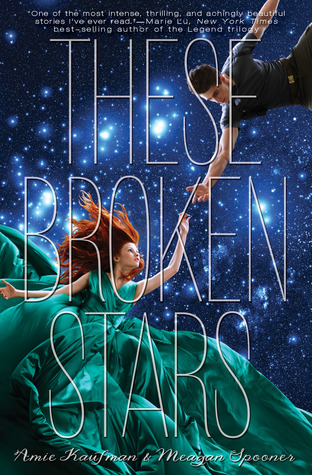
These Broken Stars by Amie Kaufman and Meagan Spooner was another book that I was seeing pop up on many "best of" lists for 2013 (now you know how I get most of my book recommendations!). The cover art is stunning, and communicates succinctly the tone, content, and aesthetic of the story. 

The first thing you should know about These Broken Stars is that it's a boy-girl book. That is, it's told through two perspectives, and one of those perspectives belongs to a boy and the other to a girl, and they alternate chapter by chapter. The protagonists here are Lilac and Tarver. Laura and Tom McNeal's Crooked is one of my favorite books that does this, alternating chapters between a female and male protagonist. There is also a section running throughout that details Tarver's debriefing. These short, one-page sections are stacked between each perspective chapter, and they largely keep the mystery of the story alive as Tarver blatantly lies his way through his debriefing. The reader can clearly see the story taking Lilac and Tarver in one direction, while Tarver makes sure to revise the narrative during his interview. 

Tarver begins the story. He is traveling on board the Icarus, a huge spaceship that can hold up to 50,000 people. And it's packed to the brim. Although Tarver would never find himself on such a luxurious ship in any other moment in his life, his circumstances have changed recently and made him of interest to the rich, powerful, and influential. He is considered a war hero, even though he is still a teenager. He returned home a decorated soldier, and was given passage on the new ship as a reward. He observes those around him, and acutely understands that he still stands apart from everyone else traveling on the Icarus. For example, different from Lilac LaRoux, daughter of the most powerful man in (seemingly) the explored universe. When Tarver fails to recognize her as such, he ends up having a frank and genuine conversation with Lilac on board the ship. She's charmed by him much more than she expects to be, and the two find themselves drawn inexplicably to one another. Lilac is on board the ship because her father designed and built it.

The setting is gorgeous, especially when Tarver sets the scene in the first few pages:
For all their trendy Victorian tricks, there's no hiding where we are. Outside the viewpoints, the stars are like faded white lines, half-invisible, surreal. The Icarus, passing through dimensional hyperspace, would look just as faded, half-transparent, if someone stationary in the universe could somehow see her moving faster than light. (3)
Their time on the Icarus does not last. The book basically takes on the Titanic meets sci-fi, as the Icarus inevitably goes down, slipping out of hyperspace and crashing on a deserted, mysterious planet. Tarver and Lilac are the only survivors (Lilac saves them both by showing off her electrical skills when they are hurtling toward the planet in an escape pod). The planet is not like any other planet that Tarver has been on, and his military duty has taken him to plenty. It's not terraformed in the way that he's used to; in fact, growth on the planet has been accelerated, and there are plants and large animals that shouldn't be here. As they journey across the planet - seeking out the fallen Icarus - they find out that the planet holds a secret deeper and darker than they could have imagined, one that might prevent them from ever returning home. 

Thursday, November 21, 2013

Eleanor and Park by Rainbow Rowell

I received an ARC of Rainbow Rowell’s Eleanor and Park last winter, but my sister ended up reading it months before I did. I didn’t get to it until about a month ago, when I started seeing Rowell’s newest publication Fangirl, out in stores. It was like a reminder to get to the other one, the one I already had, as my sister had been telling me how good Eleanor and Park is since she read it.

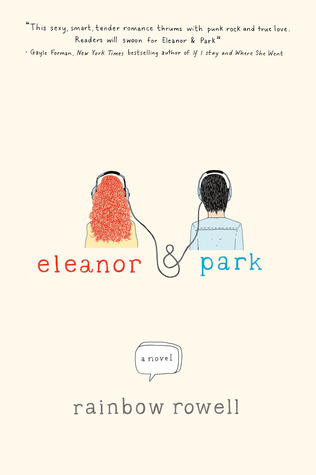
Eleanor and Park bounces back and forth between the perspectives of the main characters, tenth graders Eleanor and Park. Set in the mid-1980s in Nebraska, the two share a seat on the bus together and are inextricably tied together from that moment on. Eleanor is new to town. She lives with her mother, her mother’s new husband, and her younger siblings in a small house. Her home life is on shaky ground. She hasn’t seen her family in almost a year, since her now stepfather kicked her out of their old house and wouldn’t let her move back in until now. Park lives with his Korean mother, American father, and younger brother Josh, where he reads comic books and listens to music on his Walkman.

Their love story is a quiet, slow meandering through their grade ten year, where cool and nerdy Park falls for incredibly unique Eleanor on their bus rides to and from school. The development is so incredibly lovely, and punctuated by their sharing of everything that they love, especially comics and music. Before the two begin talking to one another, Eleanor reads issues of Watchman over Park’s shoulder, and he turns the pages slowly knowing that she is following along with him.

The heartbreak and frustration of being a teenager is so wonderfully written. Eleanor’s own self-consciousness about her appearance is detailed carefully through the book, her anxiety about her out of control curly red hair and her weight. When she meets Park’s tiny mother, she notes,

“When Eleanor was around girls like that – like Park’s mom, like Tina, like most of the girls in the neighborhood – she wondered where they put their organs. Like, how could you have a stomach and intestines and kidneys, and still wear such tiny jeans? Eleanor knew that she was fat, but she didn’t feel that fat. She could feel her bones and muscles just underneath all the chub, and they were big, too. Park’s mom could wear Eleanor’s rib cage like a roomy vest.”

Eleanor and Park is an excellent teenage romance, and I’m looking forward to picking up Fangirl soon, and Rowell’s adult novel Attachments.

Tuesday, September 3, 2013

Bluefish by Pat Schmatz


I love reading “first day of school” books at the beginning of September, and found Bluefish by Pat Schmatz just in time. Bluefish begins with Travis’s first day at a new school navigating his locker combination: “slowly spinning the dial. Seventeen…back to the left…” Over the summer, Travis has had to abruptly relocate from the small farmhouse that he shared with his grandfather and their dog Roscoe to a new town, a new house, and a new school. And the biggest change of all is that Roscoe isn’t with them any more; Travis couldn’t find him before they had to move, and he holds onto the hope that Roscoe is like one of those dogs he’s read about in the newspaper, those dogs who wander hundreds of miles from an old house to a new one to find their owners. Travis even attempts to speed up the process by leaving school early and walking in the direction of the old farmhouse to resume his search.

Travis’s story is interwoven with Velveeta’s. Velveeta (her real name is Vida) is in Travis’s class, and her journal entries give a first-person account of how she’s dealing with starting a new year of school after a tumultuous summer. She spends most of her time in an abandoned trailer in the trailer park she lives in that once belonged to an older man named Calvin, a place that is “the safest and best place I know.” Velveeta takes refuge from her absent mom and drug dealer brother, and writes, “Everything’s exactly the same except for how much you’re not here. The empty air in this trailer weighs eighty trillion tons, and it’s jumping up and down on my lungs like an elephant on a trampoline. But that beats my creepy brother’s wide-alive air any day. I’m going to stay here until he leaves.”

Both Travis and Velveeta have a secret, and both are trying to come to terms with important events that happened to each of them the summer before. They become unlikely friends at school, and start to ask the right questions of one another. Velveeta learns that Travis can’t read, and with the help of a teacher named Mr. McQueen and Markus Zusak’s The Book Thief, they begin to change this. Travis takes much longer to get at the heart of Velveeta’s story, and it isn’t until near the end of the book that he gets a clearer picture of the reality of her life, which he has only seen glimpses of.

Travis and Velveeta are exceptional characters, and both points of view are equally entertaining and interesting. I really enjoyed Bluefish for the way that it explored reading, and especially Travis’s experience with learning how to read as an adolescent. 

Wednesday, June 26, 2013

The Scorpio Races by Maggie Stiefvater


Maggie Stiefvater was one of my favorite authors to see at a panel at NCTE last year, where she was talking with Shannon Hale about world building and fantasy (I think!). I really love Stiefvater’s books, but I haven’t put one up here yet. I recently re-read The Scorpio Races, one of my favorite of her books, and thought it was a good opportunity to write a review.

The Scorpio Races is set on the fictional island of Thisbe, and it is the island’s mythology that is central to the story. Every fall, mythical water horses (capall uisce) come out of the ocean, large, fast, and dangerous. Brave islanders (or those with something to prove) choose a water horse of their own, and begin the nearly month-long process of “training” it for the annual race on the first day of November. But the water horses can’t ever really be trained. They are always drawn back to the ocean, and many riders are either drowned or killed as the horses try to get back to where they are meant to be.

Sean Kendrick has participated in the races for years, and he has a tendency to win. He is as bound to the water horses as they are to the yearly ritual of coming ashore each fall, and he rides the red water horse that killed his father in the races nine years before the book begins. It is on this horse, Corr, that he wins.

Puck is a teenage girl who ends up in the races almost by accident, entering only as a way to keep her brother Gabe on the island for a few more weeks. Without the grace time of the races, his plans to head to the mainland for work would have gone into effect faster than Puck would have liked. Puck lives with her older brother Gabe and her younger brother Finn in an old house that they care for on their own. Their parents were killed in an accident with a water horse years before. Sean and Puck alternate perspectives throughout The Scorpio Races, and are drawn together as the races get closer.

The use of the water horse mythology is incredible, and reminded me a lot of Margo Lanagan’s recent The Brides of Rollrock Island, which examines selkie mythology on an isolated island. The island in The Scopio Races, Thisbe, is a magnificent character on its own, one that Stiefvater describes from end to end. The book also has a very timeless quality about it. I remember the first time that I read it, I thought it had an almost medieval-setting. There is something about the way the clothing is described, the hard way of life, and the hierarchal structure of the island that made it feel much older than it was. But out of this timelessness are references to very contemporary inventions, and the two (usually separate) portrayals of time came together in one book. It had the effect of making me believe so much in this story, and believing in particular that it could happen anywhere.

There are so many heartbreaking moments in The Scorpio Races, but they are all tied up by mythology and adventure, all of it rolling off the coast of one very small island. 

Friday, June 14, 2013

The Sea of Tranquility by Katja Millay


The Sea of Tranquility by Katja Millay has been on my radar since 2012, when it was published as an e-book. My aunt recommended the book to me, and it sounded like an amazing read, but I don’t read e-books very often. I have absolutely no memory retention for a story when I read on an e-reader, and I also have a tendency to flip back and forth throughout a physical book a lot, which isn’t as easy on an e-reader. But I wish-listed Millay’s novel on Amazon (probably sometime around last Christmas), and didn’t think it’s early June deadline was too long to wait. Now that I’ve read the book, I’m sort of torn on the entire waiting-for-the-published-book thing. The Sea of Tranquility is one of the best YA books I’ve read so far this year, and I almost wish I hadn’t waited as long as I had for it to come out in its printed form. But I did flip back and forth so often while I was reading, and I’m really happy to have it in printed form to pass on (my sister is reading it now!).

Nastya (“NAH-stee-ya”) Kashnikov hasn’t spoken to anyone in over a year. She has just moved in with her aunt Margot in a Florida suburb, and is happy for Margot’s shift work as a nurse, as it means they aren’t often in the same place for long. When she has to, Nastya communicates with a pen and notepad, but for the most part, she doesn’t have any desire to talk to anyone, not even to answer her mom’s brief, but worried text messages. She begins her last year of high school at Mill Creek Community High School, and she has a plan for making sure everyone avoids her and no one talks to her. Dressing in tight, skimpy clothes and stilettos, and with makeup caked on, Nastya tries to make herself unapproachable, and for the most part, it works.

As for why Nastya has decided to leave her family behind in Brighton and move two hours away to the town that Margot lives in, it remains a mystery throughout most of the book. However, the clues that Nastya gives about her past are cryptic enough to keep the reader engaged right through to the end. For instance, the first few lines that we hear from Nastya at the beginning of the book are:

I hate my left hand. I hate to look at it. I hate it when it stutters and trembles and reminds me that my identity is gone. But I look at it anyway, because it also reminds me that I’m going to find the boy who took everything from me. I’m going to kill the boy who killed me, and when I kill him, I’m going to do it with my left hand.

Nastya doesn’t provide any easy answers for the reader; the truth about her past – although hinted at throughout the book – does not come in full until near the end. One of my favorite parts of the book comes early on, when Nastya is suffering through the icebreakers in her seven high school classes on the first day back. In her Intro to Music class, the teacher has the students play two truths and a lie, where “Everyone has to say three things about themselves and one of those things has to be a lie. Then the class tries to figure out which one is the lie.” Nastya admits that it’s too bad she’s not going to participate in the game, because she has the best combination of facts about herself, and the lie isn’t exactly straightforward:

My name is Nastya Kashnikov.
I was a piano-playing prodigy who doesn’t belong anywhere near an Intro to Music class.
I was murdered two and a half years ago.
Discuss.

But as much as she tries to stick to herself, Nastya is slowly pulled into the new community by more than a few unlikely candidates. One of these is Josh, and he alternates his point of view with Nastya’s to tell the story. He has a past that is similarly as haunted as Nastya’s, and his classmates treat him to the same arms-length that they give to her.

I loved The Sea of Tranquility. Nastya and Josh’s narration actually sounds the way teenagers speak and incorporates shorthand phrases like SOL and WTF in the most effective way that I think I’ve seen in a YA book. The characters are so real, and what they have to reveal about themselves speaks a lot to teenage experience. Millay handles the large issues that Nastya and Josh have faced in the most authentic way possible, and they never become sensationalized in the telling of the story. I was so invested in every single thing that happened to these characters, and it was a hard book to end. I will look so forward to see what Millay takes on next, knowing that her respect and affection for her own characters will make anything she works on worth reading.