Showing posts with label screenplay. Show all posts

Tuesday, April 5, 2016

The Haters by Jesse Andrews


Somehow, my branch of Canadian bookstore Chapters had a copy of Jesse Andrews's new novel The Haters last week, despite the fact that it's "book birthday" is today. But I didn't have an opportunity to start reading it until last night, and when I did, I read it all the way through, in-one-sitting style. The Haters is Andrews's sophomore novel, following up on the incredibly popular Me and Earl and the Dying Girl (and like Me and Earl and the Dying Girl, The Haters already has a cinematic quality to it, and also experiments with the screenplay dialogue throughout. It's easy to imagine The Haters in movie form). 

The Haters focuses on best friends Wes and Corey, who are attending a two-week summer Jazz Camp. Chapter One is entitled, "We Didn't Know Jazz Camp Would Be This Many Dudes" and shows jazz camp orientation from Wes's perspective,
Dudes were trying with all their might to be mellow and cool. Everywhere you looked, a dude was making a way too exaggerated face of agreement or friendliness. And every ten seconds it was clear that some dude had made a joke in some region of the auditorium, because all the other dudes in that region were laughing at that joke in loud, emphatic ways.
They were trying to laugh lightheartedly but it was unmistakably the crazed, anxious barking of competitive maniacs. (1)
Jazz camp attendees have to audition for one of five bands that are ranked from most skilled to least skilled: the Duke Ellington band, the Count Basie band, the Thad Jones-Mel Lewis band, the Woody Herman band, and the Gene Krupa band. Wes and Corey make Gene Krupa, along with one of the only girls at the camp. Ash (short for Ashely) is a guitarist, and Wes is immediately into her. Also in Gene Krupa is Tim, an annoying guitarist who Wes watches do a brilliant solo: "The most sensitive, brilliant mind in the room seemed to belong to an unignorable scumbag. But that should not have been surprising. That's just how the music world works a lot of the time" (30). Wes and Corey love music, and they love to hate on it. Wes's memory of Corey hating on Kool and the Gang is kind of heartbreaking; when Corey doesn't like the band that Wes absolutely loves, it kind of ruins his own love of it. 

Later, Wes and Corey leave the jazz camp campus with Ash to get high-end sushi after a successful jam session, and the three immediately get in trouble with the camp staff. After that, Ash has no trouble convincing Wes and Corey to leave with her and tour as a band across the southern states. Her rationale? "I do like jazz some of the time. But I don't think any of the jazz I like was played by someone who went to jazz camp" (37). They leave their phones behind at camp (so they can't be traced by GPS) and set off in Ash's mom's car looking to book a gig. What follows is their road trip into the southern states, and pages are crowded with their conversations. They debate band names (Air Horse, Thundergarment) and try to come up with a slogan ("work hard, play hard" is vetoed after Ash describes it as "the philosophy of being a relatively high-functioning alcoholic"). 

Like Me and Earl and the Dying Girl, Andrews experiments with form and style. Dialogue between Corey's mom and dad and then Wes's mom and dad duels on several pages. A "Courtship Initiation Sequence Checklist" occurs on page 261. Screenplay dialogue appears frequently, and these back-and-forths between Wes and Corey (and also Ash) are some of the funniest in the novel.

The Haters is the perfect read for when you're up late at night, and a little bit tired, so that all of the jokes and funny moments hit harder than they would in the daytime. The Haters is a really funny book, with laugh-out-loud moments as good as those Louise Rennison consistently delivered in her Georgia Nicolson series. I didn't know I was looking for a YA book about a band tour until Andrews wrote one. Other YA band books that come to mind are Don Calame's Beat the Band  and K. L. Going's Fat Kid Rules the World, but The Haters is a much different book from those. The music references are endless and cover a wide range of genres and styles, and many serve to root the contemporary setting. The Haters is a fantastic book, completely funny and entertaining. 

Thursday, August 29, 2013

Me and Earl and the Dying Girl by Jesse Andrews


The title of Me and Earl and the Dying Girl by Jesse Andrews introduces the three main characters of this 2012 YA novel: 17-year-old protagonist Greg Gaines, who makes a point of being an acquaintance to everyone but a friend to almost no one; Earl Jackson, Greg’s best friend and movie-making partner; and Rachel, who is diagnosed with leukemia at the beginning of the story.

Greg is insistent that his account of his re-acquaintance with Rachel (although they were briefly childhood friends, his mom pushes him to keep Rachel company after she is diagnosed with cancer) is not going to provide any life lessons, or touching moments, or one-liners written in italics (“The cancer had taken her eyeballs, yet she saw the world with more clarity than ever before”). Greg looks out for himself and he has learned the correct way to navigate the many social groups in his inner city Pittsburgh high school. He says,

“I didn’t join any group outright, you understand. But I had access to all of them. The smart kids, the rich kids, the jocks, the stoners. The band kids, the theater kids, the church kids, the gothy dorks. I could walk into any group of kids, and not one of them would bat an eye. Everyone used to look at me and think ‘Greg! He’s one of us.’ Or maybe something more like: ‘That guy’s on our side.’ Or at the very least: ‘Greg is a guy who I am not going to flick ketchup at.’ This was a brutally difficult thing to accomplish.”

Becoming friends with Rachel again compromises all of his work, as it aligns himself with just one person (from one group).

Greg talks about the year in a straightforward first-person style that is broken up by his personalized lists and movie scripts. Many of the conversations in the book are presented as dialogue in a movie, which makes the story move purposefully towards the end.

One of the highlights of the story is Greg and Earl’s own interest in movies, and especially classic and canonical movies. Greg’s father, a professor, has a collection that they start borrowing from when they are still pretty young, and one of their first finds is Werner Herzog’s Aguirre: The Wrath of God. Greg provides a good synopsis of the movie, and an excellent description of his first viewing of it with Earl, and the movie follows them throughout the book. Greg and Earl have even attempted to remake the film under the title Earl: The Wrath of God II. It was so much fun following the references to this movie throughout the book, and especially to note Greg’s coverage of the filming process, Klaus Kinski’s onset behavior, critical reception, and his own reaction to the film. It is a different kind of canonical text to appear in a YA novel, and it was a very effective one.

Although Greg resists any attempts to make his story into something meaningful and moving, it happens anyway. His friendship with Earl is at the heart of story, and the way that it unravels is much more affecting than Greg’s sort-of-friendship with Rachel. But the three of them – Greg, Earl, and Rachel – are integral to the story itself, as is the way they find each other under unconventional circumstances. 

Monday, November 5, 2012

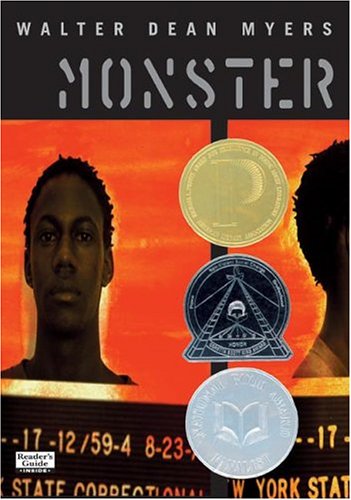
Monster by Walter Dean Myers


It has taken me longer than it should have to get around to reading Walter Dean Myers’ Monster. I was recently doing some research on young adult books that combine both text and image, and Monster was referenced a few times because of the black and white photographs interspersed throughout. Monster won the first Prinz Award when the award was created in 2000, and the experimental and challenging format it engages with represented the kind of book that the Prinz Award wanted to recognize.

Monster uses a screenplay format to tell the story of Steve Harmon, a sixteen-year-old boy who is on trial for the murder of a man, Alguinaldo Nesbitt, who owned a drug store in Harlem. Harmon is implicated in the crime by a series of criminals who are trying to lessen their sentences by cooperating with the police. On trial, awaiting his sentencing as the “look-out” in the hold-up, Harmon writes his story in screenplay form, his interest in films becoming more apparent as the novel progresses.  The screenplay is interspersed with journal entries, as Harmon must return to his prison cell during the downtime of his trial.

As a sixteen-year-old in jail, Harmon is in a constant state of fear and anxiety. He begins his narrative by writing, “The best time to cry is at night, when the lights are out and someone is being beaten up and screaming for help. That way even if you sniffle a little they won’t hear you. If anybody knows that you are crying, they’ll start talking about it and soon it’ll be your turn to get beat up when the lights go out.” He has been in jail for “a few months” but is not nearly close to getting used to the routine of imprisonment. He decides to record the trial as a screenplay, since he has been involved in a film club at his school and views the world through camera angles, close-ups, and voiceovers. He is also writing as a way of self-definition, particularly to find out who is his and what he has done. He writes of his story, “I’ll write it down in the notebook they let me keep. I’ll call it what the lady who is the prosecutor called me. Monster.”

The reader is introduced to the prosecutor, the defense, the judge, and the jury. They are a dramatic list of characters at the beginning of the screenplay, followed by the opening credits that Harmon figures to the style of Star Wars, an indication of both his age and interests. Spliced between the real-time trial are scenes that attempt to carve out Harmon’s character: him and his younger brother Jerry talking about superheroes; his film class; his friends.

There are also black and white photographs throughout, all of them apparently of Harmon. The lack of color functions as a means of reading Harmon’s trial as subsisting in a morally grey zone; his innocence is not so black and white as the portrait photographs that appear in the book. Harmon grapples with his participation in the holdup; even though he was just the look-out, casing the drug store and making sure there were no obstacles in the way, Nesbitt still was murdered. He talks to other prisoners in jail who take responsibility for their crime, anticipating “guilty” verdicts and connecting them innately to the crime they committed. Harmon, however, is different. He can’t grapple with the moral uncertainty of his crime. He didn’t pull the trigger, but he was involved, even peripherally, in murder. He represents the facts of the trial in an unflinching account of witnesses and cross-examinations, but there is still a sense of uncertainty about what Harmon’s verdict will be, and his own moral dilemma.

As the book neared the end, I was actually getting worried that the verdict wouldn’t be revealed, and that Myers’ would leave the novel hanging on the same uncertainty that threads throughout the story. Luckily, there is no such ambiguity, although I’m not sure if this does anything to lessen the uncertainty, or Harmon’s own sense of morality and accountability. The last few lines of the book hold the reader in a sense of ambivalence, as Harmon struggles to define who he is: “I want to look at myself a thousand times to look for one true image. When Miss O’Brien looked at me…what did she see that caused her to turn away? What did she see?”

I would not recommend leaving Monster unread. For its innovative form, its ambiguous subject, and Harmon’s unflinching voice, it is certainly a book worth reading.