skip to main |
skip to sidebar
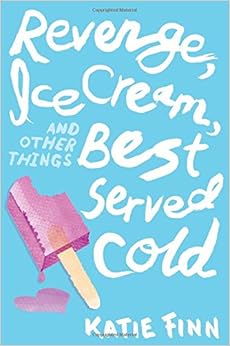
Katie Finn continues her trilogy of novels about Gemma Tucker in Revenge, Ice Cream, and Other Things Best Served Cold (a fantastic title). It's the sequel to Broken Hearts, Fences, and Other Things to Mend which was released last year. Katie Finn is the alias of acclaimed YA novelist Morgan Matson, whose books I've talked about here already. The planned trilogy takes place in the Hamptons, where Gemma is staying for the summer with her dad. She's moved into a huge mansion that belongs to her dad's writing partner, Bruce, as they both get underway on an adaptation of the successful erotic vampire novel that is referenced frequently in the book.
In Broken Hearts, Fences, and Other Things to Mend, a case of mistaken identity led to Gemma's summer getting off to a disastrous start. For the first few weeks of her holidays, she fell head-first into a revenge plan orchestrated by her childhood friend Hallie. Gemma purposefully broke up her father and Hallie's mother when they dated years ago, worried that their relationship would get in the way of her parents getting back together. This included spreading a horrible rumour about Hallie's mother, ruining her career as a novelist. Unbeknownst to Gemma, Hallie has been planning for years to get her back.
Revenge, Ice Cream, and Other Things Best Served Cold picks up right where the first book left off: after Gemma's real identity is revealed, and her relationship with Hallie's brother Josh is put to an end. Finn does an excellent job summarizing the first book without taking too many pages away from the second book. There are so many books - particularly fantasy series - where there is little or no reminder about what happened in the previous instalment, which is sometimes necessary when there's a gap of 3-5 years between books. Finn summarizes in narrative form, rehashing scenes from the previous book to remind readers of where they will pick up with Gemma.
A few new characters have been added to the story. Gemma's best friend Sophie Curtis (who Gemma pretended to be in the previous book, after Sophie's name was written on her coffee cup) comes to stay for the rest of the summer, and so do Bruce's children, Gwyneth and Ford. Ford, who is suddenly more attractive than Gemma remembers him being. He's lost his braces, and is now a nationally ranked surfer.
At first Gemma decides not to retaliate, but then thinks better of it. She gets a job behind an ice cream counter (in Morgan Matson's Since You've Been Gone, protagonist Emily scoops ice cream as a summer job, too), and enlists Sophie and Gwyneth in her plans. My sister said she had a huge amount of secondhand embarrassment reading about Gemma's plans for revenge, and I completely agree. The events escalate the night of Hallie's birthday party, setting up a perfect cliffhanger that the third and final instalment will work on resolving. It's a fun, quick read, and I'm looking forward to the resolution of the series next year.
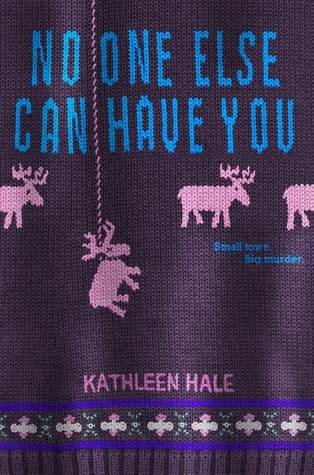
Aside from Wendelin Van Draanen's Sammy Keyes mystery series, which is aimed at slightly younger readers (middle grade rather than high school) I can't think of too many YA mystery novels of the whodunnit variety. Kathleen Hale's No One Else Can Have You is a fantastic YA mystery, and Hale gained notoriety in 2014 for more than just her first novel. In an article for The Guardian, Hale admitted to tracking down and stalking a critic, who gave her book one star on GoodReads. The fallout led to the creation of the Twitter hashtag #HaleNo, as other authors, bloggers, and readers responded to Hale's article. Hale is originally from Wisconsin, and is engaged to the hilarious writer Simon Rich.
No One Else Can Have You is firmly in the same category as Fargo, the 1996 film directed by the Coen brothers, and the 2014 reboot, a TV show on FX. Even the cover art bears similarity to both the movie and TV posters, knit detail of the title and the implication of murder. The novel is set in Friendship, Wisconsin, and the dialogue is peppered with "you betchas" and "doncha knows."


Kippy Bushman is the sixteen-year-old detective in the novel, and her quirky and abrasive personality means that she is probably not the best person to investigate the murder of Ruth Fried. Ruth was found in a corn field behind Kippy's house, murdered in a gruesome and horrific way. She was on her way to Kippy's house for a sleepover - the two were best friends.
After Ruth's death, Kippy is given her diary with the job of censoring it for Ruth's mother. Basically, this means taking a Sharpie marker to any parts that allude to Ruth's sexual history. After transcribing a few messily- written entries, Kippy finds that she'd have to Sharpie through most of the diary in order to do a sufficient job.
But Kippy also finds out that maybe Ruth didn't like her as much as she always thought she did. Many of the diary entries focus on Kippy as Ruth writes, "Kippy is so pathetic it makes me nauseous…If we lived anywhere else, like any place remotely interesting, I'd have way more options, and she and I wouldn't even know each other." Police sheriff Staake (pronounced "Steakey") immediately pins the murder on Ruth's boyfriend Colt, but Kippy thinks that's mostly because of the fact that Colt slept with the sheriff's daughter. Kippy ends up teaming up with Ruth's brother Davey, who is just back from fighting in Afghanistan, to find the real murderer.
There are tons of laugh-out-loud lines in No One Else Can Have You. Kippy is a truly fantastic narrator and even the secondary characters add something great to the story. For instance, Kippy's dad Dom, a middle school counsellor who lounges around the house in bathrobes, even when Kippy has company. When Kippy requests a salad for supper, Dom's at a loss for how to make one (Friendship is a hunting town, and everyone has freezers full of meat). He throws a bunch of almost-veggies into a bowl: "First bacon bits, which we usually use on our baked potatoes, then cheese - lots of shredded cheese. He rips open a bag of frozen peas with his teeth, then goes to the pantry and gets canned tomatoes, and dumps those in, too. Before you can say 'Gross,' he puts the whole thing in the microwave, beeps in five minutes, then turns around with his arms crossed, looking proud." Even the Fried's dogs are characters, "some kind of Great Dane/Saint Bernard/werewolf hybrid." Kippy remembers, "the first time I came over, we pulled up in Mrs. Fried's truck, and my first thought upon seeing them was 'We might not be able to kill those things with the car.' I envisioned them bouncing off the fender, getting up, cracking their knuckles, and then diving through the windshield to eat our necks." Their names are Pasta Batman and Marco Baseball, causing Ruth to quietly explain to Kippy, "Davey and I named them when we were so young we were still a little bit retarded."
There was only one place where the novels lost me, when Kippy is placed in a mental institution with a third of the novel left. It seemed like a placeholder to press pause on the narrative, delaying the reveal of the murderer. But overall, No One Else Can Have You is a great YA mystery, with an unforgettable narrator in Kippy Bushman.
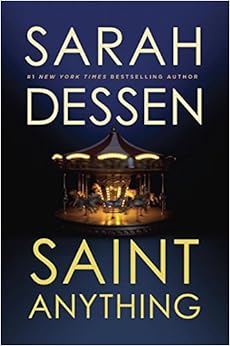
Sarah Dessen's new book Saint Anything, was just released at the beginning of May, and already I've shared my copy a couple of times. I've been reading Dessen's novels since the 1990s, when That Summer, Someone Like You, and Keeping the Moon came out.
Saint Anything follows Sydney, who's brother Peyton has just been sent to prison for drunk driving. He left a young boy paralyzed from the waist down, and Sydney is obsessed with the consequences her brother has left behind, seemingly immune to the fall-out of his accident. She decides to switch schools, moving from the prestigious Perkins Day to Jackson High School, a huge public school that she chooses because it enhances her anonymity. She doesn't want to be recognized as her brother's sister, and doesn't want to be connected to the accident.
But when she attends Jackson High School, she doesn't end up being as anonymous as she hopes she'll be. She's quickly taken in by the Chathams, brother and sister Mac and Layla, whose family owns a local pizza place Sydney visits after school. The Chatham family seems magical to Sydney. Mrs. Chatham, who has MS, Mr. Chatham, Mac, and Layla, who work at the pizza place, and Rosie, a figure skater who has recently had difficulties of her own. Pizza and french fries factor heavily into this novel, as Sydney becomes a staple at the pizza place, and Layla crusades for the perfect french fry.
Still, Peyton never disappears from the picture entirely. His weekly phone calls home assert his presence in their life. His old friend Ames, a recovered drug addict and alcoholic, also hangs around Sydney's house. He is the most unsettling character in the novel, and often "babysits" Sydney alone in the house when her parents are away. I had read an article Dessen wrote for Seventeen Magazine just a fews before Saint Anything was published. "I Thought Dating An Older Guy Was Cool - Until I Sensed That Something Was Very Wrong" is Dessen's account of her relationship with a twenty-one-year-old when she was fifteen. I didn't realize how much it would factor into her novel, and in fairly insinuating ways.
I found myself so frustrated with the Sydney's family, especially her parents, who don't do anything that they should to keep Sydney safe and loved. Their complacency in Ames's influence on Sydney's life is hard to read at times. Which is certainly what Dessen intends, if her Seventeen Magazine article is any indication.
I'll always look forward to the next Sarah Dessen book, and Saint Anything was no exception.
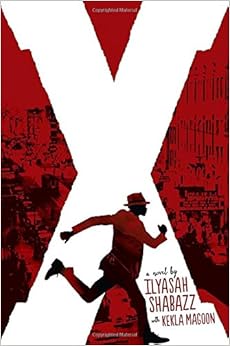
Another season of YA Sync has started over at audiobooksync.com! Every week, two free audiobooks are offered for download to Overdrive: one is a YA title, and the other is a canonical or "required reading" title. Last week, Ilyasah's X: A Novel was paired with Here in Harlem by Walter Dean Myers. Between driving, walking, and working, I finished X in just over a week and loved it.
X tells the story of the childhood of Malcolm X, following through his adolescence, teenage years, and early adulthood. Shabazz is Malcolm X's middle daughter, and an extensive author's note at the end of the novel describes her ability to communicate the intimate stories and details of her father's life. Malcolm's journey begins in Lansing, Michigan, where he lives with his siblings and mother. He then goes to live with his half-sister Ella in Boston, and then to Harlem after that. He changes his name and identity with each move: from Malcolm in Michigan, Red in Boston (because of the light colour of his hair), to Detroit Red in Harlem. He works, hustles, and eventually serves time in prison for theft.
Shabazz and Magoon's writing is excellent in X, with language that evokes the time period, and a careful detail to the historical that follows through the Great Depression and WWII. I loved listening to the novel as an audiobook, and hope to buy a physical copy of the book in the next few weeks!
A Monster Calls by Patrick Ness was published in 2011, and although it's written by Ness it was inspired by an idea by deceased YA writer Siobhan Dowd, author of A Swift Sure Cry, The London Eye Mystery, Bog Child, and The Solace of the Road. While the latter two titles were published posthumously (Dowd died from breast cancer in 2007), A Monster Calls was only a contracted idea at the time of her death. Ness was asked to take the idea and write it into a book, which was illustrated by Jim Kay. As Ness states in the introduction to the book, "[Dowd] had the characters, a premise, and a beginning. What she didn't have, unfortunately, was time." It's an incredibly successful novel and won both the Carnegie Medal and the Kate Greenaway Medal in 2012.
A Monster Calls follows Conor, a 13-year-old boy who is dealing with his mother's terminal illness. He's struggling at school, where he is equally tormented and ignored by bullies and classmates alike, all who know about his home situation. His father has moved from England to the US to start a new family, and he doesn't visit Conor nearly as often as Conor would like. Conor is plagued by a nightmare that seems to occur nightly in his dreams, but it's in reality that he meets the monster who comes to call in this book. He is visited by a monster (who is in the shape of the yew tree behind Conor's house) who visits at 12:07. The monster is old and mythical and insists Conor summoned him for help.
Over the course of the short illustrated novel, the monster tells Conor a series of stories, each which imparts the grey space in-between Conor's understanding of black and white. The stories are medieval and have a fairy tale quality. Conor inhabits each story as the monster tells it, sometimes participating in the action, though he is meant to be an observer. In exchange for the three stories, the monster asks Conor for one of his own: the truth about the nightmare that haunts his dreams.
A Monster Calls is simply written, but a complicated and complex book. At its heart, the book is about separating thoughts from actions, which reminded me greatly of the Invisibilia podcast episode "The Secret History of Thoughts." As the monster tells Conor, "You do not write your life with words…You write it with actions. What you think is not important. It is only important what you do."
It's a brilliant and powerful book, and incredibly sad. The language is enhanced by the illustrations, most of which bring the monster to life, as well as his nightly visits to Conor. It would appeal to readers of all ages: it's certainly a children's novel as much as it is a story for adults. Conor learns that stories don't always have happy endings, and that unhappy endings are important for all readers. He reflects, "That's one thing the monster had definitely taught him. Stories were wild, wild animals and went off in directions you couldn't expect.”