Showing posts with label Christmas. Show all posts

Thursday, May 2, 2013

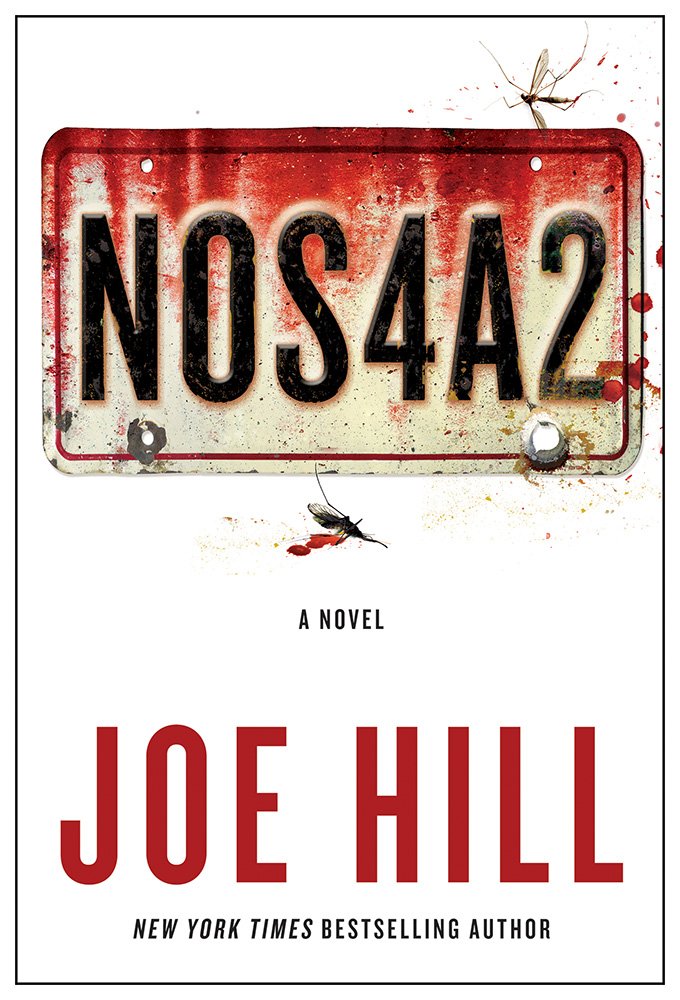
N0S4A2 by Joe Hill


I just recently (last night!) finished a book I have been so excited about for months and months now, N0S4A2 by Joe Hill. This spring is so great for new book releases, starting with Kate Atkinson’s Life After Life, Joe Hill’s book, The Ocean at the End of the Lane by Neil Gaiman in June, new books from both Sarah Dessen and Deb Caletti, a new Terry Pratchett book, Jaclyn Moriarty’s A Corner of White, and on and on. There will be quite a few reviews going up over the next few weeks and months as so many great books come out.

I first discovered Joe Hill through his comic book series Locke and Key, which is about three siblings, their mother, and their uncle, who live at Keyhouse, a sprawling New England mansion located in the fictional Lovecraft, MA. The series has been published in five volumes and I think the sixth will start rolling out issues in the fall. It’s a complicated mix of horror, history, young adulthood, magic, mythology, and excellent storytelling. N0S4A2 (pronounced Nosferatu) filled the gap for me between the last and next installment of Locke and Key, and has resulted in me also picking up one of Hill’s other novels, Heart-Shaped Box (2007). As well, N0S4A2 is illustrated (intermittently) by Hill’s Locke and Key collaborator, illustrator Gabriel Rodriguez.

N0S4A2 isn’t really a young adult book, but it spends remarkable time in its protagonist’s youth, a good quarter of the nearly 700-page book. Victoria McQueen is eight-years-old when the book begins, but she earns a nickname, “the Brat – Victoria to her second-grade teacher, Vicki to her mother, but the Brat to her father and in her heart.” When her mother’s bracelet is lost on a trip to the lake, Vic gets on her Raleigh Tuff Burner, a bike that she has had to grow into, and rides away from the fight between her parents. While she rides, she finds the Shorter Way Bridge, a covered bridge that she is forbidden to go near. Although the bridge already collapsed into the river below a year before the story begins and no longer stands in the real world, Vic finds that it opens up to her and her bike, and when she rides across it, it takes her to the place where her mother’s bracelet had been lost. The Shorter Way Bridge becomes Vic’s means of retrieving lost things – she gets on her bike and rides until she finds the bridge, and it leads her to the place that she needs to go. However, each time she crosses the bridge there is a consequence: she gets a horrible stabbing feeling in her left eye, and when she stays on the other side of the bridge for too long, she comes back weeping blood.

Vic’s path crosses inextricably with Charles Talent Manx’s when she is seventeen-years-old, and she crosses the Shorter Way Bridge looking to find trouble. She finds Manx, a tall, skinny, old man with an overbite who drives a 1938 Rolls Royce Wraith with the vanity plate N0S4A2. Manx has a talent similar to Vic’s, but he uses it in a much different way. He is able to use the Wraith to drive to a place called Christmasland, one that exists as an idea in his own mind, yet made tangible and material. He drives children in his car, feeding like a vampire off of their unhappiness and using that to fuel his car and himself. After a narrow escape from Manx, Vic’s own life begins to spiral, as she can’t distinguish between fantasy and reality for the years that follow her discovery of the bridge and her meeting with Manx.

When the story picks up again, Vic is in her thirties, married to a man named Lou who drove her away from Manx’s house on the back of his motorcycle when she was seventeen. They have a son named Bruce Wayne Carmody, and Vic has started writing a children’s picture book series called Search Engine as a way to stay still in reality. Manx, however, is back, escaped from the prison hospital he has been in for years (his heart removed during an uncompleted autopsy), and he is searching again for Vic and her bike (now a Triumph motorcycle).

I could not put down this book. It came out on Tuesday, and I read it late Tuesday and Wednesday night. Hill balances his horror with outstanding characters and story, continuously layering elements of history, pop culture, and a New England mythos to create something truly unique. The inclusion of Christmasland, a place where every day is Christmas morning, is at once chilling and familiar. Hill’s characters are so well-written, especially the lisping librarian Maggie Leigh who gets her psychic insights from her Scrabble tiles, and helps to show Vic that her strange reality really is real.

There are nods to Harry Potter and Amanda Palmer and everything in between in N0S4A2, where Hill has written an incredible story that really can’t be put down. 

Monday, September 10, 2012

Come, Thou Tortoise by Jessica Grant


Twenty-four-year-old Audrey Flowers hasn’t been home in a couple of years. She’s been on her “great safe adventure” leading her from Newfoundland to Oregon, where she lives in an apartment with Cliff, their walls covered in grips and holds for easy climbing. Winnifred, a tortoise that “comes with” the apartment, lives with Audrey, and narrates half of this return-home narrative when Audrey leaves her behind. Audrey’s scientist father is in a coma, and she believes that if she can get back to Newfoundland in time to say the right words in the right way, he will wake up.

Audrey is a “leapling,” born on the leap year, which means that although she is twenty-four, she has only had six birthdays.  She notes, “I unwind my arms and roll over to face the window. It is the solstice. Today or tomorrow. If you are born on a leap day, you can always tell. It is like a superpower. Not a very exciting one, but there you have it. You can recognize a solstice by the end-of-tether equality of the light” (236). Her father, a scientist interested in aging, passes on his passion for time and aging to his daughter. Audrey mentions near the beginning of the book that she remembers, “A man at Cambridge University has made a frog remember how to be a tadpole” (50). Grant concentrates on this theme to make Audrey appear both a grown woman and a young girl, and her return home to Newfoundland reverts her to her childhood self, where she is overcome by the memories of her dad, her Uncle Thoby, her imposing British Grandmother, and Toph, the man who once accompanied her on a visit to Newfoundland from England. All become wrapped up in a book that flashes back to Audrey’s childhood and stays there, as she creates a safe space of memory to hide out in throughout the aftermath of her father’s coma.

Jessica Grant is careful to weave the intricacies of Audrey’s “leapling” age into her personality, her reactions, and her understanding of the world. When she finds out about her father’s death, Audrey sends an email saying, “My dad is in a comma and waiting for me to open his eyes” (6), and these varieties of spelling, grammar, and even comprehension remain throughout the novel. Audrey’s almost movie-magic belief that her father will wake from his coma if she says the right words at his bedside is supported by other beliefs that become intertwined as a structure of her character. “Safe as Quantas” is her catchphrase, alluding to the fact that the Australian airline has been free of crashes, and she holds tight to that belief as she tries to protect those who are closest to her. It is a family-born idiom, “Herein lies the formula of my childhood: My dad plus Uncle Thoby equals Quantas. Which in our family means safe. Be Quantas. Be safe” (35). She phones Chuck and Linda, the couple she has left Winnifred with back in Oregon, late at night to check on Winnifred’s safety, asking, “I was just wondering if you have a fire alarm. And what kind of heaters. And where the castle is in relation to those heaters” (47). Audrey constructed Winnifred’s papier mache castle (sensitive to heaters and flame), and it is perhaps a reflection of her own inbetweenness as she retreats towards an arts and crafts mentality while also caring for something outside of herself and forming a close and important relationship. 

Audrey’s physical and mental age is conflated by her IQ-challenged state. When she phones her father and Uncle Thoby to report on her IQ results, which have been forwarded to her Oregon address in a manila envelope with other sundry affects from her grade school career, she is met with a different response than she expected, when her father says, “Listen to me, Audrey. You know what those tests measure. They measure how similar your brain is to the brain that made up the test” (71). Audrey, following his line of though, realizes what he means: “And then it dawned on me. Slowly. That what I had assumed was a high score was not a high score. It just sounded like a high score. It sounded like a not-bad grade, the kind of grade I never got in school” (71). But what is even more interesting than Audrey’s age, mental and physical, and the conversations that give way to her characterization, is her own train of thought that Grant follows through on. On the phone with her dad and Thoby, she determines that you can pronounce IQ as an acronym, “Ick” (71). This throwaway line is developed further, as she angrily says her father, “You knew…You knew my Ick was low and you didn’t tell me” (71). There is this timeless complexity to Audrey that lies in between language and thought process, as the reader follows her thought progression while it zigzags and crisscrosses and creates new meaning in intersections.

Come, Thou Tortoise becomes a nuanced mystery novel, similar in ways to Mark Haddon’s The Curious Case of the Dog in the Night-time, but to the tune of Audrey’s favorite board game, Clue. Her time at home reveals her trouble with interpretation, as her childhood is undone, unraveled by the passing of her father and the connections that she follows through to the end of the novel: her Uncle Thoby, the imposing Toph, her British grandmother, and the quality of time and extending life that has followed her, scientific-like, since her childhood. It is also a break up story and a love story, a message from a man named Judd, a Christmas light salesman, “Thought you might like to know that someone is recalling you fondly. Also that someone is tracking your flight online. Hey, you’re over Ireland” (354), and the story of the relationship between the tortoise named Winnifred who is too used to being left behind: “My shoulders sagged. Would this be another Dubai. Would I be left behind for the next tenant. Would I be left” (314). Audrey is essentially home again and finding home, after living away throughout the majority of her postadolescence. It welcomes her back and allows her to stay, grown up without having to leave her childhood completely behind. 

Friday, December 23, 2011

Winter Town by Stephen Emond

Winter Town by Stephen Emond is advertised as “an illustrated Garden State meets Nick and Norah’s Infinite Playlist,” and I think that those two comparisons really immediately describe the book as something that has been seen in other places, and will be immediately recognizable to a new audience.

The novel is set in New England at Christmas, and although the bulk of it takes place during one set of Christmas holidays in particular, Emond starts and ends the book both a year in the past and a year in the future from the present story. The Christmas holidays create the occasion of the return of protagonist Evan’s childhood friend Lucy to New England, where she visits her father for Christmas. For the rest of the year she lives with her mother in Georgia, and the return to New England allows her to also catch up with Evan. A year before this story takes place shows the Lucy that Evan knows, a normal girl with long brown hair who can relate to Evan on many levels. The bulk of the book takes place during the Christmas when Lucy returns home with her hair dyed black and chopped off, with heavy eye makeup and her nose pierced. Evan is the focus of the novel, along with his trying to come to terms with what he calls “The New Lucy.” The story takes place over a week or so, during the days leading up to Christmas until New Year’s, when Lucy has to return to Georgia.

As a standalone character (I mean in another book, without the relationship with Lucy), Evan is a great, relatable character. He feels the pressure from his father about university applications, and is trying to navigate between the future that his parents want for him and the future that he wants for himself. He is smart, kind, but overwhelmingly confused. However, when Lucy enters the picture, everything that makes Evan so likeable is immediately reversed. He can’t come to terms with the changes that have taken place in his friend, and because of his own confusion, Lucy becomes less of a character than an object for Evan to examine, question, and try to understand. And the difficult thing about that is that Lucy is an incredibly interesting and dynamic character. She’s funny, cool, and incredibly intelligent. When we do get a glimpse into Lucy’s life in Georgia during a short chapter halfway through the novel, I think we almost want to stay there, and experience the overwhelming feelings that Lucy has felt, rather than return to the banal world that Evan inhabits.

Yet, Evan goes one step further by actually turning Lucy into a character in a comic strip that he creates and titles “Aelysthia” after a fantasy world that he and Lucy made up when they were younger. As a character in his comic strip, Lucy becomes further stripped of everything that makes her so interesting and dynamic, as Evan has her speak lines such as, “Feh. I’ll be stuck here. I’ll meet some dumb guy and have dumb kids. I’ll never see the ivory tower, just ivory soap. And then I’ll die.” This oversimplification is not just in comic form; there are also hints at this through Evan’s descriptions of Lucy. The reader gets a sense, especially from the one chapter that does talk about Lucy’s life in Georgia, that there is a lot more to her, and as a reader I felt almost cheated out of her story.

Additionally, the art, music, movies, and books that this book references create this small bubble of culture, one that calls on the intertextuality between the different art forms to define the ideal audience of the book. For example, throughout this book, Emond calls on Neil Gaiman’s Sandman comic series, Stephen King’s The Dark Tower, Lord of the Rings, Ben Folds, the Beatles, and web comic series Achewood and Gunnerkrigg Court. As exciting as it is as a reader to see references to familiar works, at times the references seem artificial, as if they come with a preconceived idea about who the people who consume this culture are, and as an effect, references can take the place of more in-depth character description. That Lucy and Evan consume this culture seems to say more about them that Emond does. Still, it does lead readers down a reference rabbit hole, one that Emond sets up with care.

A focus on art is at the heart of the book. Lucy’s troubled home life and experience in Georgia have given her a drive towards expression, and she believes that Evan will never be able to be the artist he could be because his home life is so ideal. She believes that art has to come out of a place of pain and hurting, and she has a desire to almost set this up for Evan, so that he can experience the heartbreak necessary to be an artist. It is a conversation that is familiar, the origins of art and whether it can come out of an ideal situation or rather that there has to be heartbreak and loss to nurture an artist’s work. Emond resolves this discussion by the end of the novel, and whether it seems contrived or easily achieved depends on how invested the reader becomes in these two characters and their story. For me, Lucy’s pain and heartbreak was definitely where I wished the story would go towards more often, yet we return to Evan, whose ideal home life does seem boring and uneventful at times. His “with it” grandma is the one character who stands out in Evan’s family, but if Emond wants to convince readers that art can come from anywhere, he seems to double back on this by making Lucy’s story so much more engaging than Evan’s own.

This book really reads as a contemporary novel for young adults, and it does it through a fusion of words and graphics. However, I think Bryan O’Malley’s Scott Pilgrim series did what Emond is looking to do here – use comics, words, and culture alongside a male character trying to figure out how to read a female one – but I liked the way O’Malley did it a little bit better. But this novel is still an interesting reflection on a relationship, one that happens for one week out of every year, and it captures two teenagers on the cusp of the transition between high school and college both realistically and effectively.