Showing posts with label basketball. Show all posts

Monday, June 27, 2016

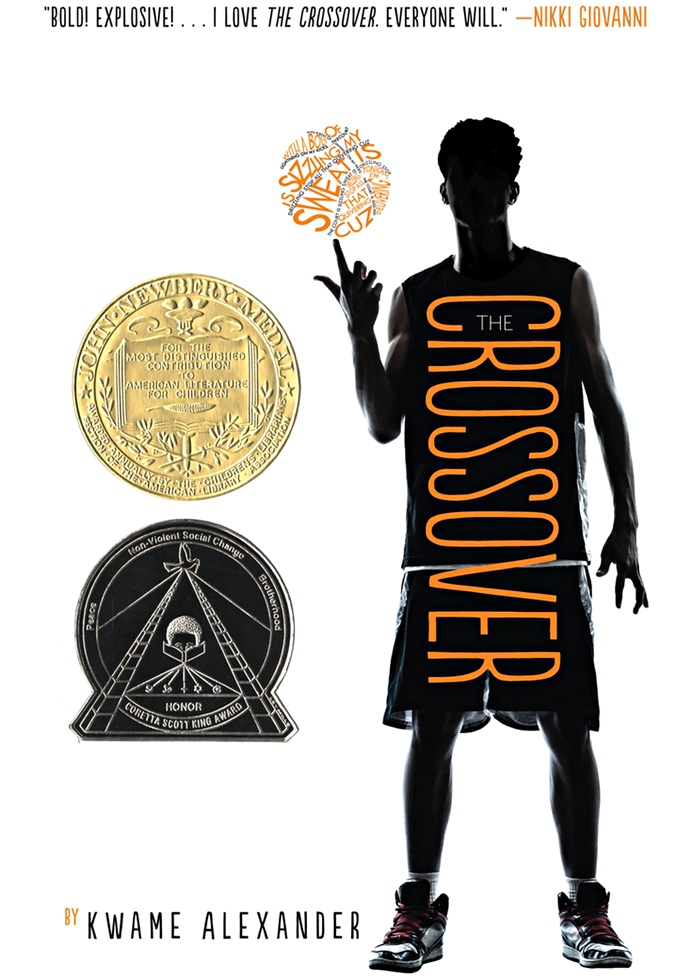
The Crossover by Kwame Alexander


The Crossover (2014) by Kwame Alexander is a Newbery-Award winning novel told in verse that experiments with typography and visual poetry. 12-year-old Josh Bell is a junior high basketball superstar, and he plays alongside his twin brother Jordan on the school team. Like Sharon Creech's Love that Dog, Karen Hesse's Out of the Dust, or Jacqueline Woodson's Brown Girl Dreaming, the novel is communicated in short, poetic sections, some of which rely on internal rhymes and other times on end rhyme. 

When Josh plays basketball, the pages of the novel come to life and animate, immersing readers in the movements of basketball. Rhymes are emphasized by changes in typography: words are capitalized, indented, falling diagonally across the page. The rhythm and motion of the game is physically explored on the page. This animation occurs only when Josh plays basketball, when the language really comes alive: "He dribbles / fakes / then takes / the ROCK to the / glass, fast, and on BLAST" (10). 

The novel focuses on Josh and his twin brother Jordan - JB - as they have to navigate their changing relationship in junior high. The dynamics largely shift when JB starts dating Alexis, who Josh nicknames "Miss Sweet Tea." Josh finds himself alone, and after a moment of frustration on the court, suspended from the basketball team. Complicating this already difficult year of school is the emerging health condition their father is now exhibiting signs of. He's a former basketball superstar who has nurtured his sons' talents. These tensions thread through the novel, the poetic language moving them from background to forefront as it progresses. 

I've had a copy of The Crossover for a few years, and read in advance of picking up Alexander's latest novel Booked. The language practically vibrates off the page, and I intend to pick up the audiobook version of The Crossover next. 

Friday, June 27, 2014

Boy21 by Matthew Quick

I unexpectedly took a short hiatus from updating this blog at the beginning of the year. I was on a roll with book reviews after NCTE in November. It's hard not to be. You pick up so many new books that are really some of the best being published for teenagers and you don't want to do anything else except for write about them and share information about them as much as you can. But I sort of hoarded my NCTE haul this year. By which I mean instead of reviewing the books I read, I just read them. And I know I made some sort of justification for just reading: "Think about the time you'll save by just reading and not writing a review! That's like an extra eighth of a book!" It was kind of ridiculous. And, as a result, I have a huge backlog of books that I've read over the last few months that haven't ended up on this blog, but instead have just been shelved or shared person-to-person. 

Boy 21 by Matthew Quick is one of those books that I should have written about here right away, but because it was sandwiched between my reading of two of Quick's newer publications - Forgive Me, Leonard Peacock and The Good Luck of Right Now - I didn't get to writing about it. But it is an incredible book, one that I still think about off and on, even though I read it last December. When I was standing in line at NCTE waiting to purchase Boy 21, I talked to a teacher who told me it was the most oft-stolen book in her high school English classroom. Her students loved the book so much that they would just keep it after she lent it to them. So she was replenishing her supply at NCTE, buying a few extra copies for her classroom. It's really that kind of book, one you want to keep your own copy of because even the physicality of the book is meaningful. 

Boy 21 is about Finley, nicknamed White Rabbit for being the only white kid on his high school basketball team. He wears the number 21 - it's his number, the one on the back of the jersey that gives him some way to identify who he is and what he cares about. He's in his last year of high school, and then he plans to escape Belmont, the run-down neighborhood controlled by the Irish mob, where drugs, violence, and rivalries define most of day-to-day life. But all of his plans change with the arrival of Russ, a basketball phenom who moves to Belmont after his parents are murdered. Russ only answers to the name Boy21 (21 was his former jersey number), and he's more than a little affected by his family tragedy. Finley's coach asks him to befriend Russ and help him to adjust to life in Belmont, and Finley agrees. He knows to do what his coach tells him to, and he knows that a player like Russ will help their team immensely. His friendship grows with Russ - as much as it can - but Russ is also a threat: will he take Finley's place on the team? Worse than that, will he take his number?

Quick's writing is impeccable, and the story is heartbreaking. The violence in the community is palpable, and both Finley and his girlfriend Erin are drawn into it daily, even though they don't want anything to do with it. The Irish mob is more than just background noise in this coming-of-age story. It inches its way into Finley and Erin's lives, and threatens to break them apart. Russ - Boy21 - is an amazingly conceived of character, and Finley's sense of responsibility to him (even when it means losing his place on the team) speaks so much to the type of characters Quick can write. And the small revelation at the end reverberates through everything that came before, reshaping the story. Matthew Quick continues to be one of my favorite contemporary authors, and his young adult and adult books consistently end up on my own best of lists.

Monday, November 5, 2012

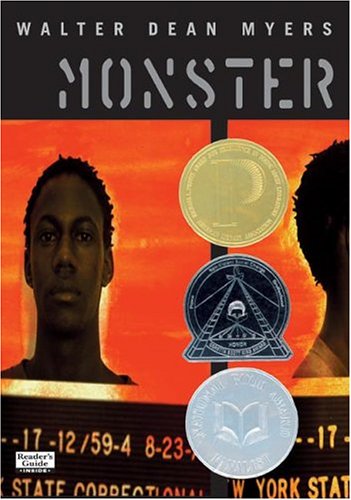
Monster by Walter Dean Myers


It has taken me longer than it should have to get around to reading Walter Dean Myers’ Monster. I was recently doing some research on young adult books that combine both text and image, and Monster was referenced a few times because of the black and white photographs interspersed throughout. Monster won the first Prinz Award when the award was created in 2000, and the experimental and challenging format it engages with represented the kind of book that the Prinz Award wanted to recognize.

Monster uses a screenplay format to tell the story of Steve Harmon, a sixteen-year-old boy who is on trial for the murder of a man, Alguinaldo Nesbitt, who owned a drug store in Harlem. Harmon is implicated in the crime by a series of criminals who are trying to lessen their sentences by cooperating with the police. On trial, awaiting his sentencing as the “look-out” in the hold-up, Harmon writes his story in screenplay form, his interest in films becoming more apparent as the novel progresses.  The screenplay is interspersed with journal entries, as Harmon must return to his prison cell during the downtime of his trial.

As a sixteen-year-old in jail, Harmon is in a constant state of fear and anxiety. He begins his narrative by writing, “The best time to cry is at night, when the lights are out and someone is being beaten up and screaming for help. That way even if you sniffle a little they won’t hear you. If anybody knows that you are crying, they’ll start talking about it and soon it’ll be your turn to get beat up when the lights go out.” He has been in jail for “a few months” but is not nearly close to getting used to the routine of imprisonment. He decides to record the trial as a screenplay, since he has been involved in a film club at his school and views the world through camera angles, close-ups, and voiceovers. He is also writing as a way of self-definition, particularly to find out who is his and what he has done. He writes of his story, “I’ll write it down in the notebook they let me keep. I’ll call it what the lady who is the prosecutor called me. Monster.”

The reader is introduced to the prosecutor, the defense, the judge, and the jury. They are a dramatic list of characters at the beginning of the screenplay, followed by the opening credits that Harmon figures to the style of Star Wars, an indication of both his age and interests. Spliced between the real-time trial are scenes that attempt to carve out Harmon’s character: him and his younger brother Jerry talking about superheroes; his film class; his friends.

There are also black and white photographs throughout, all of them apparently of Harmon. The lack of color functions as a means of reading Harmon’s trial as subsisting in a morally grey zone; his innocence is not so black and white as the portrait photographs that appear in the book. Harmon grapples with his participation in the holdup; even though he was just the look-out, casing the drug store and making sure there were no obstacles in the way, Nesbitt still was murdered. He talks to other prisoners in jail who take responsibility for their crime, anticipating “guilty” verdicts and connecting them innately to the crime they committed. Harmon, however, is different. He can’t grapple with the moral uncertainty of his crime. He didn’t pull the trigger, but he was involved, even peripherally, in murder. He represents the facts of the trial in an unflinching account of witnesses and cross-examinations, but there is still a sense of uncertainty about what Harmon’s verdict will be, and his own moral dilemma.

As the book neared the end, I was actually getting worried that the verdict wouldn’t be revealed, and that Myers’ would leave the novel hanging on the same uncertainty that threads throughout the story. Luckily, there is no such ambiguity, although I’m not sure if this does anything to lessen the uncertainty, or Harmon’s own sense of morality and accountability. The last few lines of the book hold the reader in a sense of ambivalence, as Harmon struggles to define who he is: “I want to look at myself a thousand times to look for one true image. When Miss O’Brien looked at me…what did she see that caused her to turn away? What did she see?”

I would not recommend leaving Monster unread. For its innovative form, its ambiguous subject, and Harmon’s unflinching voice, it is certainly a book worth reading. 

Friday, December 9, 2011

The Absolutely True Diary of a Part-Time Indian by Sherman Alexie

Sherman Alexie’s The Absolutely True Diary of a Part-Time Indian was probably one of my favorite books that I read when it came out a few years ago. It was the first book that I read by Alexie, which was neat, because I would encounter his short stories and adult literary novels in university courses, where, in discussions of Alexie, there were no mentions of his young adult novel (which won the National Book Award in 2007!). As much as I have really enjoyed the rest of Alexie’s work, The Absolutely True Diary of a Part-Time Indian is still my favorite by far.

In Alexie’s novel, fourteen-year-old protagonist Arnold Spirit Jr. introduces himself by stating that he was “born with water on the brain.” The first chapter of The Absolutely True Diary of a Part-Time Indian, titled “The Black-Eye-of-the-Month Club” introduces the reader to Junior’s personable and frank style of writing. He details his medical record, which reads long like a list of defects and problems, among them a stutter, seizures, and a large head that he describes as “Epic.” The novel follows Junior’s decision to leave the Spokane reservation that he lives on with his family to attend the nearby school of Reardan in order to complete his education at a predominantly white school. Although the decision to leave the reservation is made early in the book – on the occasion of Junior finding his mother’s name written in his school textbook, and his anger and frustration over the fact that the school cannot update even the textbooks – Junior has been thinking about the possibility of leaving long before he chooses to go to Reardan. Junior draws cartoons and pictures as a way to exercise his creative impetus and he notes, “I draw because I feel like it might be my only real chance to escape the reservation.” Although Reardan represents a contrast of Junior’s experiences so far, he knows that leaving the reservation to attend school each day and return home at night will provide him with the opportunity he needs to get his education. It is a brave and informed decision, as Junior understands that he will be ostracized by his tribe on the reservation while Reardan is hardly a safe and welcoming environment for him. Junior describes Reardan as “the rich, white farm town that sits in the wheat fields exactly twenty-two miles away form the rez. And it’s a hick town, I suppose, filled with farmers and rednecks and racist cops who stop every Indian that drives through.”

This move exposes Junior to models of identity, both white and Indigenous, that continue to see-saw between the reservation and Reardan throughout the novel. In each place Junior responds to the rules, relationships, and organization that govern experience on and off the reservation. These differences are usually depicted in oppositional terms that desire a model of “compare and contrast” to describe them. Junior understands how the origins of racialized difference effect experience while also using “difference” as a lens through which he can view his adolescent identity. Junior constantly reevaluates his identity position between the reservation and Reardan, where he “woke up on the reservation as an Indian, and somewhere on the road to Reardan, I became something less than Indian. And once I arrived at Reardan, I became something less than less than less than Indian.”

One of the most affecting scenes in the novel comes because Junior makes the basketball team at Reardan, only to play the first and last games against Wellpinit, his old school on the reservation. Although they lose the first game, Junior’s Reardan team beats Wellpinit the second time in order to end the winning streak of the reservation school. At the end of the game Junior says,

"We had defeated the enemy! We had defeated the champions! We were David who’d thrown a stone into the brain of Goliath!
And then I realized something.
I realized that my team, the Reardan Indians, was Goliath."

Junior’s early recognition of difference unravels into his understanding of the difference between his experience as an Indigenous fourteen-year-old in comparison to the formation of white adolescence that he observes off the reservation. Junior’s ability to mature is directly connected to his ability to experience aspects of identity of those other people that he meets and understands, and he becomes cognizant of how difference is constructed. In his speech after winning the Horn Book Award, Sherman Alexie insists that this is a goal of the novel: to find a balance between opposing structures of identity. He writes, “And this book says something else: that as much as you can love your parents, as much as you can love your community, as much as you can love your family, you can also be radically different from them. It says that you can be part of your family and yet distinct from it, and that doesn’t change your love for your family, but it changes who you become. And I think that’s a lot of what teenagers have responded to: they see in a book that you can make your own decisions for yourself and still be a loving member of you family and your community.”

The novel points to Junior’s reconciliation with himself: the impetus to leave and the desire to hold onto the family, friends, and community that provide safety and reinforcement for him. At the beginning of the novel, Junior expresses a distinction between these two halves of his forming identity when he says, “I felt like a magician slicing myself in half, with Junior living on the north side of the Spokane River and Arnold living on the south.” At the end of the novel he realizes,

"And no matter how good I was, I would always be an Indian. And some folks just found it difficult to compare an Indian to a white guy. It wasn’t racism, not exactly. It was, well, I don’t know what it was. I was something different, something new."