Young adult literature pulls a lot from mythology. I remember reading Absolutely Normal Chaos by Sharon Creech when I was younger, where main character Mary Lou Finney has to read Homer’s The Odyssey over the summer and write frequent book reports on what she thinks about it. At first, Mary Lou expresses an unfavorable opinion of the canonical work and comments, “I skimmed through the Odyssey and think perhaps I made a mistake getting this one. The print is so small (I hate that) and there’s all these weird names in it. Maybe I’ll try reading it tomorrow.” It was pretty neat to encounter this really canonical book that I’d heard about, but hadn’t thought about reading, through the journal of a character who was also my age. It was this sort of secondhand reading of The Odyssey filtered through Mary Lou, who really had her own brand of humor when interacting with the book, where she’d say things like,
I was reading this in the living room after dinner while Carl Ray was watching TV and I got so frustrated I just threw the book down and said, “Telemachus! Who the heck is Telemachus?”
And do you know what Carl Ray did? He said, without even looking away from the TV, “The son of Odysseus.”
You could have knocked me over with a feather. “And how do you know that?” I asked.
“Simple.” He said, and he kept right on watching The Dating Game.
I didn’t even think Carl Ray knew how to read.
Greek mythology seemed to be really big for a while in adolescent books (and really still is), and I mean, even J.K. Rowling sort of cited Greek mythology as providing the inspiration for some of the character names that appear in Harry Potter. And then there was Rick Riordan’s Percy Jackson series, where the titular character discovers that he is the son of Poseidon and that the world of Greek mythology is actually the setting for his own heritage and family connections.
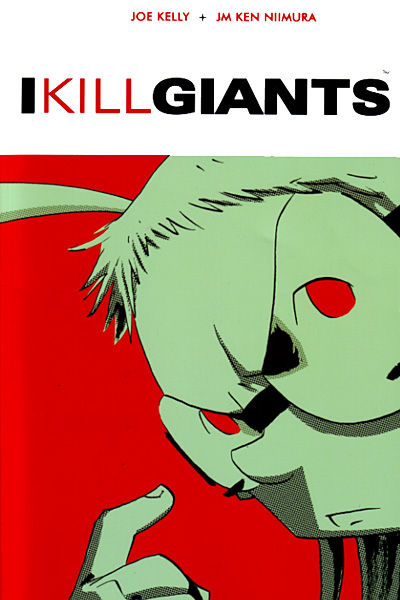
So, Norse mythology seems like it’s coming into it’s own, too. Neil Gaiman’s Odd and the Frost Giants is a nice introduction to this mythology and then Michael Chabon’s Summerland also relies on the structure introduced through Norse mythology to make a fantastical world for his adolescent characters to inhabit. Around the same time that I was reading Gaiman and Chabon, I was able to pick up a copy of Joe Kelly’s graphic novel I Kill Giants. It was a little bit of "Norse mythology overload!" Pair that with the release of the Marvel movie Thor this year, and you know, maybe it's trending.
But protagonist Barbara Thorson from I Kill Giants, her own name gleaned from an important figure of Norse mythology, was really one of the most vibrant protagonists I’ve encountered in a while. She’s a fifth-grade student who wears bunny ears in her hair, oversized glasses, and a bag slung over her shoulder that is emblazoned with a thorn, this medieval letter that she’s drawn using her own blood. The combination of graphics and text makes Barbara this ridiculously three dimensional character brought to life through the combination of speech balloons that represent that snarkiness of her character and the illustrations of her facial expressions and demeanor that go with it. Her exchanges with her teacher and other students at school are at once funny and heartbreaking, as is her eventual friendship with Sophia, the one girl in her class who is really able to gain her trust and understanding.
Combining elements and fantasy and realism, I Kill Giants makes Barbara into a hero experiencing a very real personal pain, where she creates monsters – giants that strongly resemble the Norse frost giants in mythology – to fight in the absence of a physical antagonist. Throughout the book, the reader is given small hints of Barbara’s situation to learn how the giants come to embody her pain and loneliness. Her older sister takes care of her, home is a place best avoided, and Barbara tries to stay away from the top floor of her house, which seems at once haunted and dangerous. These elements promise that the story is being driven towards an ending that resolves all of those small mysteries, but it’s Kelly’s ability to make this journey to the ending so compelling and vivid that highlights the narrative capability of I Kill Giants.
I really came to care about the main character, her story, and the world that Kelly and artist JM Ken Niimura create in this novel. Barbara is on a very singular journey, one that she has to figure out for herself, despite the fact that she learns to let other people into her life to help her through her experience. I can’t say enough about this book except “Read it! Read it!” And also, “Barbara Thorson is probably going to end up on a list somewhere, one that goes from one to ten and details the best female protagonists in literature. And she’s going to be pretty near the top.”