Showing posts with label music. Show all posts

Monday, July 4, 2016

Dumplin' by Julie Murphy


Willowdean Dickson, the protagonist of Dumplin', met her best friend Ellen because of Dolly Parton, back when they were kids. Will's aunt Lucy - a Dolly Parton devotee - bonded with Ellen's mom, Mrs. Dryver - a Dolly Parton impersonator - and now Dolly Parton is like the connective tissue of their friendship. Even Will's car is reflective of this theme: it's a 1998 cherry-red Pontiac Grand Prix named Jolene. The book begins with a Dolly Parton quote and describes Will to a T: "Find out who you are and do it on purpose." Will lives her life confidently and fearlessly.

Will lives with her mom, a health care aide by day who is devoted to running and organizing the Miss Teen Blue Bonnet Pageant every year, which has been running since the 1930s. Will's aunt Lucy - her mom's sister - used to live with them, too, but now her room is being cleaned out and Will feels lost without her favourite person in the house.

Will works at a local fast food restaurant called Harpy's, and her classmates crowd in most weekend nights just before midnight to order fries and burgers. She works with Bo, the incredibly attractive guy in the back kitchen. She reflects, "I've had this hideous crush on Bo since the first time we met. His unsettled brown hair swirls into a perfect mess at the top of his head. And he looks ridiculous in his red and white uniform. Like a bear in a tutu." This summer, Bo kisses her outside of the restaurant one night, and they spend the next few months secretly driving to an abandoned parking lot to make out. But Will is increasingly uncomfortable with the way that Bo is keeping her a secret. And Will, who describes herself as a fat girl, hates the feeling of his hands on her body, afraid that he can feel her skin spilling over the sides of her clothing. She breaks it off, and eventually quits her job at Harpy's to cross the street to get a job at the local chilli place.

Fast forward to the beginning of the school year, and Will finds out that Bo has left his private school and now attends her public school, and this time, Will's not the only person who is interested in him. When she decides to enter into the Miss Teen Blue Bonnet Pageant, her friendship with Ellen begins to change, and she finds herself more alone than she has ever been before.

Enter three other girls who are inspired to enter the pageant alongside Will - Millie ("Millie is that girl, the one I am ashamed to admit that I've spent my whole life looking at and thinking, Things could be worse"); Amanda; and Hannah. They become a group worth rooting for as acclaimed author Julie Murphy weaves an incredibly funny, real, and fabulous story with a heaping scoop of romance.

Tuesday, April 5, 2016

The Haters by Jesse Andrews


Somehow, my branch of Canadian bookstore Chapters had a copy of Jesse Andrews's new novel The Haters last week, despite the fact that it's "book birthday" is today. But I didn't have an opportunity to start reading it until last night, and when I did, I read it all the way through, in-one-sitting style. The Haters is Andrews's sophomore novel, following up on the incredibly popular Me and Earl and the Dying Girl (and like Me and Earl and the Dying Girl, The Haters already has a cinematic quality to it, and also experiments with the screenplay dialogue throughout. It's easy to imagine The Haters in movie form). 

The Haters focuses on best friends Wes and Corey, who are attending a two-week summer Jazz Camp. Chapter One is entitled, "We Didn't Know Jazz Camp Would Be This Many Dudes" and shows jazz camp orientation from Wes's perspective,
Dudes were trying with all their might to be mellow and cool. Everywhere you looked, a dude was making a way too exaggerated face of agreement or friendliness. And every ten seconds it was clear that some dude had made a joke in some region of the auditorium, because all the other dudes in that region were laughing at that joke in loud, emphatic ways.
They were trying to laugh lightheartedly but it was unmistakably the crazed, anxious barking of competitive maniacs. (1)
Jazz camp attendees have to audition for one of five bands that are ranked from most skilled to least skilled: the Duke Ellington band, the Count Basie band, the Thad Jones-Mel Lewis band, the Woody Herman band, and the Gene Krupa band. Wes and Corey make Gene Krupa, along with one of the only girls at the camp. Ash (short for Ashely) is a guitarist, and Wes is immediately into her. Also in Gene Krupa is Tim, an annoying guitarist who Wes watches do a brilliant solo: "The most sensitive, brilliant mind in the room seemed to belong to an unignorable scumbag. But that should not have been surprising. That's just how the music world works a lot of the time" (30). Wes and Corey love music, and they love to hate on it. Wes's memory of Corey hating on Kool and the Gang is kind of heartbreaking; when Corey doesn't like the band that Wes absolutely loves, it kind of ruins his own love of it. 

Later, Wes and Corey leave the jazz camp campus with Ash to get high-end sushi after a successful jam session, and the three immediately get in trouble with the camp staff. After that, Ash has no trouble convincing Wes and Corey to leave with her and tour as a band across the southern states. Her rationale? "I do like jazz some of the time. But I don't think any of the jazz I like was played by someone who went to jazz camp" (37). They leave their phones behind at camp (so they can't be traced by GPS) and set off in Ash's mom's car looking to book a gig. What follows is their road trip into the southern states, and pages are crowded with their conversations. They debate band names (Air Horse, Thundergarment) and try to come up with a slogan ("work hard, play hard" is vetoed after Ash describes it as "the philosophy of being a relatively high-functioning alcoholic"). 

Like Me and Earl and the Dying Girl, Andrews experiments with form and style. Dialogue between Corey's mom and dad and then Wes's mom and dad duels on several pages. A "Courtship Initiation Sequence Checklist" occurs on page 261. Screenplay dialogue appears frequently, and these back-and-forths between Wes and Corey (and also Ash) are some of the funniest in the novel.

The Haters is the perfect read for when you're up late at night, and a little bit tired, so that all of the jokes and funny moments hit harder than they would in the daytime. The Haters is a really funny book, with laugh-out-loud moments as good as those Louise Rennison consistently delivered in her Georgia Nicolson series. I didn't know I was looking for a YA book about a band tour until Andrews wrote one. Other YA band books that come to mind are Don Calame's Beat the Band  and K. L. Going's Fat Kid Rules the World, but The Haters is a much different book from those. The music references are endless and cover a wide range of genres and styles, and many serve to root the contemporary setting. The Haters is a fantastic book, completely funny and entertaining. 

Tuesday, June 9, 2015

Open Road Summer by Emery Lord


Author Emery Lord's debut novel Open Road Summer was published in 2014, and was followed up by The Start of Me and You in 2015. The Start of Me and You was highly recommended by author Robyn Schneider in a video when she raved about the love interest in the YA romance. The book was out of stock at the Lethbridge Chapters, so I picked up Open Road Summer and finished it in almost one sitting. 

Reagan O'Neill is joining her best friend Dee Montgomery on a 24-city-tour for the summer. Dee is a country music superstar who has just used her own breakup with childhood sweetheart Jimmy to fuel enough songs for a new hit album. Think Taylor Swift. Reagan shows up to the beginning of the tour with her broken arm in a cast and her bad-news boyfriend behind her and she's looking forward to a summer away with her best friend. 

But things change when a nude photo scandal lands Dee in hot water, her publicist scrambling for a way out. Enter Matt Finch, singer-songwriter, used-to-be member of the band The Finch Four, "a wholesome teen band that included his sister and two brothers. When we were in middle school, the band was a phenomenon. All three boys were sweet-faced, and they had hordes of screaming preteen fans. All the girls I knew wanted to be Carrie Finch, and they all wanted to marry Matt, the youngest and closest to our age." He's the perfect person for Dee to pretend to have a relationship with while he takes over as the opening act for the entire tour. He's just gone through a break-up of his own.

Lord has written song lyrics throughout the novel, some for Dee and others for Matt, many of which dredge up their previous relationships as writing works as a way to move through the aftermath. Reagan describes the title song from Dee's new album Middle of Nowhere, Tennessee as written for Jimmy:

Middle of nowhere, Tennessee,
Exactly where I want to be.
Our initials carved into the old oak tree,
And every road takes me back home.
Middle of nowhere, Tennessee,
Dancing on the porch, you and me.
This is where I was born to be,
No matter how far I may roam.

The behind-the-scenes of a country music tour include Dee donning a disguise to see Matt play at a bar, stopping at a local county fair, and zipping into gas stations to grab snacks. It's a fantastic romance, a not-quite triangle that combines Dee and Matt's fake relationship and the real relationship developing between Matt and Reagan. Reagan's voice and demeanour makes her one of my favourite characters in the recent YA novels I've read. She's been in trouble, she still gets in trouble, but she's incredibly self-aware about her actions and herself. Lord's writing is pitch perfect. There are so many similes that hang at the end of sentences, never falling into cliche. It's some of the best writing I've read in a YA romance. 

I just picked up The Start of Me and You today, and am looking forward to Lord's third novel, which was recently given a release date for 2016.  Open Road Summer is such an excellent summer read, and Lord is certainly an author I'll be watching for!

Saturday, June 6, 2015

Extraordinary Means by Robyn Schneider


I've recommended Robyn Schneider's first novel, The Beginning of Everything, to almost everyone I know. It begins with a scene depicting a kid getting accidentally decapitated at Disneyland while riding the Thunder Mountain Railroad (which I used to call "the Runaway Train" when I was little and lived close to Disneyland), but then unravels protagonist Ezra's belief that everyone has a major tragedy in their life, after which, everything changes. 

Extraordinary Means is a different kind of book than The Beginning of Everything, but carries much of the same style, topics, and discussions that were present in Schneider's first novel. 


Extraordinary Means is told from the dual perspectives of Lane and Sadie, who are both living at Latham House, a sanatorium in California for adolescents with tuberculosis. They wear bracelets that monitor the way that their body functions, alerting nurses and doctors when their stats are too low, but otherwise collecting data for a research team trying to find a vaccination that isn't resistant to the new strand of tuberculosis. The benefit of being at a sanatorium such as this is that they will be the first to try the new vaccination when it's available. While the reader is introduced to the sanatorium through Lane, who arrives on the first page of the book, Sadie has already spent months living in one of the small cottages. She's truly made it her home, and she's anxious to think about what exists for her back at home, if she'd ever able to leave.


Lane describes his first night at Latham House as wildly different from what he's used to. For one thing, he has to face the reality that kids his age die at Latham House, and not everyone hangs on waiting for a possible vaccination. He reflects, "My first night at Latham House, I lay awake in my narrow, gabled room in Cottage 6 wondering how many people had died in it. And I didn't just wonder this casually, either. I did the math. I figured the probability. And I came up with a number: eight. But then, I'd always been terrible at math." Lane is ditched by his tour guide on hist first day at Latham House, causing him to "fail" breakfast because he doesn't fill his tray with nutrition-rich foods. But Lane soon learns that he wasn't ditched at all. His tour guide was just another casualty of the disease. He has trouble adjusting to the new environment. He's an over-achiever, used to spending all of his free time studying and preparing for college applications. He's afraid his future is going to slip through his fingers if he actually "rests" like he's expected to do. He's also having trouble adjusting to being away from home. He notes, "I'm an only child, so the prospect of using the communal bathroom was pretty horrifying. Which is why I set my alarm that first morning for six o'clock, tiptoeing down the hall with my Dopp kit and towel while everyone else was still asleep."


Eventually, he gets taken in by Sadie and her friends, a close-knit group who sneak into the woods, turn off their health monitors, and seem like the right in-group to be a part of. While I loved Sadie's voice and always anticipated returning to her perspective, Lane seemed more developed over the course  of the novel, and I liked his transformation and what he had to say about his life before Latham House and his life after. Lane's realization largely has to do with the way he was working constantly towards a future without living his life day by day.  Latham House, where he's on doctor's orders to stop studying late (it's making him sick), changes all of that. Lane says, "Before I even knew what high school was, I'd already let my fear of not begin the best at it make me miserable. And I was starting to think that if I hadn't gotten sick, I would have done the same thing with college, rushing toward internships and grad school and a job. Somehow, without realizing, I'd made high school into a race toward the best college, as opposed to its own destination. It was only now that I hadn't done the same thing at Latham that I could see it, and I realized how unhappy it made me."


I really enjoyed Schneider's new novel, and what Lane came to understand about himself while he was at Latham House. I also liked the way the title was worked into the novel, and what the "extraordinary means" of this novel are. Schneider also includes an extensive author's note that describes her choice to make tuberculosis important to her novel. I'm looking forward to passing around my copy of Extraordinary Means, just like I did with The Beginning of Everything. 

Monday, June 1, 2015

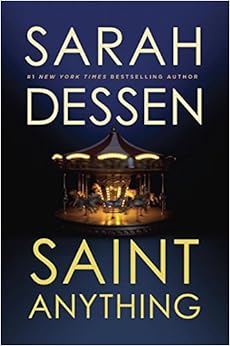
Saint Anything by Sarah Dessen


Sarah Dessen's new book Saint Anything, was just released at the beginning of May, and already I've shared my copy a couple of times. I've been reading Dessen's novels since the 1990s, when That Summer, Someone Like You, and Keeping the Moon came out. 

Saint Anything follows Sydney, who's brother Peyton has just been sent to prison for drunk driving. He left a young boy paralyzed from the waist down, and Sydney is obsessed with the consequences her brother has left behind, seemingly immune to the fall-out of his accident. She decides to switch schools, moving from the prestigious Perkins Day to Jackson High School, a huge public school that she chooses because it enhances her anonymity. She doesn't want to be recognized as her brother's sister, and doesn't want to be connected to the accident. 

But when she attends Jackson High School, she doesn't end up being as anonymous as she hopes she'll be. She's quickly taken in by the Chathams, brother and sister Mac and Layla, whose family owns a local pizza place Sydney visits after school. The Chatham family seems magical to Sydney. Mrs. Chatham, who has MS, Mr. Chatham, Mac, and Layla, who work at the pizza place, and Rosie, a figure skater who has recently had difficulties of her own. Pizza and french fries factor heavily into this novel, as Sydney becomes a staple at the pizza place, and Layla crusades for the perfect french fry. 

Still, Peyton never disappears from the picture entirely. His weekly phone calls home assert his presence in their life. His old friend Ames, a recovered drug addict and alcoholic, also hangs around Sydney's house. He is the most unsettling character in the novel, and often "babysits" Sydney alone in the house when her parents are away. I had read an article Dessen wrote for Seventeen Magazine just a fews before Saint Anything was published. "I Thought Dating An Older Guy Was Cool - Until I Sensed That Something Was Very Wrong" is Dessen's account of her relationship with a twenty-one-year-old when she was fifteen. I didn't realize how much it would factor into her novel, and in fairly insinuating ways. 

I found myself so frustrated with the Sydney's family, especially her parents, who don't do anything that they should to keep Sydney safe and loved. Their complacency in Ames's influence on Sydney's life is hard to read at times. Which is certainly what Dessen intends, if her Seventeen Magazine article is any indication. 

I'll always look forward to the next Sarah Dessen book, and Saint Anything was no exception.

Tuesday, June 17, 2014

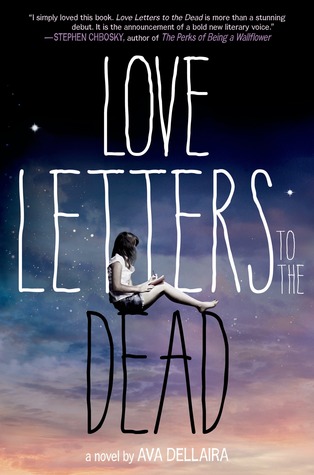
Love Letters to the Dead by Ava Dellaira

Love Letters to the Dead by Ava Dellaira was a title recommended on Amazon after I placed my last order. And, unfortunately, it was too late to go back and add it to my shipment, so I had to wait until I could pick up a copy at Chapters last week. While YA authors Laurie Halse Anderson, Jay Asher, Gayle Forman, Siobhan Vivian, and Lauren Myracle supply blurbs for the back cover of the book, I was more interested by the blurb that appears on the cover: The Perks of Being a Wallflower author Stephen Chbosky's enthusiastic recommendation, "I simply loved this book. Love Letters to the Dead is more than a stunning debut. It is the announcement of a bold new literary voice." I don't think I've read a book like The Perks of Being a Wallflower until I read Love Letters to the Dead. The similarities are astounding, and one of the easiest book recommendations for a teen reader who liked Perks would be Love Letters. And while Perks's Charlie writes his letters to a friend, Love Letters's Laurel addresses her letters to dead musicians and celebrities including Judy Garland, Jim Morrison, Amy Winehouse, and Heath Ledger. Honestly, at times it seems as if the only difference between Perks and Love Letters is the gender of the protagonist: Charlie is male, Laurel female.

Laurel's impetus for writing her letters comes from a high school English assignment at her new school: her teacher, Mrs. Buster, asks the class to write one letter to a dead person. Laurel completes the assignment - she addresses her first letter to Kurt Cobain - but she doesn't hand it in. The letters are too personal, and they get to the heart of what happened to her older sister May a few months before. She died, and Laurel was with her when it happened. Laurel's letters are specific to her relationship with May, to her experience at her new school (she started at a high school in her Aunt Amy's zone, so she wouldn't have to attend the same high school that May had), and her new friends and relationships. One of these relationships, and maybe the most important to Laurel, is with Sky, an older boy at school who has the Jordan Catalano vibe going on (many of the exchanges between the two read like a script from My So-Called Life, and so if you're missing that show, this might be the book for you). This book feels so much like a 1990s book (like Perks was), that I was thrown every time there was a contemporary reference, like to Amy Winehouse, or to The Dark Knight, and other pop culture in the last few years. It has the feel of something older, more nostalgic and plaid-covered.

Dellaira's writing shines throughout, especially her descriptions of Laurel's anxiety, depression, and uncertainty since her sister died. For example, Laurel describes, "My heart was about to spring out of my chest. I was trying hard to keep it in, because I didn't want it to land on the asphalt at her feet, next to the golden ring someone had dropped in the crack. And I really didn't want to cry" (200-201). Or when she is writing to Heath Ledger, and expressing how his death affected her:
I first got to know you from that movie 10 Things I Hate About You, and I always remember that scene where you jump up on the bleachers and sing "Can't Take My Eyes Off You" to the whole girls' soccer team to capture the heart of the girl you like. But after that, even though you got a lot of offers, you wouldn't do any more teen movies. Instead, you ate ramen noodles in your apartment and waited. You didn't just want to be famous, you wanted to be true to yourself. And eventually you got more roles, better ones, and you became the kind of grownup that made growing up seem okay, like you don't have to lose your spirit in order to get older. You became the kind of father that any daughter would have wanted to have. When they found you in your apartment, dead from too many pills, I really did think it was an accident. I don't think you meant to go. (210)
Laurel weaves her own story of loss with that of celebrities and musicians: those who have lost, have been lost, and have become the loss in others' lives.

I'm usually a reader who always wants more at the end of a book, an extra chapter, an epilogue, or an afterword. But I found myself wishing that Love Letters to the Dead ended without an epilogue, and had stopped instead with the hopeful, if inconclusive, last words, "I know I wrote letters to people with no address on this earth. I know you are dead. But I hear you. I hear all of you. We were here. Our lives matter" (313). The epilogue undoes the careful work of the series of letters, and although Laurel carries with the theme (the epilogue is a letter to another dead person, her sister May), there was something simple yet heartbreaking in the anonymity of Laurel's letters, addressed to Jim Morrison and Judy Garland, that I didn't feel in the same way when May became the addressee. I liked the uncertain hope that Laurel ended with before the epilogue, the understanding that things would be different, but that she would keep on going and living and hoping regardless.

Saturday, June 14, 2014

If I Stay by Gayle Forman

When I saw The Fault in Our Stars last week, there were about a handful of trailers beforehand, most of them based on YA novels. The Maze Runner was one, and If I Stay was another. The thing about trailers is they tell you a little bit about the movie you're seeing: it's like Amazon's "if you like this, then you'll like THIS." The movie equivalent uses trailers, suggesting that if The Fault in Our Stars is your thing, then maybe two other YA books to movies will appeal, too. Sometimes it backfires. I'm always so worried when there are a slew of trailers before a movie that I think are nothing like the movie I'm seeing, but someone thinks they are, so maybe the movie I'm seeing isn't really what I think it is?

I'd never read Forman's If I Stay, even though it came out a few years ago, and so the movie trailer functioned like a book trailer. The movie comes out in August, so I figured I had some time to read the book before I'd go to see the movie. I ended up downloading If I Stay as an audio book. It clocks in at five hours, about the same length as John Green's The Fault in Our Stars. It's read by Kirsten Potter, who transitions between the present and the past, as protagonist Mia moves back and forth through time. 

The book starts out on a snow day, a lazy, stay inside weekday that Mia, her brother Teddy, and her parents take off. They live in Oregon, where even the slightest dusting of snow constitutes school closure (Mia's father is a teacher, and it's not hard to convince her mom to skip with them, too). After a big, greasy breakfast, they get in their car and drive to visit their grandparents. Only, on their way there they get in a horrific car accident that kills Mia's mother and father instantly. Mia wakes up by the side of the road and stands up, apparently untouched. But then she spots her own body by the highway, and she sees the paramedics arrive and attend to her. She watches the aftermath of the accident, and follows her body to the hospital, into surgery, and then into the ICU.

While she keeps track of her body in the hospital, Mia recalls her relationship with the most important people in her life - her mom, dad, brother Teddy, boyfriend Adam, and best friend Kim - entering elaborate flashbacks that compose her life before the accident. Only 24 hours pass between the beginning of the book and the ending, and these flashbacks provide the bulk of the novel. Mia's memory is meant to help her make a decision, and to decide whether or not she will let go of life. 

I loved listening to this book in particular through audio book format. Mia's grand question is whether she will stay - living on while her family is gone - or if she will let go. It's the kind of book that I would rush through to get to the resolution at the ending. Pacing is my favorite aspect of audio books - there's no rushing ahead, there's no accidentally flipping to the last page and reading the last line. Audio books facilitate moving through the story at an even, steady, contemplative pace. Which is the reason I have balked against them for so long - I like the freedom of skim-reading a page. Now, it's the reason I'm looking forward to continuing to download and listen to audio books. As well, Mia's passion for playing the cello is at the heart of the book, and her growth as a musician. One of the benefits of the audio book format is that cello music was utilized between chapters, emphasizing the sound that Mia was so drawn to. 

If I Stay will be released later this summer as a movie, and you can view the trailer here:


Thursday, November 21, 2013

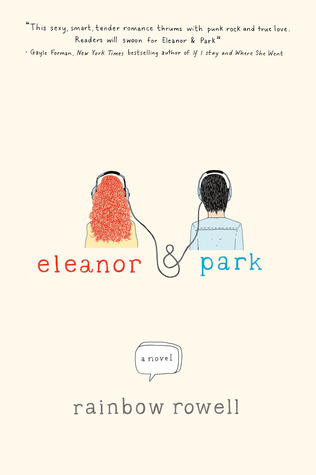
Eleanor and Park by Rainbow Rowell

I received an ARC of Rainbow Rowell’s Eleanor and Park last winter, but my sister ended up reading it months before I did. I didn’t get to it until about a month ago, when I started seeing Rowell’s newest publication Fangirl, out in stores. It was like a reminder to get to the other one, the one I already had, as my sister had been telling me how good Eleanor and Park is since she read it.

Eleanor and Park bounces back and forth between the perspectives of the main characters, tenth graders Eleanor and Park. Set in the mid-1980s in Nebraska, the two share a seat on the bus together and are inextricably tied together from that moment on. Eleanor is new to town. She lives with her mother, her mother’s new husband, and her younger siblings in a small house. Her home life is on shaky ground. She hasn’t seen her family in almost a year, since her now stepfather kicked her out of their old house and wouldn’t let her move back in until now. Park lives with his Korean mother, American father, and younger brother Josh, where he reads comic books and listens to music on his Walkman.

Their love story is a quiet, slow meandering through their grade ten year, where cool and nerdy Park falls for incredibly unique Eleanor on their bus rides to and from school. The development is so incredibly lovely, and punctuated by their sharing of everything that they love, especially comics and music. Before the two begin talking to one another, Eleanor reads issues of Watchman over Park’s shoulder, and he turns the pages slowly knowing that she is following along with him.

The heartbreak and frustration of being a teenager is so wonderfully written. Eleanor’s own self-consciousness about her appearance is detailed carefully through the book, her anxiety about her out of control curly red hair and her weight. When she meets Park’s tiny mother, she notes,

“When Eleanor was around girls like that – like Park’s mom, like Tina, like most of the girls in the neighborhood – she wondered where they put their organs. Like, how could you have a stomach and intestines and kidneys, and still wear such tiny jeans? Eleanor knew that she was fat, but she didn’t feel that fat. She could feel her bones and muscles just underneath all the chub, and they were big, too. Park’s mom could wear Eleanor’s rib cage like a roomy vest.”

Eleanor and Park is an excellent teenage romance, and I’m looking forward to picking up Fangirl soon, and Rowell’s adult novel Attachments.

Monday, October 28, 2013

Heart-Shaped Box by Joe Hill


Heart-Shaped Box by Joe Hill details the haunting of aging musician Judas Coyne in a truly terrifying ghost story. Until I started reading Joe Hill’s books and comics series, it had been a really long time since I had been actually scared by a book. Growing up, I was always able to read anything in books, it didn’t matter how gross or gory or scary it was. Conversely, I totally could not see gross, gory, or scary on TV or in movies, and at the movie theatre would be the worst thing ever. There were even a handful of book covers that I did not even want to hold onto while I read the story itself, because they were actually too terrifying. I remember when I was nineteen, my boyfriend at the time covered my copy of Margaret Atwood’s The Handmaid’s Tale in wrapping paper to mask the stitched together smile on the front, possibly the worst book cover ever. I was absolutely terrified by some parts of Alice Sebold’s The Lovely Bones, a Jack the Ripper book by Gregory Maguire (who wrote Wicked) called Lost, and Celia Rees’s young adult novel Witch Child, but a lot of time passed between reading those books and finding another book that actually scared me.

Hill’s Heart-Shaped Box did that for me. Main character Judas Coyne used to tour with his death-metal band, and collected a following of fans that continue to send him packages in the mail, filled with the gothic, the gory, and the macabre. He adds these items to his growing collection in his sprawling farmhouse that he shares with his girlfriend, his two dogs Angus and Bon, and his personal assistant Danny. One day, a package arrives at his house looking like any other: a gothic parcel with a collector’s item to add to his strange household museum. He receives a black heart-shaped box with a man’s suit folded inside. Thinking nothing of it, Judas doesn’t pay too much attention to the package, not until he realizes that something else has traveled along with the clothing: the ghost of the dead man who it belonged to.

Opening the heart-shaped box sets off the most horrifying chain of events. Hill’s depiction of Judas’s haunting is so terrifying, drawing together elements of violence, horror, hypnotism, Judas’s past relationships, and death. The supporting characters in this book were actually the highlight for me. Judas’s current girlfriend Georgia (he eschews all of his girlfriends’ names for the state that they’re from) is an amazing character, and I loved that there was such a great female perspective alongside Judas’s. Even Judas’s two dogs are central to the story itself, and how Judas steps in and out of relationships – between his assistant, his girlfriend, his dogs, his fans – is consistently on display in this novel.

Even though I just read Heart-Shaped Box a few months ago, if there was any book that I’d want to read for Halloween, this would be it, and I might even give it a re-read just for the holiday.

Sunday, March 24, 2013

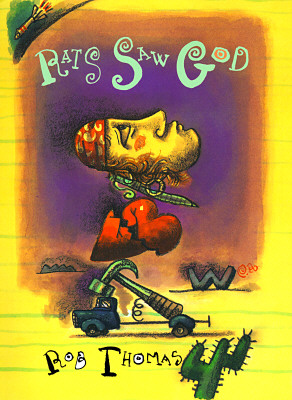
Rats Saw God by Rob Thomas


I thought it would be a good time to talk about Rob Thomas’s Rats Saw God, a YA book published in 1996. I think I bought my paperback copy when I was twelve when YA paperbacks were $6.50, and I loved it. I reread it recently in light of the news surrounding Rob Thomas’s other writing project – the TV show Veronica Mars – and it’s successful movie funding on Kickstarter. It’s a great book to pick up and read in the year or so before the Veronica Mars movie is released, especially as Rats Saw God has actually beenpicked up for a rerelease.

I had never made the connection between the Rob Thomas who wrote Rats Saw God and the same Rob Thomas who created Veronica Mars, not until I came across an episode in the second season of the TV show called “Rat Saw God.” A little bit of googling later, and I realized that the same person who wrote one of my favorite YA novels also created and wrote one of my favorite TV shows.

Rats Saw God is about Steve York, and flashes back between his junior year of high school in Texas (living with his dad, “the astronaut”) and his senior year of high school in San Diego (living with his mom and sister Sarah). On the brink of failing his senior year, a sympathetic guidance councilor named Jeff DeMouy tells him he can make up his English credit by writing a 100-page essay. Steve decides to write about his junior year in Texas, the events of which turned him into the pothead he is when we encounter him at the beginning of the novel, just barely holding onto his grades.

In Texas Steve was a member of GOD, or Grace Order of Dadists, an alternative group at the high school with hopes of getting into the school year book. It was also there that he met Dub (Wanda), the first girl he’s ever fallen in love with. He’s also juggling home life with his distant father and his job at the Cineplex. The flashbacks between the past and the present aim to match up the Steve writing the essay with the Steve he’s writing about.

Thomas’s trademark one-liners and quick dialogue are as strong here as they are on Veronica Mars, and there are similarities between the two (even if they are pretty distant. The sports teams at the high school in Veronica Mars are the Pirates; in Rats Saw God, it’s the Buccaneers. Steve York also has just a touch of Logan Echolls about him. But just barely!). It’s a quick, good read, and the dialogue between Steve and DeMouy is reason enough to pick up Rats Saw God

Wednesday, February 13, 2013

Calling Dr. Laura by Nicole J. Georges


Calling Dr. Laura by Nicole J. Georges is a graphic memoir that explores the author learning, from a psychic no less, that her father has not passed away from colon cancer like her mother and sisters have always told her, and follows the subsequent reordering of her understanding of her family. It yokes together the aspects of Alison Bechdel’s Fun Home and David Small’s Stitches that made them so notable – a careful detailing of the author’s childhood and resulting affect on their future lives as relayed by a loose frame narrative set in a sort-of-present.

The title – Calling Dr. Laura – comes from Georges calling Dr. Laura Schlessinger’s conservative radio advice show (and one of the most hilarious images in the entire book is Georges representation of Schlessinger as the sister in Dinosaurs) as she tries to come to terms with the fact that her mother and sisters lied to her. She includes the transcript of the phone call, having recorded it as it took place. As a character in her memoir, Georges illustrates herself tucking the tape recording of the phone call away and hiding it from her girlfriend Radar.

Georges begins the book in Portland, OR, where she lives with a handful of dogs, chickens, and a new rescue chicken named Mabel. Her artistic style changes as the book jumps back and forth from past to present, and her depiction of her childhood is rendered in a less descriptive and more iconic way, which suits her younger age and the material presented. Georges depicts a series of boyfriends and husbands that her mother was attached to while she grew up, many of them distant and one abusive. Each of these men gives the young Georges a present – a stuffed animal by at least two and a dog from another – and her mother insists that Georges name the gift after the boyfriend/husband who gave it to her. I thought it was hilarious to see Georges’ collection of animals growing, each one named after a man who had quickly been inched out of her mother’s life.

Relationships are at the heart of Georges’ memoir: with her mother, her two half-sisters who are ten and twelve years older than she is, her girlfriend Radar, her close friends, her dogs, and her amorphous, unknowable father. Georges is stuck up in the middle, trying to make sense of how she stands in relation to the people she loves, and how she can carve out her own identity when there are so many different ones that others want her to subscribe to.

It is an intriguing story and beautifully illustrated book. I really loved Georges’ artistic style and the times that she illustrates scenes set in Portland were some of my favorite. Although Dr. Laura is integral to the title, she only occupies a small series of pages near the end of the book (where the transcript of their phone call conversation is included), but her importance to Georges as an outlet for advice at a difficult time is notable. Likewise, the psychic who gets so much wrong about Georges gets one very important thing right – her father is still alive. The ending is almost heartbreaking, and the story as a whole is well worth the read.