Showing posts with label steampunk. Show all posts

Thursday, February 6, 2014

Curtsies and Conspiracies by Gail Carriger

Curtsies and Conspiracies is the second book in Gail Carriger’s young adult series about Sophronia Temminnick, a young Victorian woman who attends Mademoiselle Geraldine’s Finishing Academy (a finishing school where young women learn the art of espionage). The finishing school also happens to be airborne, taking the form of a floating dirigible that hovers over the moors. And the setting is Victorian steampunk, an England with a large paranormal presence. Vampires and werewolves are a natural part of high society, and two paranormal beings also teach at the finishing school: the werewolf Captain Niall and the vampire Professor Braithwope.

The book begins with Sophronia’s six-month review at Mademoiselle Geraldine’s. She engages in a series of tests that involve her identifying poisoned cakes at tea service; sending a message by code; and choosing the “correct” two items out of “a letter opener, a pair of ornate lady’s sewing scissors, a large fan, a crumpet, two handkerchiefs, and some white kid gloves.” When her examiner asks her why she did not choose the crumpet, Sophronia responds, “Oh, no, I’m not worthy.” Carriger immerses readers in a truly different world, one whose Victorian customs and culture are identifiable through social norms, etiquette, romance, and dress, but altered by a paranormal and steampunk influence.

When Sophronia receives the highest marks on the exam, she is ostracized and alienated by the rest of the girls in her class, and must embark on her studies and her espionage alone and without help from best friend Dimity. Her studies on the dirigible are complicated by the fact that the school has taken on a small group of boys from Bunson and Lacroix’s Boys’ Polytechnique, a school for budding evil geniuses (which Dimity’s younger brother attends). This includes the high-ranking Felix Mersey, Lord Dingleproops, and Dimity’s brother Pillover. Meanwhile, Sophronia continues her nightly visits to the boiler room to meet with her friends Soap and Vieve. Sophronia finds herself in the middle of a mystery, as the flying school travels to London to witness a dirigible experiment that could change the dynamics between paranormal and non-paranormal beings.

I love Carriger’s books. After I read Etiquette and Espionage, the first book in Carriger’s young adult series, I quickly found her five-book adult series (and adapted manga series) The Parasol Protectorate. This adult series is set in the same world, but revolves around older characters including the protagonist Alexia Tarabotti. Characters from both series crossover, and the rules that govern this Victorian steampunk world are consistent in each.


Monday, November 26, 2012

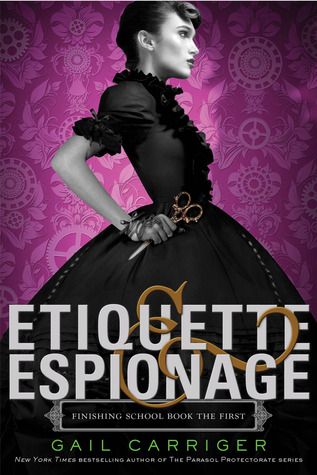
Etiquette and Espionage by Gail Carriger


Fourteen-year-old Sophronia Angelina Temminnick tumbles down a dumbwaiter, ruining her dress and her tea; is accepted into Mademoiselle Geraldine’s Finishing Academy for Young Ladies of Quality; and is bundled up in a coach with a boy heading to a school for evil geniuses and his sister, Dimity, who is on her way to Mademoiselle Geraldine’s, all in one morning. With more brothers and sisters than she can count, the fact that Sophronia is taking leave of her family’s country house is a relief to her mother, and her mother’s friend Mrs. Barnaclegoose, or, as Sophronia calls her, a “meddling old battle-ax.”

When en route to the finishing school, the coach is attacked by flywaymen (the equivalent of highway robbers, but with dirigibles) who are searching for something very valuable, something they call “the prototype.” Sophronia quickly learns that the Mademoiselle Geraldine who is traveling with them is not the real Mademoiselle Geraldine, but instead a student of the finishing school called Monique, who has been given the task of retrieving the prototype, Sophronia, and the siblings, and to deliver them to school. Sophronia quickly shows that she is not the sort of fourteen-year-old girl who sits back and waits for someone to get her out trouble; instead, she concocts a plan to rid the coach of the flywaymen, and to steer them out of danger, to arrive safely at school.

The thread that carries through Carriger’s book is that not all is as it seems, for the finishing academy does more than teach manners and etiquette; it trains young girls in the art of espionage, with an undercurrent that “to finish” means to become a highly skilled assassin. Sophronia is one of the only girls to arrive who does not have any connection to the school; most of the girls there are following in their parents’, or grandparents’ example and attending out of a sense of family allegiance. Sophronia has to figure out the quirky mix of “etiquette and espionage,” carefully determining the ropes and when to pull them. And then there is also the fact that the school does not have a precise location. Instead, it floats, a massive airship kept airborne, dropping only occasionally to the moors to collect students.

Among the professors at the school are a werewolf and a vampire, and the werewolf, Captain Niall, is one of the early highlights of the novel. When Sophronia and Dimity first meet Captain Niall, they are struck by both his bare feet and the jaunty top hat that he wears on his head. When he transforms into a wolf, Sophronia “noticed then, much to her surprise, that the top hat was still tied securely to his head. This incongruity served to calm her as nothing else could have. Later, Sophronia was to wonder if this was the reason Captain Niall always wore a top hat, even when he changed – to put people at ease. Or if he believed that, whatever the form, a gentleman should never be without his hat.” As Victorian steampunk, Carriger is concerned with details of dress, and her descriptions of clothing make for the opportunity to slip in a very precise humor. Her description of Captain Niall marks one such description, when she writes, “Captain Niall had a nice smile, and Sophronia liked his boneless way of moving. But she had a sinking suspicion he wasn’t wearing a cravat under the greatcoat. Also, it looked as if his top hat was tied under his chin like a baby’s bonnet. Since she figured it might be rude to point out the man’s deficiencies in attire to his face, she said instead, ‘I do hope the coachman finds his way back to civilization safely.’”

I couldn’t put Etiquette and Espionage down after I started reading it, and I already have Carriger’s other books on order (the five books in The Parasol Protectorate series, described as steampunk paranormal romance). Sophronia is such a likeable character, and, at fourteen, Carriger has tons of potential to map out her experiences as they take place throughout the rest of finishing school. The subtitle “Book the First” certainly suggests that there will be more in the series, as does the ending and where we leave Sophronia and the prototype. Etiquette and Espionage will be published by Little and Brown in February 2013.