Tuesday, August 30, 2011

Telling by Carol Matas

There is this book that I read when I was younger that made Renaissance Fairs sound really appealing. I mean, I am sure there are a lot of books that probably have the ability to do that, but Carol Matas’ Telling sort of made it seem like it would be one of the places you’d want to go to in the summer like, “Oh hey, medieval times, let’s get a turkey leg!”

The first book I read by Matas, a Canadian author for young adults, was Daniel’s Story. It is set during WWII and follows fifteen-year-old protagonist Daniel as he is moved between cities, concentration camps, and work camps during the Holocaust. Matas followed up Daniel’s Story with several other novels set during WWII such as After the War and The Garden. When I picked up Telling, I didn’t read the back synopsis, I just sort of assumed that it would be another novel set during WWII, like the other Matas novels I had read.

It was really nothing like that. Telling documents the nightly “telling” sessions between three sisters: thirteen-year-old Corey, fifteen-year-old Alex, and eighteen-year-old Sue. They meet in the attic of the house they live in with their mother and take turns talking about how the summer is going for each of them. It’s an interesting multi-character narrative where Matas really gets to experiment with point of view. Each sister embodies a personality that allows for very different situations, ones that Corey, Alex, and Sue can interact with and hear about, and experience without having been there. Matas engages with a way of talking story between the sisters, but the dialogue never feels like a movie script or screenplay. It feels real and organic and captures something about the characters that strict description cannot. Matas really lets the sisters speak for themselves, and share with each other (and the reader) the events that best describe them and reveal how they want to be represented.

Middle sister Alex is the backbone of this narrative. Her stories revolve around the Renaissance Fair that she works at for the summer, her first job as a teenager. She is a self-described writer and composes a play about witches that takes place during the Middle Ages to be performed at the fair. Corey, the youngest sister, talks about her friends as she tries to figure out how she can fit in without succumbing to peer pressure. A shared story between Alex and Corey reveals that Corey interrupts Alex’s play at the fair, and this largely influences the tensions that play out in the real “telling sessions.”

Finally, as the eldest sister, Sue experiences a kind of first love that doesn’t end up being as fulfilling as she hoped it would be. Memory and real time alternate as the sisters share experiences with one another, telling stories and navigating the relationships that result from the content.

Telling is a book that I can’t help but read once a year. It’s short – only 120ish pages – and is mostly driven by dialogue. It draws the reader into the story while also propelling the narrative forward, so that the entire book acts as a small whirlpool of stories that spiral through towards the end. The Renaissance Fair provides an interesting and unique backdrop for many of the conflicts to play out, and feels real without being gimmicky. Alex encounters all of the problems that come with a first job, but these are contained within an almost fantastical situation that arises from the Medieval elements. The succinct length of the novel similarly drives the reader directly into the story: we may not have much time with these characters, but we do get to know them very well in that time.

I think Telling really captures something about young adult experience, and uses tools like dialogue and multi-person narrative to explore them. It’s a book that I read fairly often, this small pocket of a summer recounted at night between three sisters.  

Thursday, August 25, 2011

Summerland by Michael Chabon

I don’t know that much about baseball. But what I do know about it, I learned from Michael Chabon’s Summerland, which is pretty impressive, because now there is a game I know all of these new words for like “designated hitter” and also “walk” and hey, my ability to identify any of that comes from a five hundred page children’s book. Which is funny because baseball definitely makes a small appearance in Stephenie Meyer’s Twilight, or you know, plays quite heavily and also brings about the only action that occurs in the entire thing, but I can’t remember learning anything about baseball through that except for that sports would be a lot more fun to watch with vampires playing because of their superhuman abilities that make you think, oh, or also, that’s steroids.

I read Summerland for the first time when I was in middle school, kind of right around the same age as the protagonists are, eleven-year-olds Ethan Feld, Jennifer T. Rideout, and Thor Wignutt. At the time I really thought Michael Chabon was a children’s author and I’d always check the children’s/YA section at the bookstore like, “Oh my god, is there another one, why isn’t there another one?” And I sort of thought that was it for a really long time, until I was in a library and found the Michael Chabon shelf which covered a pretty ridiculous amount of space, and kind of kicked myself and thought, “Oh. Well. That makes sense. Yeah. He’s a Pulitzer Prize winning author whose books have also been turned into movies and also look at these essay collections so I guess what really happened is that he was an adult literary writer who decided to write a children’s book and not the other way around.”

In the last few years I’ve been able to read a good amount of Chabon: The Yiddish Policeman’s Union, Wonder Boys, The Mysteries of Pittsburgh, Maps and Legends, and The Amazing Adventures of Kavalier and Clay. All of which he’s kind of extremely well-known for. And then last year I picked up Summerland again and it was this really great bookend to all of my Chabon reading. So great that I was like, “Okay! Here is what I’ll defend for my MA! Summerland!” And so I wrote all academically on that book and so it’s maybe cheating a little to go ahead and write a review here, but also not really, because even with all of that time and investment into one book, it’s really the story and the narrative that Chabon writes that brought me back to the book ten years after the first time I read it.

Chabon really brings a lot together in Summerland: Norse mythology, the geography and history of the West Coast, adolescence, and an American mythology of baseball. His main character, Ethan, moves to Clam Island with his father, and plays on the Little League team with Jennifer T. and Thor. But these characters don’t spend too much time in the real world. It isn’t long until they learn that the land that the baseball fields occupy, located at the tip of the island, bridge into the fantastical world of the Summerlands. And that’s where these three characters crossover to.

The Summerlands are ordered by baseball. Ethan and his friends follow a quest narrative that is punctuated by the baseball games that they play against other beings as they travel to the heart of the Summerlands to stop the end of the world. Ethan’s father, you see, has been taken by the trickster Coyote and Coyote has use for Mr. Feld’s patented helium material. He wants to use it to dissolves all of the worlds into nothing, and start over again.

Buried in this overarching quest narrative are tons of allusions to mythology and traditional storytelling that can just be followed endlessly. For example, Chabon largely uses Norse mythology to structure his fantastical worlds and the stories that take place in them are from important Norse characters and structures: Loki, Odin, and Yggdrasill. And then there is that other key mythology, that of the game of American baseball, which Chabon shows has its own legends, lore, characters, heroes, and language. The mythology fleshes out the fantastical, almost as if it backs it with a certain truthfulness or familiarity to readers.

Even after spending a LONG time writing on Summerland, I still really want to keep going back and back to it. There is just so much in there and so many trails of mythology and story.  And it’s really exciting to see what happens when adult literary authors like Chabon turn to writing for children. I kind of feel like I’m going to be checking the shelves again for another one like, “Okay, a lot of time has passed, another kid’s book please?”

Tuesday, August 23, 2011

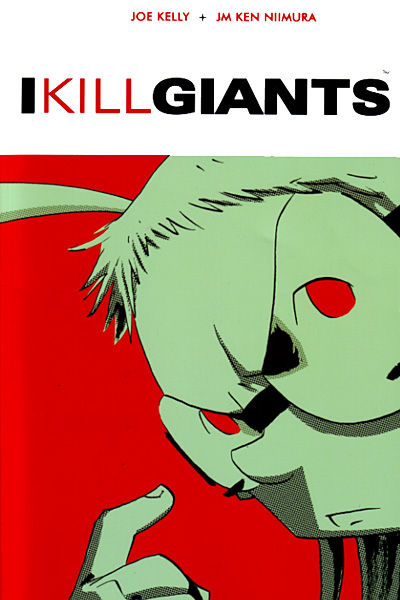
I Kill Giants by Joe Kelly and JM Ken Niimura

Young adult literature pulls a lot from mythology. I remember reading Absolutely Normal Chaos by Sharon Creech when I was younger, where main character Mary Lou Finney has to read Homer’s The Odyssey over the summer and write frequent book reports on what she thinks about it. At first, Mary Lou expresses an unfavorable opinion of the canonical work and comments, “I skimmed through the Odyssey and think perhaps I made a mistake getting this one. The print is so small (I hate that) and there’s all these weird names in it. Maybe I’ll try reading it tomorrow.” It was pretty neat to encounter this really canonical book that I’d heard about, but hadn’t thought about reading, through the journal of a character who was also my age. It was this sort of secondhand reading of The Odyssey filtered through Mary Lou, who really had her own brand of humor when interacting with the book, where she’d say things like,

I was reading this in the living room after dinner while Carl Ray was watching TV and I got so frustrated I just threw the book down and said, “Telemachus! Who the heck is Telemachus?”
And do you know what Carl Ray did? He said, without even looking away from the TV, “The son of Odysseus.”
You could have knocked me over with a feather. “And how do you know that?” I asked.
            “Simple.” He said, and he kept right on watching The Dating Game.
            I didn’t even think Carl Ray knew how to read.

Greek mythology seemed to be really big for a while in adolescent books (and really still is), and I mean, even J.K. Rowling sort of cited Greek mythology as providing the inspiration for some of the character names that appear in Harry Potter. And then there was Rick Riordan’s Percy Jackson series, where the titular character discovers that he is the son of Poseidon and that the world of Greek mythology is actually the setting for his own heritage and family connections.

So, Norse mythology seems like it’s coming into it’s own, too. Neil Gaiman’s Odd and the Frost Giants is a nice introduction to this mythology and then Michael Chabon’s Summerland also relies on the structure introduced through Norse mythology to make a fantastical world for his adolescent characters to inhabit. Around the same time that I was reading Gaiman and Chabon, I was able to pick up a copy of Joe Kelly’s graphic novel I Kill Giants. It was a little bit of "Norse mythology overload!" Pair that with the release of the Marvel movie Thor this year, and you know, maybe it's trending. 

But protagonist Barbara Thorson from I Kill Giants, her own name gleaned from an important figure of Norse mythology, was really one of the most vibrant protagonists I’ve encountered in a while. She’s a fifth-grade student who wears bunny ears in her hair, oversized glasses, and a bag slung over her shoulder that is emblazoned with a thorn, this medieval letter that she’s drawn using her own blood. The combination of graphics and text makes Barbara this ridiculously three dimensional character brought to life through the combination of speech balloons that represent that snarkiness of her character and the illustrations of her facial expressions and demeanor that go with it. Her exchanges with her teacher and other students at school are at once funny and heartbreaking, as is her eventual friendship with Sophia, the one girl in her class who is really able to gain her trust and understanding.

Combining elements and fantasy and realism, I Kill Giants makes Barbara into a hero experiencing a very real personal pain, where she creates monsters – giants that strongly resemble the Norse frost giants in mythology – to fight in the absence of a physical antagonist. Throughout the book, the reader is given small hints of Barbara’s situation to learn how the giants come to embody her pain and loneliness. Her older sister takes care of her, home is a place best avoided, and Barbara tries to stay away from the top floor of her house, which seems at once haunted and dangerous. These elements promise that the story is being driven towards an ending that resolves all of those small mysteries, but it’s Kelly’s ability to make this journey to the ending so compelling and vivid that highlights the narrative capability of I Kill Giants.

I really came to care about the main character, her story, and the world that Kelly and artist JM Ken Niimura create in this novel. Barbara is on a very singular journey, one that she has to figure out for herself, despite the fact that she learns to let other people into her life to help her through her experience. I can’t say enough about this book except “Read it! Read it!” And also, “Barbara Thorson is probably going to end up on a list somewhere, one that goes from one to ten and details the best female protagonists in literature. And she’s going to be pretty near the top.”

Monday, August 22, 2011

Noah Barleywater Runs Away by John Boyne

It’s sort of been a summer of follow-ups. It started with the new Brian Selznick book and now it’s ended with Noah Barleywater Runs Away by John Boyne. Because seriously, there is not really anywhere to go after this one.

John Boyne is probably best known for The Boy in the Striped Pajamas, his 2006 novel that was eventually adapted into a movie with a cast that seemed to be culled almost exclusively from the Harry Potter movies. It was one of those books that did everything: it worked on several levels, it told a compelling but simple story, and it appealed to a really large audience while also being something that could totally could be used for a novel study in grade school. I think one thing that really appealed about it is it reads a little bit like a fable, something that Boyne is definitely interested in exploring in Noah Barleywater.

So, Noah Barleywater was another book I was able to pick up recently and I was feeling pretty excited about it. I mean, “John Boyne! Boy in the Striped Pajamas! Something very interesting is going to happen!” The title very much does a nice little synopsis of the novel: Noah Barleywater, unable to deal with the problems he has at home, decides to run away. The further he gets from home, the more people, creatures, and beings he meets as he moves from village to village. They impart some wisdom and perspective, but mostly, they just sort of serve as these kind of annoying stop points that punctuate his journey. Like, “Ohhhh, I’m a donkey, let me tell you something about life,” or “Ohhhh, I’m a tree, listen to my wisdom.”

Boyne plays into the fable form by writing in a similar style. It’s a little straightforward and a little old-fashioned and a little timeless with Boyne throwing in words like “chap” and phrases along the lines of “a stroke of good luck.” And then there’s the reliance on the story of Pinocchio that sort of comes in at the end, something that kind of reminded me of William S. Burroughs and his cut-up technique where he'd take this linear narrative and cut it all apart to make it read in a new way. Maybe Boyne’s first draft had all of the Pinocchio stuff nicely arranged throughout and then he thought, “Cut-up technique! Do it now!” so that what happens now is the Pinocchio story just sort of…appears. The contemporary and the traditional don’t really overlap or flow together. Instead, they just stay at odds with one another throughout the novel and flip back and forth between different temporalities of time. Boyne’s protagonist Noah makes this idea of trying to pinpoint a setting and time period for this novel even more difficult because his age is not consistently represented. At times Noah seems a little like a child prodigy – he lists out the achievements he’s made by the age of eight and then deems them pretty unworthy for his age – and then other times he seems completely unaware of his situation and appears much younger than the age of eight.

But what really threw me in this book was the representation of Noah’s mother. In a book that is geared towards younger readers, Boyne writes a pretty misogynistic description of one of the only female characters (other than a teacher Noah hates) that Boyne includes. Noah expresses his hatred for his mother fairly continuously throughout the book, and Boyne later reveals that it is her terminal illness that has driven Noah from the house since he is unable to deal with the changes to his mother. Which, you know, a lot of adolescent and young adult literature has some parental contempt going on, but this kind of takes that and makes it into the unmitigated hatred an eight-year-old has for his mother. It’s something that I recognized a little in another recently released book, When Things Come Back by John Corey Whaley, which sort of does a terrible job with representing female characters as well while bordering a little bit on misogyny. For two books that were published within the same timeline, it seems like an unfortunate pattern to occur.

You know what? I was just going to go ahead and recommend this graphic novel called I Kill Giants. It’s a little bit similar to Noah Barleywater and it kind of rectifies everything that I’ve talked about in this review like, “Oh hey! Read me! Look at this! I’m awesome!” and it would make kind of a positive end to this review. Because, I mean, the key difference between I Kill Giants and Noah Barleywater is that Giants is actually good. More than that, it does a lot of what Noah Barleywater might have been trying to do, but I Kill Giants actually succeeds. So instead of a recommendation, I’ll do that one next. It’s really kind of amazing. 

Saturday, August 20, 2011

The Ghosts of Ashbury High by Jaclyn Moriarty


So, The Ghost of Ashbury High? It has a pretty cool setting.

This book, the entire thing basically, takes place on a high school grade twelve Australian English exam on Gothic fiction. English like Language Arts and Literature, not the learning and speaking of a dialect of Australian English, which, you know, would be its own sort of innovative thing and would probably be shelved over in linguistics instead of young adult fiction, or in something else entirely like “Travel!” or “Grammar!” or “How to Learn this Language Without Even Trying!”

Jaclyn Moriarty has a tendency to play around with form. Her previous books (Feeling Sorry for CeliaThe Year of Secret Assignments, and The Murder of Bindy Mackenzie) tell stories through letters, transcripts, journals, and notes on the fridge. And it doesn’t seem like she sits down and thinks, “Hmmm, how can I take this completely out of the realm of ‘traditional narrative’? Let me brainstorm the ways.” It just really seems like Moriarty has found a mode of writing that is outside of a third person or even traditional first person narrative, like, “Oh hey. This comes pretty natural. Letters and exams. People say some kind of cool stuff on those things.”

Moriarty takes an exam and she uses the questions as guiding points to explore her characters. Continuing in her Ashbury/Brookfield cycle of books (about characters who attend two Australian schools), The Ghosts of Asbury High primarily explores the relationship between Riley and Amelia, two students who have recently transferred from Brookfield to Ashbury. Characters outside of the relationship cite the gothic occurrences that they observe in their experience of Riley and Amelia, and these stories become examples on the examination. In this way, Moriarty writes a gothic story with elements of the fantastical and unexplained hauntings, however, she uses the very explicit mode of an exam that asks students to outline these same tropes to do it. It’s ridiculously metafictional and a lot of fun to read.

Recurring characters Toby, Emily, and Lydia from previous Brookfield/Ashbury books are also at the center of this novel, in addition to narrator Riley. I think Emily will always be my favorite character in any of Moriarty’s books, even if she constitutes a side character rather than a main one. She’s basically addicted to Toblerone bars and she’s always mixing up words and context, like when she describes her friend Lydia and she says, “She is not shy, but she is suspicious and therefore a bit of a reservoir with strangers.” It’s intentional humor by the author Moriarty, but this sort of self consciousness for the character Emily. It’s an interesting effect that really leads itself to a kind of character empathy.

I became really invested in the characters, but even more in the form. Mostly, I think, because it’s the form that allows for this heavy character investment. It sort of reminds me of being stressed in English class in high school when you get one of those assignments that says, “Ok, you totally have free reign here. You know, some creative leeway. Let’s see what you’re going to do with it.” And what you want to do with it is kind of be like, “Creative? I’ll show you creative!” and open up the craft drawer with the felt pens and markers and glitter and a pair of those scissors that cut cool patterns into the paper. Like that might be appreciated by a high school English teacher.

It’s so infrequent that you’re not just dealing with question, answer, multiple choice in high school that something like a creative assignment comes up and it’s pretty exciting and it's kind of stressful to really feel like you're throwing everything into it to make up for the rest of the year. But Moriarty takes the boring question/answer and then says to her characters, “Okay. Creativity. Let’s see what you can do.” And they just go. And they show off. And they become authors writing a story instead of characters taking an exam.