Thursday, September 29, 2011

The 10 p.m. Question by Kate de Goldi


Twelve-year-old Frankie Parsons worries about everything. He worries about the batteries missing from the fire alarm, the lack of food in the cupboards, and the “ominous” lightness of the pink china pig that holds loose change for the bus fare. These small events lead Frankie to the “10 p.m. Question” – his nightly talk with his mother that happens to occur at ten o’clock at night, when all of his worries need to be dispelled. His anxiety is palpable and relatable, and just one small detail that makes Frankie so sympathetic and important. Kate de Goldi’s novel follows a few short months in Frankie’s unique and funny life, from February until June.

Frankie’s cat is called the Fat Controller and his father is called Uncle George, a fact that isn’t actually revealed until halfway through the story when Frankie has to re-assert that yes, Uncle George is his father, he just doesn’t call him by that title. Frankie’s life is turned upside down at the arrival of Sydney, a girl with dreadlocks and a history of never staying in the same place for a very long time. Sydney and her siblings are each named after the place that they are born in (one is called Calcutta) and she instantly befriends Frankie and his best friend Gigs. Both boys are impressed by her skill at sports (which surprises them, since the only girl they’ve known to be athletic is their friend David Robinson’s sister: “But Gigs rightly said this was because Julie Robinson was practically a man; she was big and fierce and had a six-pack where other girls had breasts). Frankie starts to like Sydney almost immediately and they begin to write and illustrate a book together for a class project.  

The book is organized by chapters that run every second and fourth Tuesday of the month, which also coincides with the occasion of Frankie’s three great aunts – Alba, Teen, and Nellie – coming over for dinner. The women are described as gloriously fat and full of life, and their visit usually coincides with Frankie’s sister, Gordana, exiting the house. Frankie’s brother Louie, however, always comes over for the dinner (and also to do his laundry and to take the spare change off the counters).

de Goldi completely throws everything into creating memorable characters whose dialogue, description, and action gives them the most physical and tactile presence. For instance, before working in a school, Frankie and Gigs’ teacher, Mr. A, worked in a prison. de Goldi brings out this backstory and history in Mr. A by juxtaposing the sort of unknown past and “battle-hardened” disposition with the more lighthearted comedy that comes from Mr. A’s teaching. The two sides come together frequently throughout the novel, one of which occurs early on:

There were many stories circulating at Notts School about the origin of Mr. A’s scar: he’d been in a motorcycle accident; he’d fallen through a window; his wife had thrown a broken plate at him; a deranged prisoner had gone for him with a knife…
“Maybe he just had cheek cancer,” Gigs suggested once. (Frankie hadn’t even known there was such a thing, and he’d added it to his long list of terrifyingly possible diseases.)

But amidst the humor is an underlying feeling of wrongness to Frankie’s life. Even though his mother runs a cake business out of her kitchen, baking teetering layer cakes for the local businesses, she hasn’t left the house in nine years. Frankie has memories of living with his great aunts when he was younger, when his brother and his sister were able to remain at home. And then there are the worries that Frankie repeats in his head about his father’s busyness and the trouble he has in the morning finding things for school and his proclamation, “This house doesn’t work!”

Frankie reminded me a little bit of Christopher from The Curious Incident of the Dog in the Night-time, except this book seems less of a crossover novel than Mark Haddon’s was. The characters, dialogue, and situations in The 10 p.m. Question read so vividly and importantly – de Goldi’s care and investment the story that she creates is evident in her writing. I really came to care a lot about Frankie’s character in the story, and I kind of wanted to share a lot of the small details about him that were collected throughout the book, because they stuck with me for a while. I mean, Frankie’s experience at the swimming pool kind of resonated:

And last Saturday when they’d been there, he’d had his annual unsavory collision with a Band-Aid. There was nothing more revolting in Frankie’s view than freestyling your way, innocent and blissful, into the path of a used Band-Aid. In Frankie’s private hierarchy of squeamish experiences, the casual caress of a stained Band-Aid was right up there with accidentally catching sight of writhing maggots in a forgotten rubbish bag. He’d had to get out of the pool immediately last Saturday and lie on his towel in the sun to recover.

I loved this book. And I loved the characters. And I laughed a lot before it was over. 

Tuesday, September 27, 2011

Where Things Come Back by John Corey Whaley

Where Things Come Back by John Corey Whaley was another book that I was really lucky enough to pick up an advanced reader’s copy for at a conference last spring. It had just been published by Little and Brown, and it seemed like the title that they were really the most excited about. And I have to say, as soon as I saw the cover and read the jacket flap, I actually started to immediately recommend the book to other people, without even having opened the book and taken a look at the story. There’s this certain kind of adolescent and young adult novel that, at first look, Where Things Come Back reminded me of. It’s something that takes account of a summer where things happen, maybe not big, exciting, grandiose things, but small moments that add up to a truly well written and poignant story. I would place Criss Cross by Lynne Rae Perkins, Chasing Redbird by Sharon Creech, and Keeper by Kathi Appelt in that category. But again, it was just based on the synopsis and the cover, which, I know, is not always great to do.

Where Things Come Back takes place in small-town Lily, Arkansas, and focuses on protagonist Cullen Witter during the summer when the Lazarus woodpecker, a bird not seen since the 1940s, is spotted in the town. Cullen’s younger brother Gabriel has just gone missing, and the summer follows Cullen through his small moments of experience and the larger understanding that his brother has disappeared and isn’t likely to be found.

At the same time, Corey Whaley interweaves another narrative with Cullen’s, that of college student Benton and his roommate Cabot. This narrative focuses on a spin into religious fanaticism, and the way it influences the relationships between Benton and Cabot, and the people they love. Eventually, Corey Whaley makes these two vastly different narratives join together, resulting in an ending that is satisfying for its easy tie-up, but frustrating also because this same ease of solution. 

I wasn’t just reading this ARC last spring. I was also reading Noah Barleywater Runs Away, which I had received at the same conference. And a lot of the problems that I have with Where Things Come Back were also the same ones that I had with Noah Barleywater. Corey Whaley writes very strong male characters, and his focus on friendship between these characters is one of the strongest points in the book. However, it seems to be at the expense of the female characters that he writes. There are moments where the male characters completely disregard the female ones, and their throwaway comments don’t read as subtle commentary on the difference between teenage boys and girls, but instead seem more pointed, and more sexist, when they are written. Cullen’s interactions with the girls and women in his life fall short and result in underdeveloped relationships since the characters don’t have enough dimensionality to flesh out believable connections with one another.

It was a quick read that really did immerse me as a reader right into a particular moment at a particular time in a particular summer. And I really like that. I like how a book can make a temporary world that creates its own time, language, and story to hold a reader there for the time it takes to finish. But at the same time, I couldn’t completely throw myself into the narrative, or narrative(s), because the characters aren’t very sympathetic, and I couldn’t invest in them enough to want them to succeed. Now I’m not sure I’d recommend it as much as I was doing before I even read it (which I still kind of feel bad about). But, you know, it was still a little bit worth it for that really atmospheric summer story. 

Thursday, September 22, 2011

I Am the Messenger by Markus Zusak

Before The Book Thief, which is probably Markus Zusak’s most well-known book, he published I Am the Messenger (there was also Fighting Ruben Wolfe, but I didn’t ever have a chance to read it – I just sort of saw it on a shelf at the bookstore I worked at about a billion times and thought, “I should pick this up, it’s right here, how hard would that be?” except I never did). I read I Am the Messenger first, and there was a small write-up in the back of my copy about The Book Thief, so I picked that up afterwards. The two books, I kind of found them a little night and day from one another. I don’t think I would have guessed that the same author had written both of them, and that’s sort of rare sometimes. It always seems like an author has at least a little bit of a recognizable style, but the form, content, and narrative of these two Zusak books were just so radically different that it was like reading out of two different places. I liked that. It doesn’t happen very often. And I’m a little curious to see what his earlier books are like, and whether there’s a pattern there or if everything is different from the last book

Ed Kennedy, protagonist in Markus Zusak’s I Am the Messenger, is a funny and empathetic character who lies about his age to get a job as a cabdriver and thinks that “sex should be like math”. Life is pretty underwhelming for Ed, until he begins receiving instructions in the mail, written on the back of playing cards. Ed embarks on a strange four -part journey, following people and finding addresses through instructions he receives from an invisible and unknowable source. These messages instruct him to watch the actions of a family through the window of their home, to visit an elderly woman on a regular basis, and to help a teenage girl find her confidence. The instructions are not as straightforward as they initially seem, and Ed is forced to confront his own values and how far he is willing to go in a game he doesn’t exactly know the rules for.

Ed’s delivery is engaging enough to keep the reader turning pages until the end, where the reward of finding the answer to the mystery makes the process worth it. Zusak blurs the meanings of messenger and message, process and ending, crafting vibrant teen characters and a compelling story along the way. Ed’s language creates his character, and his way of talking transmits more than plot, allowing characters to hang around even after the story ends. There are some really recognizable and poignant scenes throughout that seem to get young adult experience and voice right, and they stick out of a sometimes plodding and convoluted narrative to show that character really does drive a lot of literature for teens.

To choose between this book and The Book Thief, it’s really a difficult decision to make. They are so different. This is realistic fiction at its finest, while The Book Thief has a historical/WWII/Holocaust/experimental narration/unidentifiable genre/crossover literature thing going on. But together, both highlight the skill and importance of a novelist like Zuzak, who can write so radically different across to novels in the same category (young adult literature). And his writing, and the variation between novels, keeps me wondering, “What’s next?”

Tuesday, September 20, 2011

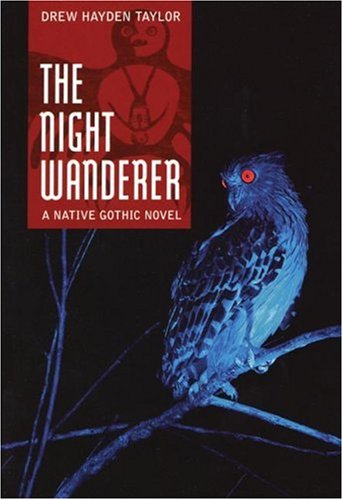
The Night Wanderer by Drew Hayden Taylor

I don’t know if you could say that writing about vampires was the thing to do over the last ten years, but the publication history sort of points in that direction. It was heralded in by Stephenie Meyer, whose Twilight Saga generated a lot of popular fiction for young adults in that area. But a writer who is recognized by a Canadian literary community, whether happily or not, followed the trend, too. Which is why Canadian author Drew Hayden Taylor’s The Night Wanderer caught my attention a few years ago, when I picked up a copy at the bookstore and read the subtitle: A Native Gothic Novel. Hayden Taylor’s novel first appeared as a play, A Contemporary Gothic Indian Vampire Story, commissioned by Young Peoples Theatre in Toronto and he wrote it into novel-form at the request of Annick Press for a 2007 publication date.

Set in the Otter Lake Reservation in Ontario, the novel revolves around sixteen-year-old Tiffany Hunter and the much older Ojibwa vampire, Pierre L’Errant. Although Tiffany lives on the Otter Lake Reservation, she also leaves in order to attend school off the reservation. Her home life has changed immeasurably since her mother left her father, and her Granny Ruth moved in to help out in the house. Tiffany’s father has taken in a lodger in the basement, the mysterious Pierre L’Errant who has just arrived from Europe. Tiffany’s answer to the changes that have taken place in her household is to stay away from home as much as possible. She goes to school, hangs out with friends, and goes out with her boyfriend Tony. Tiffany is shown not to have that much ambition, and her failing grades are constantly discussed throughout the novel. Even her Granny Ruth is disappointed in the lack of agency and interest that Tiffany conveys, particularly when she finds Tiffany’s report card: “Granny Ruth read the letter. It was Tiffany’s school progress report – the mid-semester assessment. And it was not good. Tiffany was failing practically everything in school, except art. It was a well-known fact that gym and art were the hardest to fail, but somehow Tiffany had managed to get a failing grade in her gym class.”

But as she finds out more about the mysterious lodger in the basement, and, as a result of her conversations with him, learns more about the area that she lives in and more about the history of her home, Tiffany begins to grow, develop, and mature. Hayden Taylor also creates an opportunity to discuss Aboriginal issues in Canada, and Tiffany’s boyfriend’s abuse of her taxation-free status constitutes a major plot point in the novel. And then there is that gothic thread that runs underneath, drawing the novel into darker and more ominous territory as the story progresses.

I was sold on the book before I read it, just because of Hayden Taylor’s name on the novel. I had read his Motorcycles and Sweetgrass a few years ago, a novel that sort of would rank ridiculously high above this one (it’s really good). Reading a young adult work of fiction by the same author sort of had the reverse effect of what has been happening lately in young adult literature, where literary authors are turning from writing adult books to writing books for young adults, and really exceptional books at that. Hayden Taylor’s didn’t really stand up so well. It’s a fun story and it gets in that nod at the vampire trend while making it into something sort of new, but it still felt like there were a lot more places Hayden Taylor could go, and a lot more of the gothic to mine from an Ontario setting. Still, it was nice to see a Canadian author try the young adult vampire story, and to see it happen on a reservation in Ontario, even if the novel didn't take it too much farther than that.

Friday, September 16, 2011

Abarat by Clive Barker

In anticipation of September 27, which, you know, is actually a little bit of an exciting day for fantasy publications, mostly because Terry Pratchett’s I Shall Wear Midnight is coming out in paperback and I’ve been staring at the hardcover for about a year now, wishing that it would come out in paperback because every single other Terry Pratchett book that I own is in paperback and at this point in time, it’s sort of good to keep the pattern, BUT, in anticipation of the release of Absolute Midnight, the third book in Clive Barker’s Abarat series for young adults on September 27, I’m going to talk about the very first one in that series, titled, sort of simply, Abarat.

My knowledge of Clive Barker comes from a few different encounters and sources, but he was kind of an author that I greatly underestimated the breadth of work for, because the first book that I read by him was his novel for young adults. It wasn’t until I was working at a secondhand bookstore that I started seeing a ton of his books coming through to the horror and genre paperback section and realized, “Oh wow, so Abarat. I guess that was just one of many.” Later, I read his introduction to one of the Sandman volumes by Neil Gaiman, and then I saw a movie that was adapted from one of this books, and it slowly all came together and gave me this picture of Clive Barker, a sort of, “Well, this is what he’s like. All of these pieces here, they fit together and give you a pretty good idea of his work.”

But Abarat was my first encounter and I absolutely loved it. It is a thick tome that contains Barker’s own artwork throughout, large oil painting that have been reproduced for the novel. They are grotesque and beautiful and horrifying (particularly one of Christopher Carrion, a man who surrounds himself with nightmares), and more than anything, they help bring Barker’s fantastical world to life.

Because Abarat itself is a world built from Barker’s imagination. It consists of twenty-five islands, each of which inhabits a different hour of the day (except for the twenty-fifth island, an hour unto itself). It makes for vivid settings, especially when you see the way that Barker himself conceives of each hour of the day when he begins to flesh it out into an island, its inhabitants, mood, and atmosphere. The reader encounters this new world at the same time female protagonist Candy Quakenbush does. After lighting the lamp in the lighthouse at the edge of Chickentown, her home, Candy summons the Sea of Izabella from the parallel world of Abarat and journeys there by ship. She’s given an introduction to the islands and then the book is set up for her exploration, one that she shares with readers.

Abarat was followed up by Days of Magic, Nights of War, and now, seven years after that publication, the third book is being released (Barker has mentioned before that there will be five books in the series). And it was kind of a long wait.

When that third book comes out, I’m kind of looking really forward to it. And there will definitely be a review on here. Between the writing and the images, there’s really nothing but stunning imagery throughout. And there are still a few weeks to catch up before the new one gets here.