Wednesday, November 30, 2011

Geek Love by Katherine Dunn

Most of the books that I read are relational – I’ve heard about them from another book, author, or person, and that’s why I end up reading them. The number of books that I pick up at bookstores without knowing anything about them has really decreased from when I was younger. I don’t think that is necessarily a bad thing, especially because a lot of passing along titles and encouraging readers to read certain books does come from recommendations and word of mouth and using that relational context to create a proliferation of certain books. Sometimes it happens that some book published in the 1980s is the inspiration for a book written recently. Readers who are familiar with the 1980 book will pick up the new one. Readers who read the new book might go back and dig up that 1980 publication. The second option, that’s what happened to me when I read Karen Russell’s Swamplandia (which really deserves a review of its own).  Published last spring, Swamplandia is about a family that lives in Florida, owning and operating an alligator-themed amusement park for tourists. The dysfunctionality of the situation is what makes the family (and the story) work. It’s a beautifully written novel (the alligators have “icicle overbites”) that has just been picked up for possible production by HBO (which has the book to TV show market covered right now), but in interviews, Karen Russell has noted that it was not written in isolation or without inspiration. She mentions Katherine Dunn’s Geek Love in her acknowledgements, a book that I had heard about before, but had never picked up and read until discovering the title in Russell’s novel.

Geek Love is similarly about a family whose dysfunctional situation actually provides an almost normality of experience. The novel focuses on the Binewskis, presided over by father Aloysius and mother Crystal Lil. By devising a careful combination of drugs to give to Lil during her pregnancies, the Binewskis ensure that their children are themselves able to form their own traveling family of freaks. There is the eldest, Arturo (Arty), who has flippers for limbs and must glide on his torso in order to move from place to place. Then there are Iphy and Elly, the conjoined twins in the family. The narrator, Oly, is an albino hunchback, and is continuously derided by her brother Arty because she doesn’t have anything as “special” as the rest of the siblings. Finally, baby Chick, who seems normal at first, has the most powerful oddity of them all, one that is used by their father both positively and negatively throughout the story.

The novel is structured on a series of back and forth movements across time. The reader is exposed to the day-to-day reality of Oly’s experience growing up with her family, in something that resembles a memoir-reflection. In the present day, Oly is also the focus of the story, as she describes her daily tailing of her own daughter, who is also afflicted with the same Binewskis “freakishness.” In the present Oly lives in an apartment building with her daughter, Miranda, and her mother Crystal Lil, however, neither mother nor daughter are aware that Oly lives among them (they all rent separate rooms). Neither the stay in the past or the present ever seems too much; as a reader, I never wished that the story stayed longer in either time period. It is beautifully balanced and carefully constructed.

The dysfunction characterized by the situation that the Binewskis create for their family is tempered by the strong hold that the family has on one another. Each has a job at the circus that they travel with, and each has a feeling that without one individual, the entire thing would not work. It is something that draws the reader into a small, unfamiliar world, and makes it, for a short time at least, normal, calming, and ideal. However, this is quick to fall away. Oly details the strange relationships that exist between siblings, notably, the dislike Arty seems to have for his brother and sisters, and the strange power that he wields over everyone. Oly also recalls the day that her pregnant mother took Arty, Oly, Elly, and Iphy to a grocery store, where they were shot at in the parking lot (and one of the horrors of the story, the most uncomfortable realization, is the return of this same gunman later on in the novel).

The language Dunn employs makes this novel so effective. The story is powerful enough on its own, but with a mix between the vernacular (“Spread your lips, sweet Lil,” they’d cluck, “and show us your choppers!”) to the careful description (“My mother, Lillian Hinchcliff, was a water-cool aristocrat from the fastidious side of Boston’s Beacon Hill, who had abandoned her heritage and joined the carnival to become an aerialist”). The language holds together the slowly disintegrating family for as long as it takes for the reader to make his/her way from the beginning to the end of the novel.

I couldn’t put Geek Love down. After reading it, I can see its relationship with Swamplandia and why Russell would feel so indebted to a previously published novel. However, the two books are remarkably different examinations of family and dysfunctionality, and what it takes to hold a group of people together. Both are remarkable works of fiction, and I can imagine that they will continue to influence many authors to come. 

Tuesday, November 29, 2011

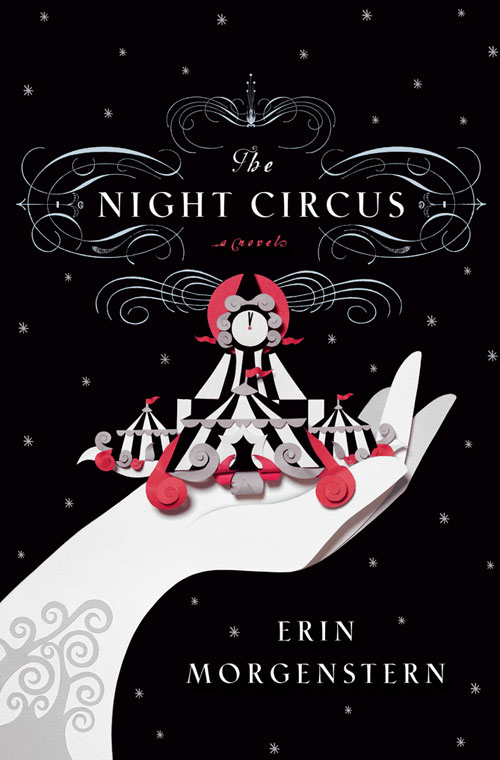
The Night Circus by Erin Morgenstern

Erin Morgenstern’s 2011 publication The Night Circus was recently optioned by a studio for film development. This is one of the first books where it seems like there isn’t going to be a huge leap made between the book and the movie, because The Night Circus already reads like a motion picture. The imagery and the description are tactile and highly imaginative. Morgenstern deftly weaves her protagonists, Celia and Marco into a moving fabric of storytelling. Bound together when they are children, Celia and Marco are forced into a competition of magical skill that seems to have neither rules nor conclusion. Their guardians train them from two separate schools of magical thought. While Marco is preoccupied with studying books and language, Celia endures her father’s more practical testing. At one point he cuts the tips of her fingers and waits for her to learn how to heal herself. As the two magicians train, a stadium is constructed for their competition. This is the Circus of Dreams, a place filled with contortionists, magicians, magical acts, and food vendors. Adhering to a strict black and white color scheme, Morgenstern’s circus comes to life through description. And when Celia and Marco are finally brought together to begin their competition, it serves as an effective backdrop to their magic.

This was one of the quickest reads I’ve encountered in a while, and I think this is because of the description and imagery that constitutes the book. There are different kinds of ways of being drawn into a story, and ways that books become categorized as “quick reads.” One is directly through the plot, when a reader almost eschews description to read for story. I think Twilight fits into this category – the description is endless and unnecessary at times, and is sometimes easily skimmed on route to continuing to read for plot. The other side of that is when description outweighs plot. There isn’t too much of one to The Night Circus. Two children (Celia and Marco) are raised by guardians who subscribe to different schools of magical thought and must compete against one another at the Circus of Dreams, a stage that has been invented for the sole purpose of allowing them to carry out their competition. However, their competitions and test of skills are subtle, distinguishable only to the two magicians. They include crafting additions to the circus, including a maze of rooms, with each new addition complementing what the other magician has done. There are no large acts of magic and miracle. These are small-scale. This doesn’t take away from the plot necessarily; it just dampens the action with its subtlety. The final test of strength between the magicians is likewise anticlimactic, and the deflation seems muted at the end of the novel. The plot meanders and pulls back in order that the description finds its place at the center of the novel. The plot is incidental to the circus itself, and Morgenstern herself seems enamored of her creation, and deservedly so: this is a place that is rich and full and magnificent. As a result, the circus itself is a character in this book, perhaps the most imposing of all, and probably the one that the reader invests the most in. The threat of the circus disappearing seems worse than one of the two protagonists not surviving to the end of the novel.

The description is the background of the book. For example, some just a cursory flip through the book again reveals these passages:

1. “Curving pathways along the perimeter lead away from the courtyard, turning into unseen mysteries dotted with twinkling lights. There are vendors traversing the crowd around you, selling refreshments and oddities, creations flavored with vanilla and honey, chocolate and cinnamon.”

2. “At midnight, the bonfire is ceremoniously lit, having spent the earlier part of the evening standing empty, appearing to be a simple sculpture of twisted iron. Twelve of the fire performers quietly enter the courtyard with small platforms that they set up along the perimeter like numbers on a clock. Precisely one minute before the hour, they each ascend their respective platforms and pull from their backs shimmering black bows and arrows. At thirty seconds before midnight, they light the tips of their arrows with small dancing yellow flames. Those in the crowd who had not noticed them previously now watch in wonder. At ten seconds before the hour, they raise their bows and aim the flaming arrows at the waiting well of curling iron. As the clock begins to chime near the gates, the first archer lets his arrow fly, soaring over the crowd and hitting its mark in a shower of sparks.”

3. “The theater is massive and ornate, with rows upon rows of plush red velvet seats. Orchestra, mezzanine, and balcony spreading out from the empty stage in a cascade of crimson. It is empty save for two people seated approximately ten rows back from the stage. Chandresh Christophe Lefevre sits with his feet propped up on the seat in front of him. Mm. Ana Padva sits on his right, pulling a watch from her bag while she stifles a yawn.”

This is why the translation of book into movie is going to be so effective. Readers will want to spend more time in that circus, and Morgenstern’s descriptions set up a fully encompassed world that seems easily moved to visual representation. However, a movie version might rectify the unity that seems to be lacking in the current version of the novel. Celia and Marco circle each other until three quarters of the way through the book, and when they are finally brought together, it is likewise anticlimactic and undeserved. What should read as a love story becomes instead a strange platonic feeling between two people who have been bound together since birth. Sure, the curtains move and the wind blows when they kiss, but the feelings behind this connection are never explored. And they should be. The love story falls flat and the characters suffer, allowing the circus to take over as character and fill the book with its setting. Reading this novel is akin to spending time in the circus, which is perhaps the most effective part of Morgenstern’s writing.

Thursday, November 24, 2011

The Imperfectionists by Tom Rachman

The setting of Canadian author Tom Rachman’s The Impressionists is an English-language newspaper based in Rome. Rachman, who grew up in an international community as he moved across continents and countries, displays this same sense of internationalism in his book. He follows a collection of characters employed by the newspaper (and one reader/subscriber), and loosely connects their stories together. At times, the novel reads as a collection of short stories, while at other points it solidifies into a novel with a clear beginning, middle, and end that transcends the individual stories, each of which is tightly encapsulated within its own beginning, middle, and end. All the way through, the history of the paper is related through short, italicized vignettes, taking the reader through its origins and ownership.

The novel starts with Lloyd Burko, an aging reporter living in Paris. His connections with his family are tenuous at best, and his attempts at staying in touch with both his son and daughter are difficult to read (particularly Lloyd’s attempt to hide his money troubles from his children while realizing that the only way he can get together with them is to take them out to lunch or meet with them to gift them with things he has purchased with them in mind). From Lloyd’s initial story, Rachman drops the reader right into the middle of Rome and the paper itself. Lloyd works as a framing mechanism, a way to preliminarily introduce the characters that readers will come to spend much more time with as the novel goes on.

For example, in the following story Arthur Gopal, the obituary writer for the paper, suffers a horrible personal trauma in his family. He receives a phone call from his wife after traveling to Geneva to interview an aging activist, and rushes back to a home irrevocably changed. This trauma has a strange effect on Arthur, one that is more carefully investigated through the stories of the other characters that follow.

And later, Hardy Benjamin, the business reporter (“My feeling is that, at heart, every story is a business story”), enters into a strange relationship with a much younger man from Ireland, and ignores any suggestions that he is leeching off of her. When he immediately moves into her apartment, Hardy is confronted with knowledgably entering into a relationship that might not be the best one for her.

My favorite story was about Abbey “Accounts Payable” Pinnola. As the novel drives towards its end, the stories start to feel less concluded. Abbey’s story is the second to last, and Oliver Ott, the descendant of the original owner of the newspaper, holds the last story in the novel. Both end strangely and uncomfortably, and move the novel into an unfamiliar territory only after the pages have ended, drawing the story out further once it’s over. Abbey’s story takes place primarily on an airplane that travels from Rome to Atlanta, Georgia, where she is going to attend an annual business meeting for the newspaper. She finds herself sitting next to Dave Belling, the man that she just arranged to have fired in order to cut costs at the paper. 

There are almost a dozen of these stories, each arranged as a chapter with a newspaper heading, such as “Kooks With Nukes” and “Europeans Are Lazy, Study Says.” I was reminded of Jennifer Egan’s A Visit from the Goon Squad, which recently won the Pulitzer for Fiction in 2011. Both novels construct a series of linked stories, whose linkages are at times subtle enough to make the stories seem almost disconnected. However, the small threads of connection tie them back into the narrative whole that make these kinds of collections so effective. Yet, Rachman doesn’t try to return the stories full circle at the end of the novel. He leaves them almost uncompleted, as if the next thread, the next new character, is going to steer the stories towards the next direction. Although Rachman describes what happens to his characters at the end, there is still an incompleteness that draws the ending past its conclusion. This was a surprise read – something picked up without knowing anything about it – and I’ve found the story staying with me still. 

Monday, November 21, 2011

The Chronicles of Harris Burdick by Chris Van Allsburg

The way I heard about The Chronicles of Harris Burdick was this: standing in the Harvard University Bookstore and seeing that Lois Lowry, Chris van Allsburg, and Roger Sutton were going to be at the Brattle Theatre talking about their new publication.

To which I responded:

“…”

And then I bought a ticket.

I was absolutely shocked that the theatre wasn’t full on the night that they spoke. Not just because of the speakers, but because of the collection that was under discussion. As a bit of background, in 1984 a book was published called The Mysteries of Harris Burdick. It was a children’s picture book, and contained a series of fourteen pictures presented without accompanying stories. Instead, each image was given a title and a single line of descriptive text. The images seem completely unrelated and without explanation, which has allowed for their use as creative writing prompts in schools because of the idea that students can come up with the “what happens next” or “what happened before” or “how did we get here.” The illustrations follow Chris Van Allsburg’s distinctive style, although an editor’s note insists that the fictional Burdick delivered them as “samples,” which helps to explain their disconnection from one another. Van Allsburg very adamantly repeated this story about the “found” illustrations at the talk, and watching an artist separate himself from his own work through use of a fictional story was really fascinating. It’s different in real life. It’s different when it doesn’t happen through an editor’s note.

This new publication, the one Lowry and Van Allsburg were there to talk about, takes the fourteen illustrations from The Mysteries of Harris Burdick and provides their possible stories. The stories tend to run around the same length (at the talk, Lois Lowry pointed out that she was one of the few authors to hit the word length on the nose), although some run longer or shorter than others. The physical book itself is a beautiful object, and is spatially the same size as a children’s picture book to keep the illustrations in tact. The short stories take their title from the title of the illustration, and most integrate the single line of text into the short story.

The contributors themselves are really the cream of the crop of authors writing for children, adolescents, and young adults. Chris Van Allsburg and Lois Lowry are joined by Sherman Alexie, M.T. Anderson, Kate DiCamillo, Cory Doctorow, Jules Feiffer, Stephen King, Tabatha King, Jon Scieszka, Louis Sachar, Linda Sue Park, Gregory Maguire, and Walter Dean Myers. The book itself is introduced by none other than Lemony Snicket, who makes the mystery of Harris Burdick believable for readers going into this new collection. Indeed, he introduces these stories without subsisting that they are the official versions. For everyone who will still use these illustrations as a jumping off point for a creative writing project, Snicket has ensured that their version may very well describe the illustration as well.

The story that stood out for me in this collection was Jules Feiffer’s “Uninvited Guests.” I almost feel like I don’t want to say that much about it, because discovering it amongst the others was my favorite moment reading this collection. I will say that the illustration that it accompanies shows a miniature door in the wall, and that Feiffer has invented a children’s author named Henry to navigate the reader through the story.

Aside from Feiffer’s, the reprint of Stephen King’s “The House on Maple Street” made for a strong end to the collection, while Sherman Alexie’s “A Strange Day in July” was another highlight. Also: M.T. Anderson’s “Just Desert.” The story ends with a personal note to the reader, one that shows Anderson breaking through the wall of reader/writer just as Allsburg broke the wall between artist/reader when he insisted that he was not the author of The Mysteries of Harris Burdick.

So. I still can’t believe that I was able to listen to Chris Van Allsburg and Lois Lowry talk for forty-five minutes about their work. And even though the talk itself strayed from the book itself (I think most of the time was spent on a discussion of e-books and Kindles), watching Van Allsburg play the part of “not-the-artist” was so fascinating that I feel lucky that I was there at all. And between Jules Feiffer and Lemony Snicket, this really isn’t a book to be missed. 

Friday, November 18, 2011

The Wednesday Wars by Gary D. Schmidt

I usually don’t think of books set in the twentieth century as historical fiction, but that’s what Gary D. Schmidt’s The Wednesday Wars is billed as. The novel returns to the 1967-1968 school year, where Holling Hoodhood finds himself alone on Wednesday afternoons with his teacher, Mrs. Baker. Holling is in the unique position of being Presbyterian in his split Catholic/Jewish town, and while the rest of his classmates leave on Wednesday afternoons to go to either Hebrew School at Temple Beth-El or to Catechism at Saint Adelbert’s.

Holling hates his time with Mrs. Baker. He is convinced that she hates him, yet is in the position of having to do everything he can to get into her good graces. His father is the owner of Hoodhood and Associates, an architectural design company that is trying to get a contract with the Baker family. Holling begins with cleaning erasers for Mrs. Baker on Wednesdays. He runs errands through the school in the afternoon and helps to clean the cages of the two classroom rats, Caliban and Sycorax. This last task does not go as planned. The rats escape and make frequent appearances in the rest of the novel.

However, at one point in their Wednesdays together, Mrs. Baker decides to introduce Holling to Shakespeare. She assigns him the Tempest, which he is actually pleasantly surprised by. Holling is taken by Caliban’s curses. He recognizes the rhythm of them and finds that he memorizes them easily. The Tempest is followed by Romeo and Juliet, Macbeth, Hamlet, and Much Ado About Nothing. Holling interacts with these stories and finds that his own life starts to reflect their stories. He ends up going out for a date with a girl in his class while he’s reading Romeo and Juliet, and uses their experience together as a way to understand what the play was about.

I was a little bit disappointed in this novel. I had heard about it a few years ago. I actually think it was an Amazon recommended novel based on some book that I bought at the time, which was probably a Newberry winner because Schmidt’s novel was a Newberry Honor book in 2008. What begins as a book about a young boy who seems to go through a series of humorous events turns into that series of humorous events. As strong of a character Holling seems like, it’s as if Schmidt’s goal of being funny takes over at times and throws the reader through a hurtling series of “this-can’t-possibly-get-any-worse.” For example, Holling is cast as the fairy Ariel in The Tempest. First he learns that he has to wear a pair of yellow tights “with white feathers attached you can guess where.” He tries to keep his participation in the play a secret from his classmates, only to have his teacher invite them all to see him. Soon Holling learns that the night of the play conflicts with the arrival of baseball player Mickey Mantle, who is coming to visit and is willing to sign baseballs. If the lead up is not enough, the actual series of events that take Holling from the play to where he needs to go to meet Mickey Mantle becomes one unfortunate event after the other. I found myself skimming through the last hundred pages or so, because it started to read like a book outline, these small events that had to be overcome in order to get the reader to the end.

Where the novel succeeds is in the interactions between Holling and his sister, and Holling and Mrs. Baker. Interestingly, throughout the novel Holling changes his opinion of how he feels about both of them. His sister – a flower child who runs away with her boyfriend Chit – is initially an annoyance to Holling (even though their exchanges at this time are a highlight of the novel). Mrs. Baker is slightly different. Holling’s belief that she hates him is never really realized. Instead, the reader can see the way that she helps Holling come to understand who he is and what he might be capable of. Nonetheless, Holling arrives at this conclusion at the end, that Mrs. Baker has had his best interests in mind throughout the novel. These two transformations take the novel out of its series of humorous events and make it about something meaningful.

I’m not sure if I would recommend The Wednesday Wars. It seems that there are so many other adolescent and young adult novels that use humor much more effectively, as a way to affect emotion in important and dynamic characters. Spud by Jon van de Ruit is one of these, as is Harris and Me by Gary Pullman. But I did like to spend some time in Holling’s world, and to return to a slightly less contemporary time period to do so.