Monday, January 30, 2012

Lost & Found by Shaun Tan

The first time I heard about Shaun Tan was recently, when I was browsing through the graphic novels section at the bookstore. His new publication, The Arrival, was on display, and in the way that new books do, it lead me backwards to some of Tan’s previous publications. Lost and Found by Shaun Tan is an omnibus that contains The Red Tree, The Lost Thing, and The Rabbits. The book reads like a mix between a children’s book, a graphic novel, and a picture book.

The first story, The Red Tree, was my favorite, and it sort of hit me like a ton of bricks reading it for the first time. It’s a simple story, with only a handful of words on each page (the other two stories have much more narration), and the illustrations are done in a variety of styles of art, a few of which really reminded me of Dave McKean. The Red Tree describes an ordinary day, where a girl is waiting for a change to happen in her life. One illustration is of the girl drawing tallies on the back of giant snail shell, a snail that is in turn almost miniscule against the background, and it drips with the difficulty of waiting for time to pass to a place where a change can happen. Tan writes, “Sometimes you wait and wait and wait and wait and wait and wait and wait but nothing ever happens. Then all your troubles come at once. Wonderful things are passing you by. Terrible fates are inevitable.” The short story carries a weight with it, realistic and familiar, that is resolved in a simple, subtle, and beautiful way.

The second story, The Lost Thing, follows a narrator who begins, “So you want to hear a story?” which seems to express the weight of his experience that drives him to pass on his story. The story starts on a nondescript day, when the narrator finds “The Lost Thing,” with “a sad, lost sort of look. Nobody else seemed to notice it was there. Too busy doing beach stuff, I guess.” Tan’s illustrations in this story are beautiful and detailed, and his imagination devises a creature that seems to incorporate elements of a robot, an octopus, and a boiler, and is bright red in color. Unable to find its owner, the narrator follows instructions from another creature to find the place where lost things go. He leaves the thing in a place that is filled with others like it, but the narrator seems unsure that his Lost Thing really belongs there. Still, he leaves it there and goes on with his life, collecting bottle caps in a futuristic world where people seem indifferent to those lost things, the things that do not belong in their world. The Lost Thing was adapted into an animated film, and won an Oscar for Best Animated Short in 2011.

Finally, The Rabbits is written by John Marsden (the prolific Australian writer) and illustrated by Tan. It is a postcolonial tale, and, as Tan explains, “The Rabbits is a story of universe colliding: one culture driven by powerful technology that transcends nature (much like our own), and another whose spirit is embedded in an ancient ecology.” The words are supported and taken to a new level with Tan’s illustrations, and it rounds out this collection of three strong, powerful stories.

Saturday, January 21, 2012

Beauty Queens by Libba Bray

I think that sometimes it happens when you re-read a book or watch a movie that you’ve loved for so long, but you’ve maybe never exactly pin-pointed why, and realize that it has totally informed a lot of your political and social perspective. When I graduated with a Women’s Studies minor I was spending basically the first time relaxing after a lot of school, and was watching movies on cable TV. And I saw this one, All I Wanna Do (um, with Kristen Dunst, actually), that I had loved since I was in middle school, and after watching it I thought, “Oh. Women’s Studies minor. That makes sense.” Another one of those was Tamora Pierce’s Alanna series: “Women’s Studies. Feminism. Check, and check.” Although the movie and the book were both fiction, at their heart they passed on strong female characters and ideas.

It’s a really nice middle point whenever pop culture – literature, movies, music – actually does connect with feminism, because it’s sooooooo unfortunately rare. And it forms this sort of instant recognition and almost validation, through the real world that you get right out of its fictional one.

So. Libba Bray’s Beauty Queens. The only reason it took me as long as it did to pick this one up was because it’s still in hardcover. Luckily, I got it for Christmas this year (thanks, Mom!) and I seriously devoured it from last night until late last night.

The premise of Beauty Queens, from Bray’s acknowledgments, “A plane full of Beauty Queens crashes on a deserted island. And….GO!” The parallel to Lord of the Flies is immediately apparent, especially with the background that there is a war going on (Lord of the Flies was set against the background of WWII). But the idea of what happens when you do introduce female characters to a situation like Lord of the Flies, that traditionally male-centric story, is what makes this novel so engaging. As the characters put it themselves:

“I’ve been thinking about that book about the boys who crash on the island,” Mary Lou said to Adina one afternoon as they rested on their elbows taking bites from the same papaya.
Lord of the Flies. What about it?”
“You know how you said it wasn’t a true measure of humanity because there were no girls and you wondered how it would be different if there had been girls?”
“Yeah?”
Mary Lou wiped fruit juice from her mouth with the back of her hand. “Maybe girls need an island to find themselves. Maybe they need a place where no one’s watching them so they can be who they really are.”

Still, the parallel to Lord of the Flies is hardly even a jumping-off point for this book. What Bray creates is entirely her own, something – like Going Bovine – that has the ability to break through generic boundaries. Bray returns to the same criticism of pop culture that made Going Bovine so great, but she takes it to the next level. Here, reality television shows have gone out of control, The Corporation is in control of everything, and a narrow beauty standard has been clearly defined, and Bray’s biting criticism of these topics (and more) is paired with humor. This novel includes the cast of Captains Bodacious IV: Badder and More Bodaciouser!, a teen pop sensation called Boyz Will B Boyz (whose single “Safe Tween Crush” includes the lyrics, “Wanna rock you girl, with a butterfly tunic. / No, I’m not gay, I’m just your emo eunuch. /), and “commercial breaks” from the story that include commercials for beauty products, television shows, and movies (such as WEDDING DAY 3: THIRD TIME’S THE CHARM:

CHARLIE
(tearful)
What if Mr. Wrong is the best I’m going to get?

GRANDMA
(patting her hand)
Love means making sacrifices. I know these things. I’m old.)

And under all of these layers – great story, parallel to a canonical novel, political, social, and pop culture critique, and relatable, real, incredible characters – is a focus on feminism and what it’s like to grow up as a teenage girl in contemporary culture. Sometimes these are in-depth, and other times they are off the cusp, such as when Petra explains,

“I sewed a banner to catch the attention of planes. You can’t see it now because they took it down.”
Adina turned to the camera with an amused-but-confused expression. “Why?”
“It had the word bitches in it, which is perfectly fine to use if you’re a rapper or a director making a movie about career women, but not if you’re a teen girl talking about her homies.”

This is already the longest review I’ve written, and I feel like I haven’t even begun to get at what this book is! Out of all of the reviews so far, this is the first that gets an all capslocks, “PLEASE READ BEAUTY QUEENS BY LIBBA BRAY. IT IS REALLY THE BEST THING EVER.”

I can just imagine how engaging it would be to read a book like this in high school, either instead of Lord of the Flies or alongside it. Canonical books like Lord of the Flies are still taught (my sixteen-year-old sister just did it this past semester in high school), but more contemporary novels like Beauty Queens still aren’t really across the board – they’re left out of curriculum to teach novels written sixty years ago. It’s important also that those novels are still circulated in schools, but Beauty Queens is that new kind of version of canonical novel, like so many other new young adult novels. It seems like a missed opportunity to stay with just Lord of the Flies (which, you know, doesn’t have a single female character), or other such canonical novels, when something like Beauty Queens has something for every student, female or male.

I absolutely loved this book. It’s really the first novel I’ve ever read that I’m anxious to actually start reading again, right from the beginning, and the ability for Bray to be able to tell a great story while also letting me do the whole, “wow, these are really the things I believe in,” is just incredible. 

Wednesday, January 18, 2012

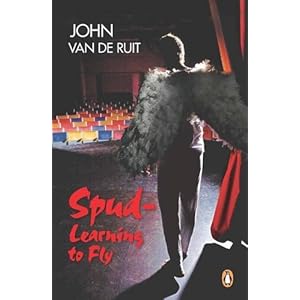
Spud: Learning to Fly by John van de Ruit

Spud: Learning to Fly is the third novel in John van de Ruit’s series about sixteen-year-old Spud Milton, detailing the time that he attends school in South Africa in the 1990s. This series of books is one of my favorites, and it is really similar to Louise Rennison’s Angus, Thongs, and Full-Frontal Snogging, but maybe directed at a more male adolescent audience instead of Rennison’s female one. Both use a journalistic style to document life at school, home, and in between, and the authors’ humor is probably the most notable and remarked on aspect of both series. Rennison’s series spans ten novels, and van de Ruit’s is at three, but promises four, and they’re an interesting complement to one another.

The newest novel sees Spud continuing in his artistic endeavors, finally sharing with his family and friends his ambitions to be an actor. The highlight of one of the previous novels was probably the narration of Oliver! the play put on at Spud’s school. Spud manages to play the titular character and the event is one of the funniest, and enlightening for Spud (in another production at the school, Spud’s friend and dorm-mate, Fatty, is cast as an anchor). However, alongside the humor is the political and cultural reality of South Africa in the 1990s, and Spud particularly notes apartheid, Nelson Mandela, and national referendums. This South Africa setting for a young adult novel is incredibly effective.

In these novels the boys don’t go by their real names (actually, when they are called on by their real names by some teachers or parents or in official school news, they are rendered almost unrecognizable to a reader who has come to know the characters as Rain Man, Fatty, Rambo, Meg Ryan’s Son, Plump Graham, and Mad Dog, and the teachers as The Glock, The Guv, and Viking). When a new member joins Spud’s house, he is nicknamed “Stutterheim” because of his obvious stutter. Spud remarks:

“Why do parents think they can just send a boy with obvious problems to a school like this? What do they expect – that he’s going to thrive? Mind you, nobody ever gave Vern much of a chance at survival, and he’s made the school play and is now whispered in some quarters as a potential prefect!”

The highlight of this newest novel is a staging of A Midsummer Night’s Dream (and, interestingly, Rennison’s novels also highlight the staging of plays such as Romeo and Juliet and Macbeth). The cast from Spud’s all-boy school travels to Wrexham, an all-girls school that supplies the female members of the cast. Spud, the cast, and two teacher chaperones, stay for several weeks and are guided around the campus by two thirteen-year olds, Penny and Brenda. Spud’s English teacher, The Guv, seems to fare the worst from the temporary relocation as Spud notes, “We came across The Guv who was stalking around in a tweed suit and looking disturbed. He admitted to being completely lost and very near suicide.”

This book continues in the same vein of the previous two, and takes the reader further into Spud’s life at school and at home (where his psychotic dog Blacky is consistently terrorized by his father). Spud: Learning to Fly is hilarious while also keeping Spud’s journey through adolescence at its center, and I’m glad there’s still one more novel on the way to keep his story going.

Saturday, January 14, 2012

Hole in My Life by Jack Gantos

When I was in middle school, our class read Jack Gantos’ Joey Pigza series. They’re about Joey Pigza, a boy with ADHD, and the books are funny while also having the ability to say something about an event or a moment or a feeling in a way that feels like it hasn’t been done before. I was reminded of these books in 2011, when I went to a screening of a documentary Library of the Early Mind, a movie that is comprised of interviews with children’s book authors. Jack Gantos really stole the movie (although he had stiff competition from Daniel Handler!) when he talked about the circuitous route that led him to writing books for children, much of which is replicated in his memoir Hole in My Life, that follows through his stay in prison as a young man and the events that brought him there. The novel was also a Prinz Honor Book, and versions of the novel include Gantos’ mug shot and a note, “The prisoner in the photograph is me. The ID number is mine. The photo was taken in 1972 at the medium-security Federal Correctional Institution in Ashland, Kentucky. I was twenty-one years old and had been locked up for a year already – the bleakest year of my life – and I had more time ahead of me.”

Gantos’ narrative moves back and forth through time, beginning with the above sentence before removing the narrative to Gantos’ junior and senior years of high school, where he bounced between living in different places including with his family, family friends, and in a motel room that he rented on his own. He started doing drugs and drinking in his newfound independence, but most of all, this time includes Gantos reflecting on the books that he was reading at the time, the way that they made him feel, and how they affected his experience. During this time, he was writing down ideas: “book ideas came to me in full-color flashes, like bits of a film remembered, or a forgotten conversation suddenly pulsing to life. These were the great notions of sprawling novels that jolted me awake in the middle of the night or sneaked up on me as I drove my car so that I’d scrawl them on the white vinyl of the front seat next to my leg.”

The transition from idea to story came when he moved to St. Croix in the Virgin Islands. There, Gantos was recruited by a man named Rik to captain a small boat to an island, dig up two thousand pounds of hash, and get the boat to New York City for a ten thousand dollars cash compensation. Hearing Gantos speak candidly about this in Library of the Early Mind rivals the narrative telling of it. Gantos enters the adventure in the way that he recognizes a character entering a story:

“It was not lost on me that so many writers had gone to sea, and for them, setting off to cross the water was the same as setting down to fill the pages with their adventures. Before leaving I had gone to a used bookstore and selected every title I could find which had something to do with the sea. I had Billy Budd, Martin Eden, Treasure Island, Heart of Darkness, The Odyssey, Robinson Crusoe, and the Mutiny on the Bounty trilogy. I was armed with books the way the navy goes to sea armed to the teeth. I figured these books would have to live with me as cabin companions since Hamilton was so snappish. But I didn’t mind. I wanted to write while sailing, and I was more than willing to come under the spell of books.”

Hamilton, Gantos’ traveling companion, seems a man best avoided, yet Gantos has to live on a small boat with him for the weeks that it takes to get to New York. And when they arrive in New York, things fall apart, the two men are caught, and Gantos finds himself carted off to prison.

It is here that he begins to write, between the lines on the pages of a prison library book. Lucky to get a job in the prison as an X-ray technician, Gantos is able to move out of the normal prison which kept him out of the trouble that caused the injuries he saw in the prison hospital. All throughout the novel Gantos tries to insert himself into a story that will give him something to write about, but, once in prison, he understands that the material was there all along.

If anything, this novel is a reminder of the importance of story, both Gantos’ personal story and the narratives and potential for stories that came out of it. From the canonical and contemporary novels that are referenced throughout the novel, and Gantos’ reading of them, to his own writing that takes place, to his emulation and replication of the characters in the books that he reads, stories are inset within stories throughout Hole in My Life. Gantos shows himself to be an expert storyteller, finding narrative in all things. 

Thursday, January 12, 2012

Why We Broke Up by Daniel Handler


One of the funniest interviews I’ve ever heard is with Daniel Handler on CBC’s radio show Q. I think he was there to talk a little bit about his children’s picture 13 Words with Maira Kalman, his musical involvement with the Magnetic Fields, and a little bit about The Series of Unfortunate Events that he wrote under the pseudonym Lemony Snicket. But mostly the interview was just Daniel Handler making hilarious comments about pop culture and recent news. It was a great interview, and in it he also happened to mention Why We Broke Up, a young adult novel that he wrote and Maira Kalman (of The Principles of Uncertainty) illustrated, which just came out a few weeks ago.

Why We Broke Up tells the story of just why, exactly, Min Green broke up with Ed Slaterton. The reasons why are woven in with Kalman’s illustrations, her representations of the objects Min leaves in a box and drops off at Ed’s house, each of which helps to tell the story that Handler writes. Some of these illustrations include a ticket stub to an old-fashioned movie, a protractor, and two bottle caps.

Min narrates the story of her relationship with Ed, a second-person narration where Ed, the recipient of this letter/novel, is present. Her narration is poignant and conversational:

“You didn’t know I never go to my locker until after first. You never really learned my schedule, Ed. It is a mystery, Ed, how you never knew how to find me but always found me anyway, because our paths tug-of-warred away from each other for the whole loud and tedious stretch of school, the mornings with me hanging out with Al and usually Jordan and Lauren on the right-side benches while you shot warm-up hoops on the back courts with your backpack waiting with the others and skateboards and sweatshirts in a bored heap, not a single class in common, your Early Lunch trash-dunking your apple core like it’s part of the same game, my Late Lunch on the weird corner of the lawn, hemmed in by the preppies and the hippies bickering over the airwaves with competing sound tracks except on hot days, when they truce it with reggae.”

This book is filled with large moments and small ones, all of those that are deemed necessary by Min to tell the story of a high school relationship. The pairing of words and illustrations makes the story tactile and meaningful, and brings another dimension into the end of a relationship. The circular story – Min dropping off a box on Ed’s front steps and proclaiming their relationship over, to the beginning, middle, and eventual end of the relationship, where the novel starts – works perfectly, and Min Green’s voice will stay in your head a long time after finishing this novel.