Sunday, May 6, 2012

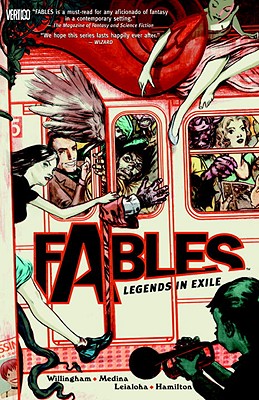
Fables: Legends in Exile by Bill Willingham


Since I finished reading Neil Gaiman’s Sandman a few years ago, I’ve been trying to find another series to start, one that has a lot of reading to catch up on. I started Fables today and think that I’ve finally found that.

Fables: Legends in Exile introduces Fabletown, a community of fairy tale people and creatures that live among New Yorkers. After being run out of their homelands by the Adversary, who may have been “a mere woodland sprite, while others claim he was once a god – thrown down from the vast heavens when his corruptions had become too great for his lofty brethren to tolerate,” they came to the New World and made a home in New York (and a prose story penned by Bill Willingham called “A Wolf in the Fold” at the end shows how they made the transition). There’s a vein of The Lord of the Rings and Sauron in the depiction of the Adversary, and a throwback (I think!) to C.S. Lewis and Narnia in the history of their immigration to New York (which also is a lot like Gaiman’s American Gods, which is all about immigration and the stories we bring with us from one country to another).

Legends in Exile opens up in present day New York, when the murder of Rose Red is all anyone can talk about. Her apartment has been found trashed and bloodstained, and it’s up to detective Bigby Wolf to figure out what happened. Rose Red is the sister of Snow White – Snow White acts as deputy to the Mayor, but really it’s her who pulls the strings in Fabletown. She teams up with Bigby to track the murderer down, confronting suspects like Rose Red’s boyfriend Jack (of the beanstalk) and ex-fiancĂ© Bluebeard (from the stories that show him as a demon/man who murders his wives on their wedding night), under pressure from the Mayor to solve the murder before the annual Day of Remembrance.

Fairy tales exist to be re-written and revised, and are sort of entering into a ton of new variations recently. Once Upon a Time and Grimm are hour-long TV shows that were picked up for full seasons in 2011-2012, and two adaptations of Snow White are out this year. But there is something about the comics genre that retains the seditious edge to fairy tales, the undercurrent of “something is not right” that runs through the traditional stories, especially those collected by the Brothers Grimm. The gritty New York scene twists this revision even further in the direction of its roots, and the mystery/detective theme of this first volume highlights the violence implicit in those original stories.

Also, the cover art for Fables is sort of incredible, which is why there have been published collections of the covers for sale in addition to the story itself. James Jean did most of the cover work for Fables, and waiting for a new one is almost like waiting for a new Dave McKean cover for Sandman, where they seem to say as much about the story as the writing/illustrations in the issues do. I didn’t really start reading comics/graphic novels until university, when I needed a big-time break from straight prose, and now I sort of lean towards them more than traditional books. Not always, but if I’m looking for a really good story with excellent writing and images and illustration that do more than support, but write a story of their own, I head to that section of the bookstore. Fables is up to 121 issues, and it’s something new to dive into during the summer. I’m going to try to keep track of them on here – or at least as far as I can get in the next few months.

I’m hoping to have a few exciting reading projects up this summer, so…stay tuned!

Sunday, April 29, 2012

Along for the Ride by Sarah Dessen


Auden doesn’t sleep at night. She’s been an insomniac since before her parents separated, when she used to listen to them fighting in the room across the hall. There’s a 24-hour diner near her house that she spends the late night to early morning at, reading textbooks and catching up on homework. Homework is really all Auden knows. She uses it like a bubble to keep her separated from all of the things that other people her age are doing, the ones that she doesn’t know how to break into. But when her brother Hollis sends her a tacky picture frame (framing a picture of himself) from Europe, where he’s been backpacking for nearly two years, something changes. Auden reads the caption at the bottom – “THE BEST OF TIMES” – and decides to spend the summer living with her dad, his new wife Heidi, and their newborn, Thisbe, at a beach town called Colby for the summer.

Auden doesn’t know what she was expecting, but it isn’t Heidi looking different from her usual, put-together self sinking into postpartum depression, or her absent dad who’s already distancing himself from his new daughter by immersing himself in writing a new book. At night Auden listens to the wave machine Heidi uses to put Thisbe to sleep and notes, “So I was there, in a beachfront house, listening to a fake ocean, and this just seemed to sum up everything that was wrong with the situation from start to finish.”

She starts working for Heidi’s boutique and finds herself right in the middle of a normal, teenage summer that she’s always avoided. A really great sidebar of the plot is a focus on biking – Colby’s bike shop is a main geographical locations highlighted by the novel. And it’s through biking that Auden meets Eli, almost twenty, who used to bike competitively with his best friend Abe. Eli encourages Auden to set out on a quest to reclaim the childhood that she never had since she was pushed right into schoolwork and academics by her professor parents. Following Eli and Auden through these events is so much fun, but underlain by the fact that their quest happens only at night, since both have trouble sleeping. While Auden is still dealing with her parents’ divorce, Eli is dealing with Abe’s death. They form a friendship more than a relationship at first, focusing on keeping one another company during the long hours that they usually spend alone.

The question at the center of the novel is whether people can really change, or if they’re stuck in the rigid, inflexible boxes that they make for themselves. Auden’s interested in the patterns in her family, and is unaware that she follows the same ones, trapping herself in the academic, alienated loop that her mother and father live day to day. She watches her dad slide into the same flawed relationship he had with her mom, and notes,

“If he’d kept himself apart from the rest of the world, these things would have been just quirky annoyances, nothing more. But that was just the thing. He did involve other people. He reached out, drew them close. He made children with them, who then also could not separate themselves, whether they were babies or almost adults. You couldn’t just pick and choose at will when someone depended on you, or loved you.”

Auden doesn’t realize that she’s already trapped in a pattern, and even though Eli tries to show her that she can step outside of that particular way of living at any time she wants to just by changing a few things about herself, it isn’t as simple as choosing to change.

There are so many times that you want to cheer Auden on for showing that it is possible to step out of your comfort zone and change. Because the question about people changing doesn’t just apply to her father – whether he can stay in his new marriage with Heidi and Thisbe – but it applies to herself, too. Auden’s preoccupation with change seems like it’s externally motivated, but looking for evidence of change in other people seems to convince her that it’s possible for her to change also. And the cheering comes with a lot of setbacks and stepping backwards, but Auden was one of the first protagonists in a while where she genuinely surprised me as a reader by some of her actions. Hooking up with Jake, a guy she doesn’t even know when she moves to Colby. Showing up at the bike park without knowing anybody. Standing up for herself at a house party thrown by Eli’s ex-girlfriend. Auden is actually a surprising protagonist, which is something about Sarah Dessen’s novels that makes them work so well. Her protagonists are real, surprising, and flawed.

Even the cast of supporting characters are round and dynamic, flawed and interesting. Maggie was my favorite, filled with a lot of surprises of her own, and throwaway lines like this one that made me snort-laugh every once and a while: “I was in the bathroom. The walls are so thin there! I sometimes can’t even pee if anyone’s in the kitchen.”

My sister has every single Sarah Dessen book, and when I’m looking for something really fun to read, with a good story, and strong characters, I always ask to borrow one. Her books are basically a genre of their own. 

Wednesday, April 25, 2012

The Story of Us by Deb Caletti


Cricket and her family are staying at Bluff House on Bishop Rock for a weeklong wedding. It’s one the west coast, not far from Seattle, and Cricket says, “Well, if there was actually going to be a wedding, Bluff House on Bishop Rock was a beautiful place for one. Set up on the edge of the cliff, the house was all white, with three levels of wraparound decks, and a rambling boardwalk leading to the beach.” The wedding that will hopefully happen is between Cricket’s mom and a man named Dan Jax, but Cricket’s mom has a tendency to leave her husbands-to-be at the Sea-Tac Airport at the last minute to avoid getting married altogether. Her mom’s complicated relationship with relationships has affected Cricket, too, as she describes the different men that her mom has lived with, the blending of separate families, the arrival of stepsiblings, and a whole lot of complication.

There are several threads of story in the book, all of which intersect in order to tell the story of Cricket’s family, and Cricket’s sort-of-ex-boyfriend who she emails regularly from Bishop Rock.  On a self-imposed break, her relationship with Janssen, her brother Ben’s best friend, is on hold. Even though he has been a part of Cricket’s life and family for almost ten years – since they moved into the house down the road from his – his absence at the wedding is necessary while Cricket sorts out her feelings. Her regular emails to Janssen tell “The Story of Us”; she details how they met, how they fell in love, and where things fell apart. Cricket’s difficult relationship with her father is revealed through these emails, since Janssen was present for one very important and frightening visit from Cricket’s father that he stepped in the middle of. Cricket explains,

“I love my father, but it’s a complicated love. He can be great, really great, and then he’s suddenly a storm slowly building, a storm that finally tosses lawn furniture and garbage cans, knocks trees down onto roofs. Dan was a regular, calm sky. You kept looking up there, and, yeah, it was still blue and still blue.”

But her father is not the only man that her mom has lived with, and Cricket spends a good deal of time talking about the changes that came with her mother’s relationships, including gaining a stepsister and stepbrother:

“Blending was a great idea, yeah, but Olivia and Scotty didn’t care about school and ate junk food for breakfast, and on the weekends they’d stay in their pajamas in front of the TV until the day got dark again. We did care about school; we ate Cheerios, not Skittles, in the morning; and on the weekends we’d go to a baseball game of Ben’s and come home only to find them in the same place as when we’d left. You can use whatever words you want, but I knew they weren’t my brother and sister.”

Now, with Dan Jax in the picture, Ben and Cricket are about to gain two new stepsiblings, eighteen-year-old Hailey and fifteen-year-old Amy, who are both fairly opposed to their father’s second marriage. As family collects and gathers at Bishop Rock, tension is pulled in with it, and Cricket just holds on to hope that her mom and Dan can make it through the week. All of the family members allow Caletti to really play with character, and you’ll find some of the most dynamic, funny, nuanced, sympathetic, and incredibly dislikeable characters in The Story of Us. There are exchanges and dialogue that really should not be missed, and small observations that Caletti sneaks in when you’re not expecting them. Two of my favorite:

“Have you ever accidentally put your slippers on the wrong feet? Your feet know in a second without looking that there’s been a mistake.”

“We’d take our shoes off, and you’d tell me my toes looked like a row of old men standing together. Old men, waiting at a bus stop.”

Underlying all of this is a thread that follows Jupiter, Cricket’s dog, as Cricket, Ben, and their mom remember different points of Jupiter’s life that have impacted their own. Cricket talks about small, meaningful moments that explain so much about having a dog as part of a family. While Ben and Cricket used to pack up their weekend bags to visit their dad, Cricket would hear her mom talking to Jupiter: “‘What are we going to do this weekend, huh, girl?’ Mom would ask her as we packed our bags. ‘Slumber party, you and me?’” Jupiter is along for the wedding, trying to get along with Cruiser, Dan’s dog, and Jupiter’s presence means an excuse for Cricket to get out of the house and take her for a walk when things get too stressful.

Caletti’s books usually focus on teenagers right at the cusp of adulthood: about to leave home, family, and familiarity. Her protagonists seem to fall between seventeen and eighteen; Cricket is eighteen in this book, but her brother and Janssen are twenty, raising the character age slightly past where it usually sits in her books. Leaving home and moving away is important to all of the characters here. Caletti’s The Nature of Jade ended by talking about how it was possible to balance family and going away, but the pull of staying is even more present in The Story of Us, especially when Cricket and Ash talk one night:

“You know what happened to me? You spend the last years of high school dying to get away, right? But somewhere in there it hits you. It gets real.”
“I know,” I said.
“The, what, pieces of you that you’re leaving.”
I stared at him. That was it exactly. Exactly. No one hat put it that simply before. That rightly. I nodded.
“Don’t tell anyone I said that,” Ash said.
“Don’t tell anyone I said that,” I said.
“For some reason no one says these things. You’re not supposed to talk about that part. Why is that? It’s wrong to love your family? The place you live? It’s your home. It’s all who you are.”

The Story of Us is another beautifully written book by Caletti that gets relationships, families, and the pieces that make them up so right. 

Tuesday, April 24, 2012

Paper Towns by John Green


Quentin has been in love with Margo Roth Spiegelman since their parents moved next door to one another in Central Florida.* Quentin’s narrative begins by remembering Margo from when she was nine-years-old, when “she wore white shorts and a pink T-shirt that featured a green dragon breathing a fire of orange glitter. It is difficult to explain how awesome I found this T-shirt at the time.” Margo wore the dragon t-shirt on the morning that she and Quentin found a dead body in their neighborhood. After asking around, Margo finds out that the man that they found out was thirty-six-year-old Robert Joyner, and that he committed suicide because of an impending divorce. Even though Quentin tries to explain, “Lots of people get divorces and don’t kill themselves,” Margo sees it differently, and she tells Quentin, “Maybe all the strings inside him broke.” The first few pages of the book, and their varying views on death and suicide, explain a lot about Quentin and Margo, and why they don’t speak throughout almost all of high school. They don’t reconnect until one random night a few weeks before graduation when Margo climbs through Quentin’s bedroom window and asks for a favor.

Quentin agrees to go with Margo, “borrowing” his mom’s minivan to drive through Central Orlando, following Margo’s step-by-step plan that begins at a Publix grocery store:

“Now, I’m not sure what you’re supposed to say to the checkout woman at twelve-thirty in the morning when you put thirteen pounds of catfish, Veet, the fat-daddy-size tub of Vaseline, a six-pack of Mountain Dew, a can of blue spray paint, and a dozen tulips on the conveyor belt. But here’s what I said: ‘This isn’t so weird as it looks.’”

After their night together, Quentin believes that things have changed: he’s going to go to school, Margo’s going to come back into his life, and they won’t go back to ignoring each other again. Instead, Margo disappears. And even though she’s run away before, Quentin knows that this time seems different, and more final.

But a detective who has been involved with Margo’s disappearances before tells Quentin that she leaves clues behind that would guide her parents to where she’s run to; they just usually can’t decipher them. For example, she left the letters “M-I-S-S-“ in her alphabet soup before she disappeared to Mississippi. Quentin is determined to find her, and believes Margo has left a series of intricate clues that are for him, starting with a Woody Guthrie poster taped to the window facing Quentin’s bedroom.

Forming the background of Quentin’s self-imposed mystery is the end of high school, prom, and graduation. Balancing the frantic can’t-turn-back of both of these events – Margo’s disappearance and the nearing end of high school – isn’t that difficult for Quentin, who, already, is not really a fan of everything that comes with graduation. He explains, “It was a well-known fact that I was opposed to prom. Absolutely nothing about any of it appealed to me – not slow dancing, not fast dancing, not the dresses, and definitely not the rented tuxedo. Renting a tuxedo seemed to me an excellent way to contract some hideous disease from its previous tenant, and I did not aspire to become the world’s only virgin with pubic lice.”

Finding Margo becomes more important than all of that, even though his friends, Radar and Ben, eventually get swept up into the occasion. And some of the exchanges between Quentin, Radar, and Ben definitely highlight the humorous side of Green’s writing, that are so worth it to find scattered throughout the novel.

Still, even with the dueling events at the heart of the novel, Paper Towns looks at the way that people can become abstracted, fictionalized ideas of who they really are. It’s similar in this way to Green’s Looking For Alaska, as in both novels Green’s male protagonists become fascinated by a larger-than-life female character, too big to pin down, to date, or to really know. In Paper Towns Margo gets turned into an idea, and even though Quentin thinks that he is deconstructing his idea of her as he follows Margo’s clues, he is really just searching to create new ideas and new Margos that are more tactile than the one he couldn’t know. John Green’s nuanced, pop-culture heavy, philosophical writing, makes all of his books so worth reading. He uses Walt Whitman’s “Song of Myself” as a poetic and philosophical guide for Quentin, and it also becomes a text that holds clues to Margo’s disappearance. All of the separate threads of Paper Towns culminate in beautiful writing, particularly at the end where Green writes,

“Maybe it’s more like you said before, all of us being cracked open. Like, each of us starts out as a watertight vessel. And these things happen – these people leave us, or don’t love us, or don’t get us, or we don’t get them, and we lose and fail and hurt one another. And the vessel starts to crack open in places.”

* The geography is one of the reasons that I loved this book. In the acknowledgments of Paper Towns, John Green thanks his parents and adds, “I never thought I would say this, but: thank you for raising me in Florida.” I graduated from high school in Florida right in the geography where Green’s novel is set, and sometimes for me reading a book where I know the place well enough to recognize neighborhoods and streets when they are named in books makes me want to keep reading even more. 

Monday, April 16, 2012

Tesseracts Fifteen: A Case of Quite Curious Tales edited by Julie Czerneda and Susan MacGregor

Tesseracts Fifteen: A Case of Quite Curious Tales, the fifteenth anthology in the Tesseracts series highlighting Canadian science fiction and fantasy, focuses on YA as an organizing factor for twenty-seven short stories and poems. Interestingly, the collection begins with a defense of young adult literature, of showing the importance of housing fantastical content in a “younger” category. But the editors discuss that YA literature doesn’t necessarily mean a younger audience: it means complex writing, careful and believable character development, with a touch of the curiosity of fantasy. As Susan MacGregor, a co-editor of the collection notes, “Excellent writing is excellent writing, in no matter what genre it finds itself.” Young adult literature opens up the category of fantasy, and creating an anthology of “crossover literature” generates a larger audience of adolescents, young adults, and adults within the fantasy genre, furthering the reach of the Tesseracts collections.

The range of form, style, and content in this anthology covers first person, third person, poetry, journal entries, historical, futuristic, and present timelines. And each story contains a teenage/adolescent protagonist, creating a range of topics and situations for characters to work with that exist outside of the adult fantasy genre, even if many of the tropes and archetypes might remain the same.

E.L. Chen’s “A Safety of Crowds” begins the collection, a look at celebrity, social networking, and identity. Chen uses Jenna Crow as the figure to explain the hyper-connection available through technology, where,

“That night, a young man will raise his phone to identify the cute redhead dancing in front of the stage and see Jenna Crow superimposed on the screen, headphones held up to her ear and nodding in time to the music. He’ll record a video, geotag it and post it online – and for the next few days the club will be packed with people eager for a glimpse of the ghost-Jenna spinning for a party in a mirror world that only exists in people’s phones.”

Chen also crafts a unique and supernatural story, layering fantasy with a critique and observation of connection and connectivity through technology. T.S. Eliot makes an appearance (or, his poetry does), as connection is also shown to be transferred through reading and writing.

Amanda Sun and Nicole Luiken look at two fantastical tropes present in many stories in this genre, and their young, empathetic, dynamic protagonists carry these far. Sun’s “Fragile Things,” introduces Alex, a boy who lives on a farm where his daily chores include feeding and taking care of a unicorn. It has the feel of Peter S. Beagle’s A Fine and Private Place at times, reflective and necessary. Luiken’s “Feral” is about Chloe, a fifteen-year-old werewolf who is the only one of her friends who has not yet made the “Change.” It examines young adulthood and the inevitable transition from adolescence to adulthood that is marked by the ability to “Change,” grow, and develop, in this case, facilitated through transformation into a werewolf.

Katrina Nicholson’s “A+ Brain” reflects on similar issues brought up by Scott Westerfeld’s The Uglies series, where teenagers are able to get surgery that irrevocably transitions them out of adolescence. When the protagonist upgrades from a C- brain to an A+ one, “www.facebook.com becomes the Harvard Political Review, www.youtube.com becomes NASA’s Hubble Telescope Page, www.twitter.com becomes National Public Radio.” Robert Runte’s “Split Decision” introduces my favorite protagonist in this collection, and uses an interview-like/first person style to re-tell the story of a sci-fi event that happens at school. The protagonist’s voice is immediate and believable, beginning the story by talking about the lockdown at the middle school,

“Mr. Shakey? Oh, sorry. Mr. Sheckley, the principal. But we call him “Mr. Shakey,” because sometimes his judgment is kind of off. Like, that has to be the lamest code phrase ever. I mean, I ask you: if you’re in the school intent on a killing rampage and you hear ‘drop everything and water the plants’ over the PA, wouldn’t you at least suspect that that means, ‘go into lockdown?’”

At a time when fantasy novels for young adults are widely read and hugely successful – Harry Potter, The Hunger Games, Inkheart, Eragon, Divergent – a collection of YA short stories* in the fantasy genre** – and a Canadian collection particularly*** – makes a space for the growing category of YA fantasy. Each story is accompanied by an author bio, allowing Canadian readers to become familiar with the writers expanding and developing the fantastical genre today.

* Geektastic: Stories from the Nerd Herd was edited by Holly Black, and pulls short stories from John Green, Libba Bray, David Leviathan, Sara Zarr, and Garth Nix (and graphic novel writer/artist Bryan Lee O’Mally provides illustrations).
** A new collection of YA fantasy short stories, Zombies vs. Unicorns was also edited by Holly Black, and its authors are international – Libba Bray, Margo Lanagan, and Scott Westerfeld, for example.
*** Peter Carver edited a collection of Canadian YA short stories called Close Ups, which included more realistic material from authors such as Tim Wynne-Jones, Budge Wilson, Martha Brooks, Sarah Ellis, Kathy Stinson, and Linda Holeman.