Wednesday, June 27, 2012

The Sleepy Hollow Family Almanac by Kris D'Agostino


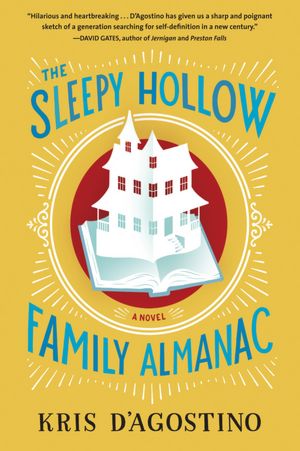
The Sleepy Hollow Family Almanac by Kris D’Agostino reminded me how much I read books based on what I’ve heard about them, or if I’ve heard about them – it isn’t often that I just pick something up without reading the back, recognizing the author, or knowing something about the title. Not so with Family Almanac. It was just a random pick-up, and I’m so glad I found it.

The novel follows Calvin Moretti, as he ditches Boston University and returns home to Sleepy Hollow, New York, where he moves back in with his parents, his brother Chip, and his seventeen-year-old sister Elissa. Calvin reverts to his high school self, spending long hours in his bedroom, high and masturbating (“To take my mind off this horrifying scenario, I count the number of girls near my chair whom I would have sex with. I stop at eighteen, realizing my standards have fallen to fantastic new lows”), where he lies “on the floor listening to Appalachian folk music from the 1920s until I can’t keep my eyes open anymore, at which point I crawl into bed and drift off.”

His father, a pilot, has been diagnosed with cancer and is so obsessed with his mortality that he wanders around in his dressing gown with a gun sticking out of his pocket. His end-of-the-world provisions (the rice, guns, oil, and canned beans stacked in the garage) coupled with crippling medical bills are slowly bankrupting the family. Calvin might have had to move home, but there might not be a family home to live in for long. He saves as much money as he can (most of it is directed to student loans), looking at apartments and knowing that he can’t, at twenty-four-years-old, afford to move out on his own. Although he has a job working as a preschool teacher for developmentally challenged children, it does not pay enough for him to get by.

Calvin’s stuck, not just because of his financial situation, but his inability to make something happen. As he sits in his car “waiting at the lights on the way home, I look at myself in the rearview mirror. ‘Just do something.’” Moving back home places him in an ambivalent position, where he is no longer taken care of by his parents, but still relies on them for his basic needs. He doesn’t so much revert back to his teenage self but feels as if he has been given permission not to leave it: “I look at my reflection in the doors and am embarrassed that I still dress like a teenager: dirty jeans, T-shirt.” He is invited to the wedding of an old friend from school that he hasn’t talked to in years, and the event is one of the highlights of the novel (he brings his dad as his date, and his dad brings his gun). Calvin can’t shake free from the idea that he is doing something wrong with his life, and that everybody else has somehow magically figured it out: “I’m jealous even of my classmates who seem to have set up miserable lives for themselves. At least they have lives. I’m convinced of this. Any life is better than aimlessness.”

D’Agostino narrates in a detached, but reflective way, and sentences end almost lyrically, transforming characters’ words from the mundane to the poetic:

“Dad passed his stress test,” Elissa says.
“I know, I say. “He’s downstairs crying about it right now.”
The weeks tumble by. I do not get in their way.

and

“I’ll drive back,” I say. “Jesus.”
“Watch it,” my grandmother says. “He hears you.”

and

“Do you want to know the sex?” he asks. We look at Elissa.
“Let’s be surprised,” she says.

Memory entangles with the present situation: Chip, helping to support the family by paying the mortgage; Calvin, feeling a responsibility to help out, but never quite putting a plan into action; and Elissa, her own teen pregnancy complicating the tenuous family situation. Calvin can’t find a present, mostly because returning home forces him to live in a nebulous shadow of the past. Memory is everywhere, and he spends a considerable time writing in his own journal, if not changing the situation, at least trying to understand it:

When I was thirteen, I played a year of Little League baseball. Mostly as an unspoken favor to my father. They stuck me in right field, the only position where I might possibly avoid all contact with the ball. I batted seventh in the order. Once, during a game toward the end of the season, a fastball hit me square in the nose, knocking the plastic helmet off my head and splaying me out in the dirt. When I came to, I could taste blood in my mouth. My father was squatting over me, along with Coach Ruggiero and half the team. He put his hand under my head, told me not to move. I didn’t want to get up. I would’ve stayed there forever. I have never felt as safe as I did lying there with a broken nose.”

D’Agostino tackles that current economic clime, where return home is a narrative of post adolescence. The writing is in the vein of Dave Eggers and Jeffrey Eugenides, and shows Cal's inability to change the stagnant situation of his life.  

Saturday, June 16, 2012

Keeper by Kathi Appelt


Sheree Fitch’s Sleeping Dragons All Around is a children’s picture book about a little girl tiptoeing through her house at night past eight sleeping dragons. She’s headed to the kitchen to get a big slice of “Mocha Maple Chocolate Cake.” It’s not really related to Kathi Appelt’s Keeper, but it’s a book introduction to Appelt’s novel, in a sort of roundabout way.

For years, I didn’t have any connection to the title, Sleeping Dragons All Around. I thought it was great, and remember having the picture book in the house, just sort of there, with a title that sort of rolls around and sticks for a while, even if you’re not opening it up to read the story. And then I took a Romantic lit course and read “The Eve of St. Agnes” by John Keats and found these lines buried near the end:

She hurried at his words, beset with fears, 

For there were sleeping dragons all around, 

At glaring watch, perhaps, with ready spears---
Down the wide stairs a darkling way they found.--- 
   
In all the house was heard no human sound.

Maybe it’s just because I probably went ten years without that connection, which doesn’t feel like a missing link until you find the way to put it back together again, but that made a little window that looked out from a contemporary children’s book into the early 1800s.

Kathi Appelt’s Keeper does something similar. It starts with a few lines from T.S. Eliot’s “The Love Song of J. Alfred Prufrock”:

I have heard the mermaids singing, each to each,
I do not think that they will sing for me.

I love that these are books for children and adolescents that make an introduction or connection to some really great, canonical poems, making them accessible without allowing them to take over the content of contemporary work. I really like the idea of adolescent and young adult books as being windows into canonical novels, and using windows to view canonical texts while keeping a more contemporary, and sometimes relevant, focus for younger readers.

The Prufrock poem is especially relevant to Keeper, a book about ten-year-old Keeper who’s waiting for the blue moon, an occasion that draws mermaids to the sandbar on the Texas coast. Her own mermaid-mother swam away when Keeper was three, and this is a chance for her to make things right again. Keeper draws a fairy tale world around its protagonist, one that begins to crack apart as she gets trapped in the open waters of the Gulf of Mexico with a seagull named Captain and BD (Best Dog). The chapters are short and to the point of being almost lyrical, and the characters are as diverse and memorable as the story.

There’s Dogie, who lives next door and owns Dogie’s Beach Umbrella and Surfboard Shop, “which had at one time been a yellow school bus but was now simply known as ‘the Bus.’” Keeper is his “waxwing,” helping Dogie wax and surfboards that come into the shop – “He didn’t pay her much – a cold Dr Pepper, plus one dollar for waxing a short board or two for waxing a long board – but she was proud of her work.” And then there is Signe, who Keeper lives with, who makes gumbo for the blue moon in a big pot on the stove. The morning that the book begins on shows Signe “standing there with her wooden spoon in one hand. Signe’s bright white hair stood up in spikes. Keeper loved Signe’s hair. According to Signe, her hair turned white when she was only fourteen, right before she left Iowa. It had been snow white ever since.”

When Keeper’s sympathy for the crabs that are destined for the gumbo disrupts the entire blue moon day, she sets off on an adventure, ill-fated and dangerous. But she can’t help saving them from the boiling stew, wondering, “Was this what it was like to have mermaid blood running through your veins?”

The focus on childhood and adolescence in Keeper is almost heartbreaking, the breaking down of fairy tales and legends and stories that become protective and safe like a blanket to a young girl who has been left by her mother. Appelt’s writing shines here, just as it did in The Underneath, as she tells a story that is nothing like anything else that has been told before. 

Tuesday, June 5, 2012

Motorcycles and Sweetgrass by Drew Hayden Taylor


I read Drew Hayden Taylor’s Motorcycles and Sweetgrass only about a few years ago when it first came out, and usually I don’t reread too many books so close after reading them for the first time. This is one of those exceptions.

Hayden Taylor’s story begins “Somewhere out there, on a Reserve that is closer than you think but still a bit too far to walk to, lived a young Ojibway boy. Though this is not his story, he is part of it. As all good tales do, this one begins far in the past, but not so far back that you would have forgotten about it.” And it ends with the lines, “And that’s how it happened to a cousin of mine. I told you it was a long story. They’re the best ‘cause you can wrap one around you like a nice warm blanket.”

In between, Motorcycles and Sweetgrass tells the story of the Benojee clan who live on the Otter Lake Reserve (where protagonist Tiffany Hunter lives in Hayden Taylor’s YA novel The Night Wanderer). Lillian Benojee is dying, and her children, including the new chief of the Otter Lake Reserve, Maggie Second, are crowded in her house, saying their good-byes. Which is why every single one of them is a little taken aback (to say the least) when a man clad in black leather and a black helmet drives up on a 1952 Indian Motorcycle, walks into the house “like he’s been here a thousand times before,” and knocks on Lillian’s bedroom door. Virgil, Maggie’s son and Lillian’s grandson, sneaks around the side of the house to look through Lillian’s bedroom window. He sees the man, young, white, blonde hair, and blue eyes, lean in and kiss “his grandmother, and quite passionately too. It was the kind of kiss you see only in movies and on television, the eyes-closed, toe-curling kind.”

The man sticks around for Lillian’s funeral, but when he doesn’t leave again, Virgil’s worried that there’s something more going on. Especially when the strange man introduces himself as John Tanner to Virgil, and then as John Richardson to Virgil’s mother, and then there’s the fact that Virgil was sure John’s eyes were blue and now they’re green, or maybe hazel. When John basically tells Virgil to stay out of his way so that he can go after Virgil’s mom Maggie – “You see, I knew your grandmother way, way, way before you were born…That was the last time I felt good. I want that feeling again. I’m hoping it runs in the family, if you know what I mean” – Virgil starts to get really worried. His mom’s been dealing with the stresses of being chief, especially because the Otter Lake First Nation has just bought three hundred acres of new land. Maggie’s listening to all of the suggestions for what to do with that land – waterparks, movie studios – and, as Maggie notes, working on the political side of the purchase as well. As she drives up to her mother’s house, Maggie reflects, “the idea of Native people getting more land was an absurd concept to most non-Natives. Five hundred years of colonization had told them you took land away from Native people, you didn’t let them buy it back. As a result, the local municipality was fighting tooth and nail to black the purchase.” To Virgil, the stress of the mysterious John coming into her life seems like one more thing that Maggie doesn’t need.

He ends up enlisting in the help of his Uncle Wayne, his mom’s brother, who lives alone out on a teardrop-shaped island that is known as “Wayne’s Island.” Virgil knows his uncle is weird, but he didn’t really anticipate the fact that Wayne has been in training as a martial artist. All over the island there are “broken branches hanging off trees in every direction. They were all snapped in the same manner, either to the right, or to the left, in a small spot near the base. No long pressure fractures as if an axe had done it.” Virgil has some trouble convincing his uncle that Maggie needs help, especially because all he has to go on is John’s changing last name and eye color, and the fact that all of the raccoons seem to hate him. He doesn’t help himself by telling his uncle about the threatening petroglyphs he finds “on my favourite rock,” because his uncle just answers, “You have a favourite…rock? That’s so sad.”

But as time passes, it becomes more and more evident that John isn’t exactly who he says he is. In fact, Wayne suspects he might be Nanabush, “The Trickster? The central character of Anishnawbe mythology, the paramount metaphor in their cosmology? The demigod? The amazing, handsome, intelligent and fabulous Nanabush? That Nanabush?” The petroglyphs Virgil found on a rock of two figures that looked like John and his mother riding off into the sunset take on another meaning. His uncle explains,

“It was those petroglyphs you mentioned that got me thinking. I thought it was impossible but still…you see Virgil, many cultures, ours included, believe the west is the land of the dead.”
Things clicked for Virgil. “The setting sun!”
“Exactly. He arrived, and your grandma, my mother, went west. Nanabush knows how to get there, and back. And now, maybe, he has developed an infatuation with your mom.”
“Oh my god! I just thought he wanted to move to Vancouver with her.”

Motorcycles and Sweetgrass is packed full of humor, good writing, nuanced characters, and outstanding story. The book even contains a conversation between Nanabush (John) and Jesus, albeit in the dream, where John says, “Hey, I read that book about you, your biography…that big black book everybody talks about…Needed an editor. No offence, but it went on forever.” Motorcycles and Sweetgrass has a strong appeal as a crossover book – Virgil is a grade-seven student in the novel (and Hayden Taylor jokily notes, “The bell curve was invented for boys like him), and is such a strong and likeable protagonist, comparable to those found in YA literature. It’s a great read, and there’s really so much going on in a Drew Hayden Taylor books, layers and layers of narrative and story to soak up.

Tuesday, May 29, 2012

Alice, I Think by Susan Juby


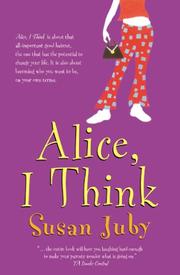
Susan Juby isn’t just writing YA books anymore. Or, more specifically, she isn’t just writing about Alice Macleod, a teenager living in Smithers, BC, who is trying to leave her hobbit-costume legacy behind and, with the help of her therapist, transition from homeschool into alternative school. Juby’s new publications include her memoir, Nice Recovery, which details her struggle with alcoholism, and The Woefield Poultry Collection, is more adult than young adult (even though eleven-year-old Sarah Spratt is one of the highlights of the book). And I can’t say enough about Getting the Girl, this hilarious young adult mystery novel that Juby wrote a few years ago. But whenever I think about Susan Juby, I always go back to Alice, I Think and the two books that came after (Miss Smithers and Alice Macleod, Realist at Last).

(I had a friend from Smithers, BC, who had Susan Juby come to his school to do a reading and was really excited about it, which is basically on the opposite side of this interview with, and I can’t remember who exactly, but I think it was this British tennis player, where J.K. Rowling went in to read an excerpt from Harry Potter at his elementary school or something, and he was like, “Eh, no big deal.”)

When the book starts, Alice is reflecting on the event in elementary school that drove her to be homeschooled for most of her life. She “blame[s] it all on The Hobbit,” since Alice attends school dressed in the hobbit costume that her mom made for her and meets a girl named Linda:

            “So you’re a what?” she asked.
“I’m a hobbit. We are small and ordinary but also special. We can be sort of invisible sometimes. And we laugh like this.” I have her my deepest and fruitiest laugh.
“You know what I think?” she asked.
I shook my head.
“I think you look like an ugly boy.”

Linda leaves Alice alone on the playground, “hobbit hat in hand, burlap sack filled with extra cakes for new friends over my shoulder.” After that, Alice is homeschooled, and now, where the book begins, she is in high school, her first therapist has just suffered a meltdown, and Alice has decided to transition back into Alternative School.

Alice is such a likeable protagonist because she has a concept of normal, and she tries to stay as close as possible to that idea, but she also knows who she is and that normal isn’t really what she’s looking for. She is unique. And she overthinks everything. Juby traces these thought patterns on their unpredictable and waving paths, which actually start to make sense and become more rational than what Alice holds up as “normal.” For example, she goes out for coffee with a guy named Aubrey and she thinks,

Anyhow, I think Aubrey might be a sociopath. I mean, he is very confident for a seventeen-year-old. He wants to be a “low-fi musician,” which I think means that you don’t have to know how to play your instrument that well or be a very good singer. He said he “revels in misanthropy, but in a wholesome way.” I couldn’t help thinking about Ted Bundy. I guess that not all sociopaths are serial killers. I read somewhere that sociopathism can be very good in certain kinds of careers. And Aubrey isn’t necessarily a sociopath – I just sort of wonder why he would want to have coffee with me.

The entire time she’s on the date, and even afterwards, she’s trying to figure out just what, exactly, she’s doing. She thinks, “For a while I thought I was going to throw up. Was this a date? Was I dating? Have I headed out into the sexual marketplace? I have nothing to sell…I think I love Aubrey. I know I love my hair. I may even be a girl. The rituals of humans are very odd.”

The three books about Alice MacLeod fit into the “humor for young adults” category, and a lot of them are usually by British authors (all of the Molesworth books, and St. Trinian’s, and Adrian Mole, the ones that are around 1950s category of humor for adolescents, and then Louise Rennison and Helen Fielding’s Bridget Jones’s Diary). And having this category sort of sink into Canada is so great, because sure, it’s always easy to read characters into other, more familiar places, but it’s kind of awesome whenever there’s a book set in Smithers, BC, so you can go, “Oh yeah, I know that town.” A few years ago The Comedy Network turned Alice, I Think into a TV show and it still runs in Canada sometimes. And if anything, the ending of the book, Alice, I Think, is reason enough for reading this series.*

* And Getting the Girl. Protagonist Sherman Mack is just as nuanced as Alice MacLeod, and just as funny. 

Tuesday, May 22, 2012

Stardust by Neil Gaiman

At the beginning of each semester, sometimes I poach books from classes that I’m not in. I KNOW. It is not a good thing, especially because then you end up in one of those poached book classes and find out you’re in trouble for the first assignment because it is impossible to get a copy of whatever you need to do it because some stranger from another class has bought the copy you were supposed to buy. But I poach books all. The. Time. Mostly because I am thinking, “Why am I not in this class where they are reading REALLY GOOD BOOKS and I am stuck with reading Jane Eyre for the third time, and oh hey, I have to buy TWO DIFFERENT VERSIONS of Wuthering Heights for two different classes in one semester. And over here some class is reading Stardust by Neil Gaiman.”

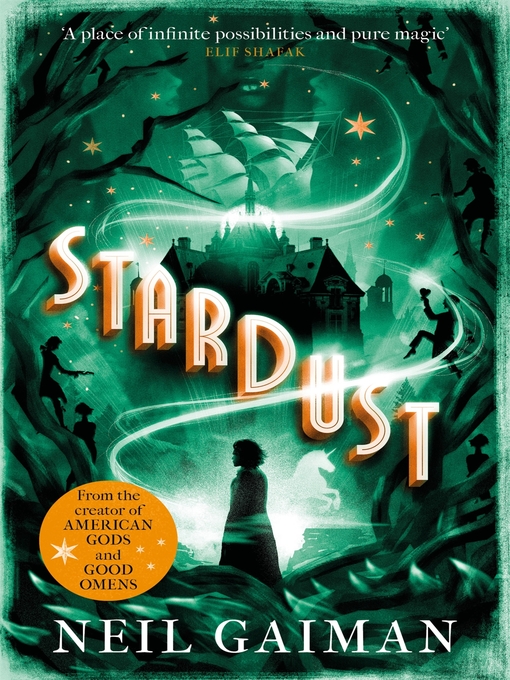
Stardust is one of those crossover books, shelved in Fiction and YA alternatively, sometimes with different covers marketed to their specific audiences. I think it was nominated for an Alex Award through YALSA, those awards that are for books that are typically written for adults, but that teens love to read. And I am going to go full disclosure, but there is not one book written by Neil Gaiman that I don’t own. Okay, maybe not his Duran Duran biography. But novels, picture books, short story collections, graphic novels, and collaborations? Ahem. They are part of the reason that I have so many bookshelves. I first picked up Stardust at a university bookstore about five years ago, because some lucky class was reading it for Intro to Prose Fiction.

I just re-read Stardust, and it’s such a funny feeling to read a book again after the movie adaptation has been out for a few years. The movie version of Stardust (from 2007) is really great, directed by Matthew Vaughn and written by Matthew Vaughn and Jane Goldman (Jonathan Ross’ wife!); it’s sort of an updated Princess Bride, where it’s quirky, meta, fantastical, funny, and heartbreaking. The book carries those same characteristics, but Gaiman’s writing is always so distinct and reading the novel is like walking through a series of beaded curtains, where pieces of characters and setting and story get stuck and hang back, dragging along behind you through the next one.

But the novelization of Stardust still came after the graphic novel that Gaiman first published with illustrations by Charles Vess (which means that it’s not just Fiction and YA that it gets shelved in, but also Graphic Novels at the bookstore), and I think that it’s my favorite version, out of the three: graphic novel, novelization, movie.  Vess’ illustrations really push it into the fairy tale genre, and the long prose paired with images takes it out of simple categorizations of shelving, making this a truly border-crossing story.

Stardust is about many characters in many places, but the character who ties it all together is Tristan Thorne, who promises a girl from his village, Victoria Forester, that he will cross the Wall that divides the town from the Faerie realms to retrieve a fallen star. Tristan doesn’t realize that he is not exactly of a straightforward birthright, since his father’s visit to the Faerie Market years before resulted in Tristan being left as a baby in a basket at his father’s doorstep. Now that he takes off across the Wall, his connections to that place become more real and his heritage apparent. Yvaine, the fallen star, is worth reading the story for – and Gaiman’s rendition of a fallen star as a beautiful young woman – and I think her introduction in the graphic novel and the novelization of Stardust is my favorite way to meet her.

Meanwhile, there are other storylines taking place in the background, forming the present action and altering Tristan’s course. One of my favorite storylines is that of the sons of the eighty-first Lord of Stormhold in Faerie, who is about to die and has the problem of passing his crown to one of his remaining sons (by this point, it seems, there should only be one son remaining, having edged out the rest of the competition). Brothers Secundus, Quintus, Quartus and Sextus are already dead, and their shades stand as “unmoving, grey figures, insubstantial and silent,” waiting in limbo for the next Lord of Stormhold to come into power. This passage comes from the graphic novel, and I really love Gaiman’s writing and imagination and invention, especially when it appears so straightforward, but underlain with so much other invented history and past, already woven together in his own head, so that something complex and fantastical can appear on the page for the reader:

Three of his sons remained alive: Primus, Tertius and Septimus. They stood, solidly, uncomfortable, on the left of the chamber, shifting from foot to foot, scratching their cheeks and noses, as if they were shamed by the silent repose of their dead brothers. They did not glance across the room towards their dead brothers, acting, as best they could, as if they and their father were the only ones in that cold room, where the windows were huge holes in the granite and the cold winds blew through them. Whether this is because they could not see their dead brothers, or because, having murdered them (one apiece, but Septimus had killed both Quintus and Sextus, poisoning the former with a dish of spiced eels while, rejecting artifice for efficiency and gravity, simply pushing Sextus off a precipice one night, as they were admiring a lightning-storm far below them), they chose to ignore them, scared of guilt, or revelation, or ghosts, their father did not know.

Oh, does Neil Gaiman not get enough love around here? I’ll make sure to put up a review of The Graveyard Book soon, because that is one of his books that really shouldn’t be missed. But Stardust, for it’s incredible range of interpretation of an original fairy tale story, is a great place to start with, and you can really jump into any of the three mediums, depending just exactly what you're in the mood for. And believe me, by the end of whichever one you choose, it'll be hard to resist picking up the other versions, just to see the intricacies of interpretation and adaptation.