Saturday, November 17, 2012

Beautiful Creatures by Kami Garcia and Margaret Stohl


Beautiful Creatures by Kami Garcia and Margaret Stohl is the first book of a supernatural/fantasy/romance series along the lines of Twilight and The Shiver Trilogy. Sixteen-year-old Ethan Wate lives in the small southern town of Gatlin, South Carolina, where nothing ever changes, and no one ever leaves. He feels as if he’s set apart from the rest of the town; both of his parents are professors who have made sure he didn’t adopt the same Southern drawl as the rest of his friends by creating, instead of a swear jar, a jar Ethan had to fill with money every time he dropped the “g” off the end of a word. His mother, an expert in the history of the Southern United States, has just recently been killed in a car accident, and Ethan’s author father has grown even more reclusive than ever, sleeping all day and writing all night. Ethan feels alone, isolated, and fearful that he will be stuck in an unchanging routine in an unchanging town.

But when Lena Duchannes (her last name rhymes with “rain”) comes to town, Ethan sees the potential for things to be different. She is the niece of another recluse in the town of Gatlin, Macon Ravenwood, who owns a large estate across town. Garcia and Stohl frequently reference classic and canonical books, especially because both Ethan and Lena are extremely well read. Ethan compares Macon to Boo Radley from To Kill a Mockingbird, connecting the secluded and isolated Macon to the well-known character. But Macon isn’t just a reclusive, ignored by the town; he is regarded as a subject of fear, trepidation, and anxiety, and the fact that Lena is living with him instantly turns the town against her when she starts to attend high school.

Yet, Lena doesn’t just arrive in Gatlin. She has been appearing in Ethan’s dreams for several weeks, and his recognition of Lena in real life becomes a sign of the potential for change and meaning.

But, like the protagonists of so many supernatural romances, Lena isn’t just as she appears, and Ethan, it seems, might not be so normal either. Lena is a Caster from a very large family of Casters, who have the ability to affect the elements through magic. She writes numbers on the back of her hand, counting down the days until her sixteenth birthday, when she will choose whether she is “Dark” or “Light,” which essentially boils down to whether she will use her powers for good or for evil.

Beautiful Creatures is not so structurally simplistic as Twilight, however, even if the love story between Ethan and Lena at times seems remarkably similar. The Southern US setting opens up a historical connection, allowing for numerous flashbacks to the Civil War that examine Lena’s own family history as well as the history of the United States. The residents of Gatlin hold a Civil War Reenactment every year, and this, mixed with detailed flashbacks to the 1800s and Sherman’s March, makes history interesting and accessible. The way Garcia and Stohl allow their characters to interact with both literature and history provides additional layers of story that run beneath their own, original fantasy.

This first book is part of a four-book series – Beautiful Creatures, Beautiful Darkness, Beautiful Chaos, and the just-published Beautiful Redemption. This is another fantasy series that provides an involved, otherworld that is placed just over top of our own, providing enough story to create an interesting story with a lot to hold on to. The movie adaptation will be out in February and the trailer looks great.

Monday, November 12, 2012

I'll Seize the Day Tomorrow by Jonathan Goldstein


I’ll Seize the Day Tomorrow is a Jonathan Goldstein book that I didn’t even know was coming out. I regularly listen to Goldstein’s CBC show WireTap and have read Ladies and Gentlemen, The Bible! but didn’t know that he had a new book coming out.

It’s really difficult not to read a book by Goldstein without hearing his characteristic voice, especially when bits and pieces of this book have already been featured on WireTap. There are so many echoes of Goldstein on the radio in this book, especially stories like “Soulmates,” about Mary Poppins and The Penguin meeting at a dinner party expecting to have a lot to talk about considering the whole umbrella thing. I remember hearing that story, and many others on WireTap (the book is divided up into around fifty chapters, vignettes, or, as described in the introduction, Goldstein’s “pensées”), and reading the stories I remember hearing Goldstein say on the radio provided something like instructions for how to hear the voice narrating this book.

The occasion for the book is Goldstein’s impending fortieth birthday, and the book chronicles his thirty-ninth year, as he counts down the weeks until he turns forty. Goldstein retains his existential, anxiety-ridden style, supported by an infrastructure of humor, a complicated combination of heaviness and light, heaviness and light. The foreword and the epilogue are both written by his (ex)agent, Gregor Ehrlich, a self-referential framing mechanism that critiques and comments on the book.

Instead of writing about the book as a narrative whole, I’m just going to include a few selections from the book, to highlight what I think makes it another incredible book by Jonathan Goldstein:

1. “It appears someone has taken a candy out of the office candy dish, removed its wrapper, sucked it, and put it back in the bowl where it now sits stuck to the bottom, red, wet, and gleaming. Someone who is capable of something like that is capable of anything. There is a sociopath among us. I make a mental note to stop using the communal office dishrag and start keeping my uneaten Melba toast in a locked desk drawer.”

2. “Everyone has a hidden talent for something. The lucky ones discover theirs before it’s too late. Would it be more sad or less sad to go through life never discovering you can fly, or discovering it only a minute before dying? I guess it would really allow for a beautiful death – an old man flying out the window after a long life.”

3. “Step one: shave. While doing so, I stop at the moustache and stare at myself in the mirror. Moustachioedness. I look like a completely different style of person, like the kind of guy who’d sing Motown songs in the public showers at the Y – someone who’d shirtlessly open his front door to the gas man, possibly calling him ‘chief.’ When I finish I’m left feeling as if, after a long night out, my face has finally taken off its pants.”

I’ll Seize the Day Tomorrow is almost like an extended episode of WireTap, funny, introspective, and never incidental.

Monday, November 5, 2012

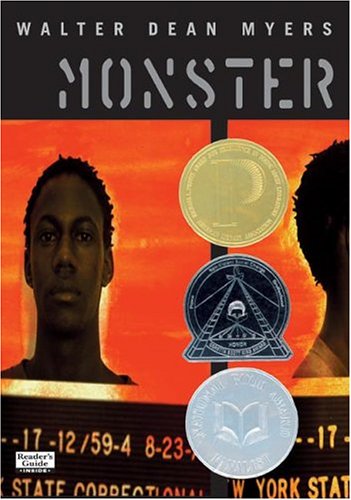
Monster by Walter Dean Myers


It has taken me longer than it should have to get around to reading Walter Dean Myers’ Monster. I was recently doing some research on young adult books that combine both text and image, and Monster was referenced a few times because of the black and white photographs interspersed throughout. Monster won the first Prinz Award when the award was created in 2000, and the experimental and challenging format it engages with represented the kind of book that the Prinz Award wanted to recognize.

Monster uses a screenplay format to tell the story of Steve Harmon, a sixteen-year-old boy who is on trial for the murder of a man, Alguinaldo Nesbitt, who owned a drug store in Harlem. Harmon is implicated in the crime by a series of criminals who are trying to lessen their sentences by cooperating with the police. On trial, awaiting his sentencing as the “look-out” in the hold-up, Harmon writes his story in screenplay form, his interest in films becoming more apparent as the novel progresses.  The screenplay is interspersed with journal entries, as Harmon must return to his prison cell during the downtime of his trial.

As a sixteen-year-old in jail, Harmon is in a constant state of fear and anxiety. He begins his narrative by writing, “The best time to cry is at night, when the lights are out and someone is being beaten up and screaming for help. That way even if you sniffle a little they won’t hear you. If anybody knows that you are crying, they’ll start talking about it and soon it’ll be your turn to get beat up when the lights go out.” He has been in jail for “a few months” but is not nearly close to getting used to the routine of imprisonment. He decides to record the trial as a screenplay, since he has been involved in a film club at his school and views the world through camera angles, close-ups, and voiceovers. He is also writing as a way of self-definition, particularly to find out who is his and what he has done. He writes of his story, “I’ll write it down in the notebook they let me keep. I’ll call it what the lady who is the prosecutor called me. Monster.”

The reader is introduced to the prosecutor, the defense, the judge, and the jury. They are a dramatic list of characters at the beginning of the screenplay, followed by the opening credits that Harmon figures to the style of Star Wars, an indication of both his age and interests. Spliced between the real-time trial are scenes that attempt to carve out Harmon’s character: him and his younger brother Jerry talking about superheroes; his film class; his friends.

There are also black and white photographs throughout, all of them apparently of Harmon. The lack of color functions as a means of reading Harmon’s trial as subsisting in a morally grey zone; his innocence is not so black and white as the portrait photographs that appear in the book. Harmon grapples with his participation in the holdup; even though he was just the look-out, casing the drug store and making sure there were no obstacles in the way, Nesbitt still was murdered. He talks to other prisoners in jail who take responsibility for their crime, anticipating “guilty” verdicts and connecting them innately to the crime they committed. Harmon, however, is different. He can’t grapple with the moral uncertainty of his crime. He didn’t pull the trigger, but he was involved, even peripherally, in murder. He represents the facts of the trial in an unflinching account of witnesses and cross-examinations, but there is still a sense of uncertainty about what Harmon’s verdict will be, and his own moral dilemma.

As the book neared the end, I was actually getting worried that the verdict wouldn’t be revealed, and that Myers’ would leave the novel hanging on the same uncertainty that threads throughout the story. Luckily, there is no such ambiguity, although I’m not sure if this does anything to lessen the uncertainty, or Harmon’s own sense of morality and accountability. The last few lines of the book hold the reader in a sense of ambivalence, as Harmon struggles to define who he is: “I want to look at myself a thousand times to look for one true image. When Miss O’Brien looked at me…what did she see that caused her to turn away? What did she see?”

I would not recommend leaving Monster unread. For its innovative form, its ambiguous subject, and Harmon’s unflinching voice, it is certainly a book worth reading. 

Thursday, November 1, 2012

Y: The Last Man, Unmanned by Brian K. Vaughan


The first collected volume of Y: The Last Man, Unmanned, follows protagonist Yorick Brown as he discovers that he is most likely the last living man, after “something” causes men to die all over the world. Yorick – named by his Drama professor father (his sister is Hero, continuing the literary theme) – is introduced before the event occurs, shut up in his apartment talking to his girlfriend on the phone (she’s in Australia for an archeological dig). His penchant for magic and the art of escape is evident in the first few panels, as he hangs from the top of his bedroom door, phone squeezed between the crook of his neck and his shoulder, attempting to escape from the self-imposed straightjacket trapping his upper body.

Yorick is a graduated English major without a job. He didn’t get the job he had been hoping for, and tells his girlfriend, “I graduated more than a year ago, Beth. And the job market isn’t exactly booming for English majors with moderate-to-poor computer skills.” He’s adopted a helper monkey called Ampersand, and is supposed to be training him before sending him back to the company (where Ampersand will apparently, Yorick says, “help quadriplegics with their chores and shit”). He is introduced as aimless and ambiguous, and why Yorick and his male pet monkey are the only two survivors in the world with a Y chromosome is an apparent mystery. He alludes to the idea of fate and determinism on the phone to Beth (this phone call lays much of the groundwork of Yorick’s character and predicament), in a conversation about Elvis and his twin brother who was stillborn. Yorick says, “How insane is that? I mean. What if Jesse had lived and Elvis had died? Or…or what if they had both lived? I don’t know. Do you ever think about destiny? Why does fate choose one man over another, that sorta thing?” Even though he’s talking about the job he didn’t get, it still sets up the same question of why Yorick.

Yorick’s introduction is paralleled by his mother’s, a Democratic representative who lives in Washington, DC; a woman in Jordan wearing an amulet, and an agent named 355 there to protect her; a scientist about to give birth to her own clone; Yorick’s sister Hero, an EMT officer whose firefighter boyfriend has just been called to an emergency; and a female soldier in Palestine. Although they remain mostly unconnected, or connected loosely, these events will start to make sense in relation to each other as Unmanned continues.

The story gets interesting when it starts to answer the question it poses: what if “gendercide” destroyed “every last sperm, fetus, and fully developed mammal with a Y chromosome”? And why is Yorick left behind to bear witness to the event? Vaughan introduces readers to a group of women called the Amazons, who are adamant about resisting the return of men to their female society, and travel to monuments emblematic of the patriarchy to scrawl graffiti and enact other acts of damage. There is also a group of women who attack the White House, insisting that because their Republican husbands died, they should be able to take their seats. Vaughan’s imagination extrapolates the reality of women in contemporary society, and allows him to question what if?

Vaughan’s unique introduction of Yorick and a society, our society, absent of men, is incredibly well-structured, not just in terms of imaginative possibility but also in terms of character and story. It has also been collected into Cycles, One Small StepSafeword, and others – I’m looking forward to catching up on them all!

Monday, October 29, 2012

Gone Girl by Gillian Flynn


Gone Girl is the recently published mystery/psychological thriller by bestselling author Gillian Flynn. The beginning of the book finds characters Amy and Nick on the morning of their fifth wedding anniversary. The day seems the same as any other, just with a light addition of celebration: Amy makes Nick crepes for breakfast, Nick meets her in the kitchen downstairs before leaving for work at the bar he owns with his twin sister Margo. The first chapter serves as an introduction to their life, uprooted from New York and moved to Carthage, Missouri after Nick found out his mom had cancer. Rather than a temporary move, they have been in Missouri for a few years. They live in a house. Nick bought a bar. They have settled into a new way of living, even though New York was the place that they met, fell in love, and started to make a home.

Nick begins the story with an unsettling description of his wife: “When I think of my wife, I always think of her head. The shape of it, to begin with. The very first time I saw her, it was the back of the head I saw, and there was something lovely about it, the angles of it. Like a shiny, hard corn kernel or a riverbed fossil. She had what the Victorians would call a finely shaped head. You could imagine the skull quite easily.” Nick’s careful narration starting on “the day of” his wife’s disappearance reveals the weathered tension between him and Amy. The question of “What have we done to each other? What will we do?” is the question that shapes the narrative, determining what happens to a couple when they grow apart together, and the lengths they will go to preserve or end their relationship.

Late in the morning of their anniversary, Nick returns home from work to find that Amy has disappeared. The front door is wide open and the cat is sitting outside on the front steps. The living room has been overturned, furniture out of place and broken. Nick is slow to react to the fact that is wife is missing. He is slow to call the police, to call Amy’s parents in New York (who have written a successful children’s book series called Amazing Amy, based on their daughter), and to come up with an alibi that explains why he was late to work that morning. And then there is the fact that he continuously returns to the shape of her head, in a way that makes it seem very much like Nick has murdered Amy.

Nick’s experience of the day of Amy’s disappearance and the days after are interspersed by Amy’s own diary entries, beginning with the night that she met Nick for the first time in New York. Her diary reads as a love story, and is juxtaposed eerily alongside her disappearance and the police’s suspicion that Nick might just have murdered his wife. Their present is interwoven with their past, inviting the reader to speculate about what happened to the couple and what the nature of the mystery at the heart of this novel really is.

However, halfway through the book, Gone Girl turns into something like I’ve never read before. It’s not an easy mystery story; it’s complicated and layered, frustrating and exhilarating. Nick and Amy are doubled characters. They are one way in the first half of the book, and then they are another way in the second half, and it is up to the reader to reconcile these differences and determine, in the midst of it, what exactly has happened to Amy, and what will happen to Amy and Nick. Gone Girl is an incredible portrayal of a couple that relies on the psychological games that they play with one another, and what happens when they go too far.