Monday, April 22, 2013

Withering Tights by Louise Rennison

After shelving her Georgia Nicolson series after the tenth and final book, Louise Rennison switched to writing about Georgia’s cousin, Tallulah Casey. Tallulah now stars in two books, Withering Tights and A Midsummer Tight’s Dream, and the third, The Taming of the Tights, comes out this August. I picked up Withering Tights when I was stuck at a coffee shop/book store for a few hours and ran out of things to read. Rennison’s book had just been released in paperback, and I bought it and read it in one sitting. I was hesitant for a while about beginning the new series; I grew up loving the Georgia Nicholson books and read them from my early teens into my early twenties. Rennison’s humor is so in tact in this new series, and Tallulah Casey is just as interesting and relatable a character that Georgia was. There was an early chapter in the first Georgia Nicholson book – Angus, Thongs and Full-Frontal Snogging – that was literally a laugh-out-loud moment for me when I was twelve, and that moment has continued to be the touchstone that I always remember back to when another book has the same effect. There are several of those in Withering Tights, and nothing in Rennison’s writing style has changed from one series to another.


Withering Tights follows fourteen-year-old Tallulah to Performing Arts College, where she is going to spend the summer. Rennison has used references to Shakespeare frequently in her other books, especially where Georgia and her friends were part of the cast of Macbeth and Romeo and Juliet at school. She continues with the references in her new books, and branches out into those 19th century British books that are still read by teens in high school. For example, on one of Tallulah’s first visits to the school, the comparison between Wuthering Heights and Withering Tights is made explicit:

Then we rounded a corner and saw before us the ‘magnificent center of artistry,’ Dother Hall. I couldn’t help noticing its fine Edwardian front and the fact that its roof was on fire.
As we looked up at the flames and smoke a figure emerged onto the roof in between the high chimney pots. 
I said to Vaisey, “Bloody hell, it’s Mrs. Rochester. Bagsie I’m not Jane Eyre, I don’t want to get married to some bloke who shouts a lot.”
Vaisey said, “It can’t really be Ms. Rochester, can it?”
I said, “Well you say that, but it all adds up, doesn’t it? We’re in Yorkshire on some moors at a big house, the roof’s on fire, and someone, who may or may not have been banged up in the attic for years, has just come out onto the roof. I’m only stating the obvious. Who else could it be?” 
Then we noticed that “Mrs. Rochester” was wearing a mackintosh and carrying a fire extinguisher. And she started putting the fire out with foam. 
After the fire was out Mrs. Rochester disappeared amongst the chimneys.

Tallulah arrives in the tiny town that borders the school, and immediately begins comparing the reality of the school with the small informational brochure she examined at the beginning of the book. For example, she asks her friend Vaisey, “Where are the boys? Where is Martin and his tiny instrument?”, referring to the boy with the lute in the brochure. Another girl at the school explains to Tallulah, “Well, Dother Hall used to be mixed, but there was some sort of incident involving a game called ‘twenty-five in a duvet cover’ and since then boys are banned.” Rennison sets up a parallel all girls school for Tallulah, just as Georgia attended one in the other series. However, there are still male characters to be found, especially at Woolfe Academy on the other side of the woods.

Withering Tights follows Tallulah and her friends for the summer, and is so worth the read. If you’ve been missing Rennison’s writing, this new series is a great follow-up (especially for the references to Georgia [and Norway] that appear throughout!). 

Sunday, March 24, 2013

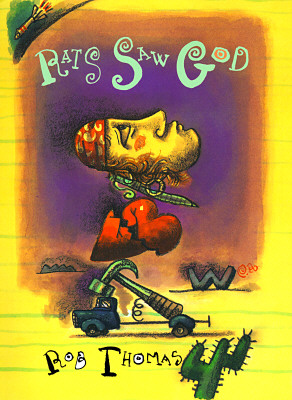
Rats Saw God by Rob Thomas


I thought it would be a good time to talk about Rob Thomas’s Rats Saw God, a YA book published in 1996. I think I bought my paperback copy when I was twelve when YA paperbacks were $6.50, and I loved it. I reread it recently in light of the news surrounding Rob Thomas’s other writing project – the TV show Veronica Mars – and it’s successful movie funding on Kickstarter. It’s a great book to pick up and read in the year or so before the Veronica Mars movie is released, especially as Rats Saw God has actually beenpicked up for a rerelease.

I had never made the connection between the Rob Thomas who wrote Rats Saw God and the same Rob Thomas who created Veronica Mars, not until I came across an episode in the second season of the TV show called “Rat Saw God.” A little bit of googling later, and I realized that the same person who wrote one of my favorite YA novels also created and wrote one of my favorite TV shows.

Rats Saw God is about Steve York, and flashes back between his junior year of high school in Texas (living with his dad, “the astronaut”) and his senior year of high school in San Diego (living with his mom and sister Sarah). On the brink of failing his senior year, a sympathetic guidance councilor named Jeff DeMouy tells him he can make up his English credit by writing a 100-page essay. Steve decides to write about his junior year in Texas, the events of which turned him into the pothead he is when we encounter him at the beginning of the novel, just barely holding onto his grades.

In Texas Steve was a member of GOD, or Grace Order of Dadists, an alternative group at the high school with hopes of getting into the school year book. It was also there that he met Dub (Wanda), the first girl he’s ever fallen in love with. He’s also juggling home life with his distant father and his job at the Cineplex. The flashbacks between the past and the present aim to match up the Steve writing the essay with the Steve he’s writing about.

Thomas’s trademark one-liners and quick dialogue are as strong here as they are on Veronica Mars, and there are similarities between the two (even if they are pretty distant. The sports teams at the high school in Veronica Mars are the Pirates; in Rats Saw God, it’s the Buccaneers. Steve York also has just a touch of Logan Echolls about him. But just barely!). It’s a quick, good read, and the dialogue between Steve and DeMouy is reason enough to pick up Rats Saw God

Wednesday, March 13, 2013

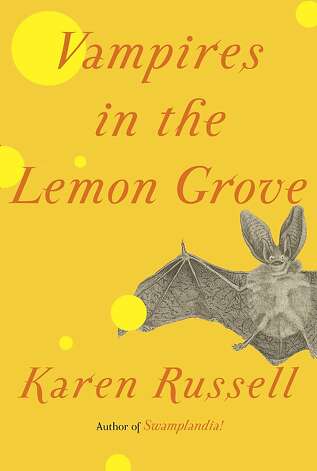
Vampires in the Lemon Grove by Karen Russell


I wrote about Karen Russell’s Swamplandia here when it came out a few years ago, and just stumbled across her new collection of short stories in the bookstore the other day! Vampires in the Lemon Grove is a new collection (in the vein of her first book of short stories, St. Lucy’s Home for Girls Raised by Wolves) of eight short stories, each of them as different as the one that came before it, and all of them clear contenders to be anthologized in other publications.

The book starts with the titular “Vampires in the Lemon Grove,” a story about a pair of old married vampires who have found a home at a touristy lemon grove in Italy. Clyde and Magreb have been together throughout most of their immortality, which has posed all sorts of new obstacles to marriage. Clyde can no longer transform from man into bat, while Magreb lives in bat-form in a cave in the mountains.

“Reeling for the Empire” is an elaborate tale of a woman named Kitsune who works at a silk factory; however, along with the other women, she is turning into a silkworm herself, spinning out vibrant green thread. After signing herself over to the factory without knowing of the transformation she has agreed to, Kitsune learns that there is a metamorphosis in her future if only she will allow herself to take it.

Many of Russell’s stories are written about teen characters, with the transition between childhood and adulthood in mind. Two of these, “Proving Up” and “The Graveless Doll of Eric Mutis” were my favorite in the collection, and two that I will continue to return to. “Proving Up” is an American Gothic story set in the frontier farms of the west, where a family must prove that they have acquired a glass window for their farmhouse in order to get ownership papers. It is a haunting piece of history, built on chilling images from frontier living. “The Graveless Doll of Eric Mutis” is narrated by a boy in grade eight. It records the events that follow him and his friends after they find a scarecrow that resembles a disappeared classmate of theirs named Eric Mutis. As the story goes on, the narrator reveals the connection between himself and Eric Mutis, pulling apart a terrifying world of middle school bullying.

Every story in this collection is so worth the read (I haven’t even mentioned “The New Veterans,” a story about horses living together on a farm, each one the reincarnation of an American president), as they show off Russell’s skill of reworking language and story into something completely new. 

Monday, February 25, 2013

Wildwood by Colin Meloy


Wildwood by Colin Meloy is the Decemberists singer and songwriter’s first foray into children’s fantasy. Meloy explores the fantastical story of a forest that borders Portland, Oregon, which has been given the name the Impassable Wilderness. Beautifully illustrated by Meloy’s wife, Carson Ellis (who also provided the art for The Mysterious Benedict Society), Wildwood belongs standing shoulder to shoulder with such fantasy series as C.S. Lewis’ Narnia or Lemony Snicket’s A Series of Unfortunate Events.

The story begins with eleven-year-old Prue McKeel setting out on an everyday adventure with her baby brother, Mac. She pulls him in a Radio Flyer wagon hitched to the back of her bike, and takes the reader on a geographical journey through Portland. When she stops at the park to take a break, a murder of crows swoop down on her brother and carry him off into the sky. When she watches them take him towards the Impassable Wilderness, a forested area that she knows not to go into, she understands that she is going to have to go and find him and bring him back.

The Impassable Wilderness, however, is not just a forest. Instead, it contains a magical host of characters, animal and human alike, who have been living there for years. There is a particular magic that keeps the residents of Portland out, and keeps the inhabitants of the Wilderness safe inside. Teaming up with Curtis, an exuberant boy from school (and my favorite character from the book), Prue ventures in to save her brother.

Curtis and Prue are separated from one another not long after they entire the Wilderness. They are startled by a host of coyote soldiers who call themselves by Russian names, and Curtis gets taken while Prue manages to escape. Their separation from one another allows them to cover even more territory than they would be able to explore together in the pages of the book, providing the reader a more clear and comprehensive picture of the Impassable Wilderness and what it holds inside. Curtis spends time battling with the coyotes, donning their uniform and fighting for their cause (even if he’s not exactly sure what that cause it). Prue is taken by a mailman to the South Wood, where she experiences bureaucracy taken to another level, a corrupt government, and a sorrow-filled history. When she asks for help from the government she finds it a complicated route. As the narrator notes,“[Prue’s] only struggle with bureaucracy was when she’d been on the waiting list for a particularly popular book at the library.” The government of the South Wood is something much different.

Prue and Curtis become more and more entangled with the politics and culture of Wildwood and find their way into its complicated history and relationship with the human world. Mac sits at the center of the story, the person Prue is searching for, and the key to the personal history of her family that she could never have known. Wildwood is a lyrical book and even includes several songs sung by a band of bandits. It is reminiscent of The Hobbit in that way, and allows the reader to fully interact with the world. I would recommend following up with the sequel, Under Wildwood.

Wednesday, February 13, 2013

Calling Dr. Laura by Nicole J. Georges


Calling Dr. Laura by Nicole J. Georges is a graphic memoir that explores the author learning, from a psychic no less, that her father has not passed away from colon cancer like her mother and sisters have always told her, and follows the subsequent reordering of her understanding of her family. It yokes together the aspects of Alison Bechdel’s Fun Home and David Small’s Stitches that made them so notable – a careful detailing of the author’s childhood and resulting affect on their future lives as relayed by a loose frame narrative set in a sort-of-present.

The title – Calling Dr. Laura – comes from Georges calling Dr. Laura Schlessinger’s conservative radio advice show (and one of the most hilarious images in the entire book is Georges representation of Schlessinger as the sister in Dinosaurs) as she tries to come to terms with the fact that her mother and sisters lied to her. She includes the transcript of the phone call, having recorded it as it took place. As a character in her memoir, Georges illustrates herself tucking the tape recording of the phone call away and hiding it from her girlfriend Radar.

Georges begins the book in Portland, OR, where she lives with a handful of dogs, chickens, and a new rescue chicken named Mabel. Her artistic style changes as the book jumps back and forth from past to present, and her depiction of her childhood is rendered in a less descriptive and more iconic way, which suits her younger age and the material presented. Georges depicts a series of boyfriends and husbands that her mother was attached to while she grew up, many of them distant and one abusive. Each of these men gives the young Georges a present – a stuffed animal by at least two and a dog from another – and her mother insists that Georges name the gift after the boyfriend/husband who gave it to her. I thought it was hilarious to see Georges’ collection of animals growing, each one named after a man who had quickly been inched out of her mother’s life.

Relationships are at the heart of Georges’ memoir: with her mother, her two half-sisters who are ten and twelve years older than she is, her girlfriend Radar, her close friends, her dogs, and her amorphous, unknowable father. Georges is stuck up in the middle, trying to make sense of how she stands in relation to the people she loves, and how she can carve out her own identity when there are so many different ones that others want her to subscribe to.

It is an intriguing story and beautifully illustrated book. I really loved Georges’ artistic style and the times that she illustrates scenes set in Portland were some of my favorite. Although Dr. Laura is integral to the title, she only occupies a small series of pages near the end of the book (where the transcript of their phone call conversation is included), but her importance to Georges as an outlet for advice at a difficult time is notable. Likewise, the psychic who gets so much wrong about Georges gets one very important thing right – her father is still alive. The ending is almost heartbreaking, and the story as a whole is well worth the read.