Monday, May 13, 2013

Counting by 7s by Holly Goldberg Sloan


I recently received an ARC of Holly Goldberg Sloan’s Counting by 7s, a new middle grade/young adult novel due out this August. The book follows twelve-year-old Willow Chance, a child genius who takes care of the sprawling garden in her backyard and diagnoses medical conditions (mainly skin conditions) for fun. When her parents die suddenly in a car crash, Willow is left alone, navigating the foster care system under the care of her caseworker. It is clear that Willow is an exceptional and special young girl, and the people that she meets along the way in the novel recognize that too.

To avoid seeing Willow end up at the Jamison Children’s Center (where she would live until she found a more permanent foster situation), two unlikely individuals come together to take her under their temporary care. The first is Dell Duke, a guidance counselor Willow has been mandated to see on a regular basis. He has invented a color-coded system that categorizes every child and teenager he sees into made-up categories, a system that allowed him to check out of his job on day one. After getting a perfect score on a series of challenging tests when she starts at a new school, and finishing all of them well under the full length of time given to write them, Willow is accused of cheating and sent to Dell. She keeps the truth hidden – that she didn’t cheat at all, she is just an extraordinary girl – and sees Duke anyway. While waiting outside his office, she meets another pair of teenagers, Mai and Quang-ha, Vietnamese siblings who live in the garage behind their mother’s nail salon. Their mother, Pattie, becomes Willow’s other guardian, and they grow to become an extended, mismatched family.

I loved the structure of the story, as Goldberg Sloan takes the reader alternately through Willow’s past and present, as well as the past and the present of the other characters in the book. Although Willow has a first-person perspective when she narrates, the other characters pick up the story in a secondhand, third person, way. It is always clear that Willow is the protagonist of the story, but that the other characters have just as much to say as she does. Duke Dell, who at times seems like a horrible character, became my favorite person by the end. The book is ultimately about belonging, and the families that people make for themselves. Willow’s narration is no-nonsense and straightforward, but it dips into nuance and description at just the right times. Willow also imparts an unbelievable amount of information about the things that she loves throughout the novel, about medical conditions and plants, math and languages. The way these characters transform one another (without even meaning to!) is so believable and moving, and the ways that they wove their lives together has stayed with me long after putting down the book. 

Thursday, May 9, 2013

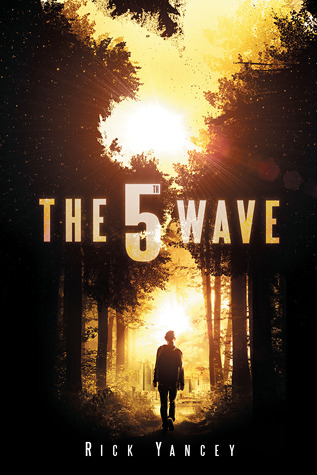
The 5th Wave by Rick Yancey


Rick Yancey’s new dystopian novel for teens, The 5th Wave, was released this week, and coincidentally, its release date was the same day I finally got around to reading the ARC copy I received a few months ago. I wish I had read it sooner than this week (and I really wish I had read it before viewing the movie adaptation of Stephenie Meyer’s The Host, which shares much in common with Yancey’s interpretation and extrapolation of a potential alien invasion of Earth), but instead I read it almost in one sitting on Tuesday. I love Rick Yancey’s other works, especially The Monstrumologist and The Curse of the Wendigo, which are modeled on Victorian novels preoccupied with evolution and eugenics, but written for a contemporary teen audience. The 5th Wave is a departure from these other works, examining a much more present condition and time.

The 5th Wave is told from a handful of perspectives, two of which I won’t share here because it’s really worth it to identify all four narrators when reading the book, but is mostly focused on teenage Cassie, “Not Cassie for Cassandra. Or Cassie for Cassidy. Cassie for Cassiopeia, the constellation, the queen tied to her chair in the northern sky, who was beautiful but vain, placed in the heavens by the sea god Poseidon as a punishment for her boasting. In Greek, her name means ‘she whose words excel.’ My parents didn’t know the first thing about that myth. They just thought the name was pretty.” The book starts in Cassie’s present, where she is hiding in the woods from the Others, aliens who look like humans who are slowly eradicating the earth of its population. If you’ve seen or read The Host, the alien presence there seems very similar to the way they appear in Yancey’s book, that is, a familiar human presence with an alien, or Other, mind. When Cassie explains, “Aliens are stupid,” she means,

The ones we made up, the ones we’ve been making up since we realized those glittering lights in the sky were suns like ours and probably had planets like ours spinning around them. You know, the aliens we imagine, the kind of aliens we’d like to attack us, human aliens. You’ve seen them a million times. They swoop down from the sky in their flying saucers to level New York or Tokyo and London, or they march across the countryside in huge machines that look like mechanical spiders, ray guns blasting away, and always, always, humanity sets aside its differences and bands together to defeat the alien horde. David slays Goliath, and everybody (except Goliath) goes home happy. 
What crap. 
It’s like a cockroach working up a plan to defeat the shoe on its way down to crush it.

Cassie explains the four waves that have taken place already, each wave taking out another chunk of the human population. The first section of the book – told from Cassie’s point of view – was my favorite, as Cassie narrates the isolation and fear that haunts her present situation in tandem with describing life before the invasion. Yancy returns to a normal day at Cassie’s high school, no different from any other, when the 1st wave hit (an electronica magnetic wave that knocks out cars, cell phones, and electricity). Cassie is so likeable as a character because Yancey is careful to show how she got from a high school classroom thinking about her crush and texting her best friend to fighting for her survival in the woods, detailing this transition in a powerful first section. When the perspective changes to another character (Cassie’s younger brother Sam is also a narrator), Yancey is able to build the context and world of his story further, but I always missed Cassie’s voice and narration every time a new character perspective was introduced. Interestingly, Cassie’s first image of the cockroach being crushed by the shoe on the first page of the book continues through, always threading itself back to that original image that Cassie provides.

Consistent with recent sci-fi and fantasy books for teenagers, there is a love story in The 5th Wave, however, it is not as satisfying as I was looking for it to be as a reader. The romance between Cassie and an older teenager named Evan Walker seems incidental to the story, is rushed, and lacks the emotional attachment and empathy that so many fantasy and sci-fi books for teens seem to get so right. In order to keep Cassie’s strong narration and sense of her own self in tact, the romance could have been missed, rather than how it instead seemed to make Cassie an inconsistent and unbelievable character.

The 5th Wave is a strong story by an incredible author of YA books, and gives readers of Divergent, The Hunger Games, and other dystopia books for teens another great addition to the genre. Yancey’s imaginative speculation of an alien invasion is, in its way, very believable and carefully laid-out, and gives the book a sense of veracity that many sci-fi and fantasy books lack. The 5th Wave has already been optioned by Sony Pictures, and so readers who want to read the book before they see the movie should find it in stores soon!

Monday, May 6, 2013

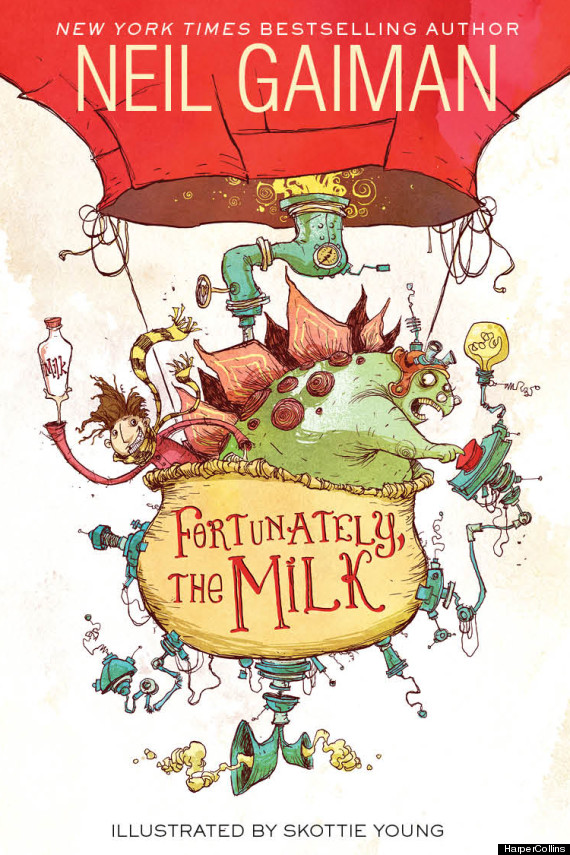
Fortunately, the Milk by Neil Gaiman


I was so excited to receive an ARC of Neil Gaiman’s upcoming Fortunately, The Milk, written for readers between the ages of 7-12. With a publication date in late September, Fortunately, the Milk strikes me as a perfect back-to-school-book, when younger students need a silly and nonsensical escape from starting another year in a new grade.

When two children are left at home with their father while their mother presents at an out-of-town conference, they run out of milk for their breakfast. Their father heads out to the store to pick some up for their cereal (and his tea), but he encounters quite a few adventures and misadventures on the way back home. These include abduction by aliens, a ship of eighteenth-century pirates, Professor Steg and his Floaty-Ball-Person-Carrier, wumpires, time travel, space travel, and more. All the while, the refrain “Fortunately, the milk” carries through, threading the premise of the story always backwards towards the fridge empty of milk and the necessary trip to the store.

Gaiman’s text is paired with illustrations by Skottie Young, which take the silliness and the whimsy of the story even further. I will definitely purchase a copy of Fortunately, the Milk when it comes out in September, since the ARC only has about half of the illustrations completed. The book is about the size and shape as a Magic Tree House Book., a length that is so suited for younger readers.

It is a fun, quick read that is, at times, like watching the best bits from an episode of Doctor Who (which is not surprising since Gaiman has written two episodes for the show). I’m looking forward to picking it up again in September for a re-read!

Thursday, May 2, 2013

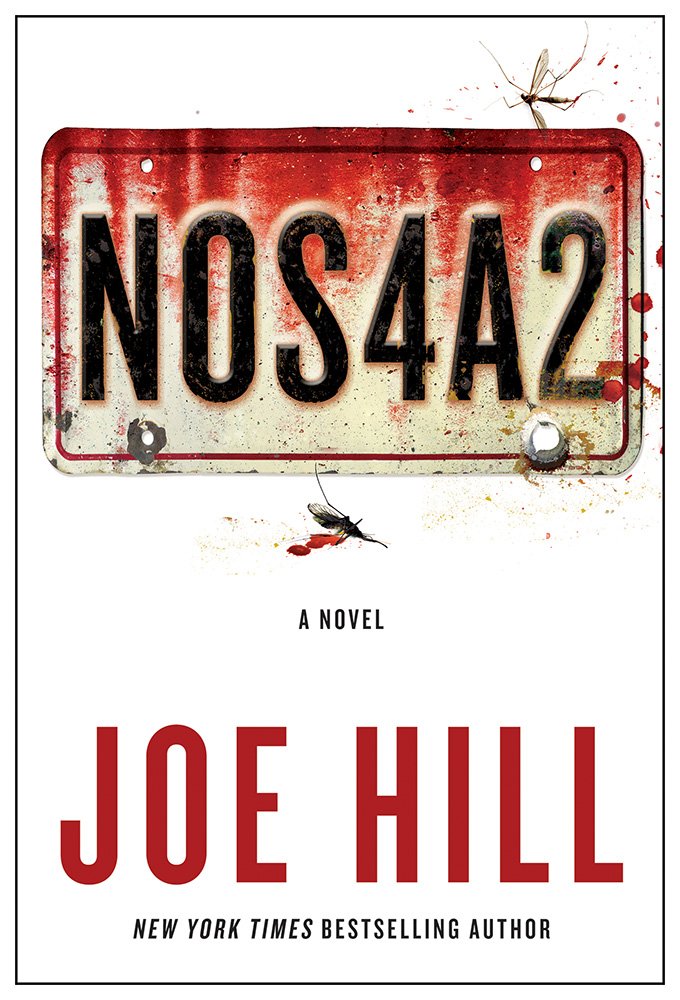
N0S4A2 by Joe Hill


I just recently (last night!) finished a book I have been so excited about for months and months now, N0S4A2 by Joe Hill. This spring is so great for new book releases, starting with Kate Atkinson’s Life After Life, Joe Hill’s book, The Ocean at the End of the Lane by Neil Gaiman in June, new books from both Sarah Dessen and Deb Caletti, a new Terry Pratchett book, Jaclyn Moriarty’s A Corner of White, and on and on. There will be quite a few reviews going up over the next few weeks and months as so many great books come out.

I first discovered Joe Hill through his comic book series Locke and Key, which is about three siblings, their mother, and their uncle, who live at Keyhouse, a sprawling New England mansion located in the fictional Lovecraft, MA. The series has been published in five volumes and I think the sixth will start rolling out issues in the fall. It’s a complicated mix of horror, history, young adulthood, magic, mythology, and excellent storytelling. N0S4A2 (pronounced Nosferatu) filled the gap for me between the last and next installment of Locke and Key, and has resulted in me also picking up one of Hill’s other novels, Heart-Shaped Box (2007). As well, N0S4A2 is illustrated (intermittently) by Hill’s Locke and Key collaborator, illustrator Gabriel Rodriguez.

N0S4A2 isn’t really a young adult book, but it spends remarkable time in its protagonist’s youth, a good quarter of the nearly 700-page book. Victoria McQueen is eight-years-old when the book begins, but she earns a nickname, “the Brat – Victoria to her second-grade teacher, Vicki to her mother, but the Brat to her father and in her heart.” When her mother’s bracelet is lost on a trip to the lake, Vic gets on her Raleigh Tuff Burner, a bike that she has had to grow into, and rides away from the fight between her parents. While she rides, she finds the Shorter Way Bridge, a covered bridge that she is forbidden to go near. Although the bridge already collapsed into the river below a year before the story begins and no longer stands in the real world, Vic finds that it opens up to her and her bike, and when she rides across it, it takes her to the place where her mother’s bracelet had been lost. The Shorter Way Bridge becomes Vic’s means of retrieving lost things – she gets on her bike and rides until she finds the bridge, and it leads her to the place that she needs to go. However, each time she crosses the bridge there is a consequence: she gets a horrible stabbing feeling in her left eye, and when she stays on the other side of the bridge for too long, she comes back weeping blood.

Vic’s path crosses inextricably with Charles Talent Manx’s when she is seventeen-years-old, and she crosses the Shorter Way Bridge looking to find trouble. She finds Manx, a tall, skinny, old man with an overbite who drives a 1938 Rolls Royce Wraith with the vanity plate N0S4A2. Manx has a talent similar to Vic’s, but he uses it in a much different way. He is able to use the Wraith to drive to a place called Christmasland, one that exists as an idea in his own mind, yet made tangible and material. He drives children in his car, feeding like a vampire off of their unhappiness and using that to fuel his car and himself. After a narrow escape from Manx, Vic’s own life begins to spiral, as she can’t distinguish between fantasy and reality for the years that follow her discovery of the bridge and her meeting with Manx.

When the story picks up again, Vic is in her thirties, married to a man named Lou who drove her away from Manx’s house on the back of his motorcycle when she was seventeen. They have a son named Bruce Wayne Carmody, and Vic has started writing a children’s picture book series called Search Engine as a way to stay still in reality. Manx, however, is back, escaped from the prison hospital he has been in for years (his heart removed during an uncompleted autopsy), and he is searching again for Vic and her bike (now a Triumph motorcycle).

I could not put down this book. It came out on Tuesday, and I read it late Tuesday and Wednesday night. Hill balances his horror with outstanding characters and story, continuously layering elements of history, pop culture, and a New England mythos to create something truly unique. The inclusion of Christmasland, a place where every day is Christmas morning, is at once chilling and familiar. Hill’s characters are so well-written, especially the lisping librarian Maggie Leigh who gets her psychic insights from her Scrabble tiles, and helps to show Vic that her strange reality really is real.

There are nods to Harry Potter and Amanda Palmer and everything in between in N0S4A2, where Hill has written an incredible story that really can’t be put down. 

Tuesday, April 30, 2013

Skinnybones and the Wrinkle Queen by Glen Huser


Skinnybones and the Wrinkle Queen is one of my favorite titles, and I think I picked up the book on that description alone. The book, by Glen Huser, is about teenaged Tamara (Skinnybones) and Mrs. Barclay (the Wrinkle Queen). Tamara is paired with Mrs. Barclay for a class assignment, as her class walks the three blocks to the Sierra Sunset Senior’s Lodge to visit with the seniors there. Tamara has jumped from foster home to foster home to land with the Shadbolts, Shirl and Herbert, and their two children. An aspiring model, Tamara fakes an allergy to flour (modeling it after a program she watched on TV about gluten intolerance) after noting the absence of any healthy food at all in the house. Still, the Shadbolts make a change from the previous family she lived with, the Rawdings, “with their lists of rules all over the place, taped to the fridge, in the inside of the bathroom door: Don’t use more than 6 squares of bathroom tissue during a visit. Don’t open the refrigerator door unless you have permission.” She skips school frequently to watch Fashion TV, and has to check in regularly with her social worker, Mr. Mussbacher.

Mrs. Barclay, on the other hand, has ended up in the Senior’s Lodge by an unfortunate mistake: thinking that she was going to die quite soon, she signed power of attorney over to her nephew, Byron, who insists that she sell her house and her car as soon as possible. Mrs. Barclay notes, “Six months ago, when the pain was so bad I made me dizzy, I was sure my boat was headed out to sea, all primed with tar, reading for the torch. I said things; I signed things. But the funeral barge wasn’t set afire. And, God, it’s hard to have to hobble back to shore and find Byron waiting for you.” She intersperses her knowledge of opera (which is full of Norse mythology) with her understanding of people and places, her go to set of allusions to describe a situation.

The two form an unlikely pairing when both set their sights on the west coast, Mrs. Barclay hoping to attend the opera in Seattle and Tamara wanting to register in a modeling workshop in Vancouver. They decide to make that happen, and set off from Edmonton in Mrs. Barclay’s boat of a car.

Although there are places where the journey and what will happen on it seem transparent, Huser is always conscious of his characters and imbues them with a personality that doesn’t get lost in the predictability of the story. For instance, he carefully alludes (only once or twice) to how Tamara’s dream of modeling affects her well being, noting at one point when she almost faints in a meeting that she could have had more to eat lunch. Similarly, Huser only subtly shows Mrs. Barclay’s own knowledge of her “bad” days, her confusion when she sleeps an entire morning away, or Tamara’s worry when Mrs. Barclay isn’t herself. The story is told through their intersecting perspectives, moving between Tamara and Mrs. Barclay throughout the book.

Skinnybones and the Wrinkle Queen is a quick, light, and satisfying read, with a fun map-out of the journey from Edmonton to the west coast and back again.