Thursday, June 13, 2013

In Darkness by Nick Lake


In Darkness by Nick Lake was the recipient of the 2013 Prinz Award, which recognizes exceptional YA literature. Lake weaves together two stories, one set during the 2010 Haiti earthquake, and the other following the earlier history of Haiti in the late 1700s and told though Toissaint L’Ouverture.

When the earthquake hits Haiti, Shorty finds himself trapped in the very hospital he went to for treatment of a gunshot to the arm. He doesn’t know for certain what event triggered the collapse of the hospital, he only knows that he has been left in complete darkness with no way to get out. At first, there is no real linking of Shorty’s and L’Ouverture’s stories. In the first few hundred pages or so, their stories rotate with one another, and the reader is taken back and forth between “Then” and “Now.” This travel between the 18th and 21st centuries is not at all as jarring as it could be. Instead, the Haiti setting holds both experiences together, even though so much time exists between them.

L’Ouverture’s story begins when he is fifty-four years old, as he becomes the leader of the Haitian Revolution, leading the population of slaves towards the goal of becoming a self-governing free people. In Darkness could easily replace a book such as Uncle Tom’s Cabin in high school classrooms, because although the setting is changed from the US to Haiti, the horrors of slavery are just as present here, alongside the recent context of the 2010 earthquake in Haiti. Shorty’s story begins in the darkness of the collapsed hospital, however, he backtracks while trapped to tell the reader where he came from. He speaks primarily about the horrors of his own life in the Site Soley where two gangs – Route 9 and Boston – shape much of his everyday life.

Their lives intertwine while Shorty is trapped in the hospital, as they both reflect on death and dying in their present (for Shorty) and past (L’Ouverture). The age difference between the two men is impressively woven together and made into a single understanding that a life-changing experience can happen at almost anytime. L’Ouverture is fifty-four when we meet him in his historical Haiti, while Shorty is just a teenager. Still, a sense of impending death surrounds them both, something that L’Ouverture thinks about often:

“The beauty of this is that when you die there will always be someone waiting, there will always be those you haven’t lost, standing there, the curve of their back and the stance of their feet so familiar. There will always be someone there, saying: ‘We have waited so long. It is so good to see you. Come here.’”

Their lives weave together in an interesting way, and it is worth reading through to the end to watch the two individuals’ lives, separated by much time, if not distance, overlap.

In Darkness is exceptionally written, and uses a mix of English, French, Kreyol, historical context, and pop culture to bring Haiti to life for readers. There is more to this book than the two stories it tells. Instead, In Darkness focuses on bringing a country to life for readers who may be unfamiliar with it. Historical and contemporary contexts bring these separate events together in a way that no other work can. 

Monday, June 3, 2013

Three Times Lucky by Sheila Turnage


Sheila Turnage’s first book for kids, Three Times Lucky, is set in Tupelo Landing, North Carolina, population 148. Eleven-year-old Moses “Mo” LoBeau works in the café that joins up with her house for the summer. She is under the care of Miss Lana and the Colonel, two larger than life characters who have been like parents to her. Mo floated down the river to Tupelo Landing on the night of a hurricane when she was still a baby, and was rescued by the Colonel. She has lived with them ever since, although she still floats messages in bottles down the river in hopes that her Upstream Mother will read them and come to find her.

When local resident Mr. Jesse turns up dead one day, Tupelo Landing is quickly taken over by Detective Joe Starr and Deputy Marla as they investigate the case. The town is populated by characters who are dynamic and nuanced, from Mo’s best friend Dale (named Dale Earnhardt Johnson III after the race car driver, while the “’III’ in Dale’s name stands for Dale Earnhardt’s car, the Immortal Number 3”), Dale’s older brother Lavender Shade Johnson, Mo’s enemy Anne Celeste, Mayor Little (“We always choose a Little for mayor in case a television crew ever comes to town. Littles like to talk and they’re naturally neat; even their babies dress good”), to Dale’s dog, Queen Elizabeth II.

Aside from Mo, Dale was my favorite character in the book. Although Mo’s back story includes losing and never knowing her mother, her life with the Colonel and Miss Lana seems close to charmed. The Colonel calls her “Solider” and gives her advice that holds up outside of the story itself, and Miss Lana dresses up in wigs and costumes and clearly loves Mo. Dale’s home life, however, is less than perfect. His nineteen-year-old brother Lavender moved out of the house the second he could and lives a short drive away. His mother, Miss Rose, is stuck in a horrible marriage, and Mo notes, “Miss Rose used to be a real beauty, back before time and Dale’s daddy got a hold of her. That’s what people say: coal-black hair, a tilt to her chin, and a sway that made men stand taller.” Dale’s father, Macon Johnson, is in a constant state of drunk, and his behavior is such common knowledge that even Mo thinks hardly nothing of it when they pass him on the road drunk driving:

“That was Daddy,” Dale panted. I nodded, trying to ignore the heat of his breath against the back of my neck.
“He wasn’t weaving,” I said comfortingly.

And when Detective Starr comes to town asking questions, Dale won’t even give up his own name at first. Instead he says,

“Me? My name is…Phillip. Sir.”
The café gasped and I gave Dale a sharp kick in the shin. “I mean, it’s Dale,” he said, his eyes filling with tears. Dale’s family is like that. Let the Law come within twenty yards of them, and every male over the age of six – uncles, brother, fathers, cousins – starts lying his fool head off. Dale says it’s genetic. Miss Lana says that’s poppycock.

Three Times Lucky is one of those rare books where every character could star in a book of his/her own, from protagonist Mo to a much minor, but no less important, character named Grandmother Miss Lacy Thornton. It is also one of those perfect summer books that starts just after school gets out in June, and carries through the summer (Mo and Dale are actually horrified to see their teacher Miss Retzyl outside of the school itself). It feels timeless in its setting, something that could be read fifty years ago and could be read fifty years later. I am really looking forward to whatever Turnage writes next!

Wednesday, May 29, 2013

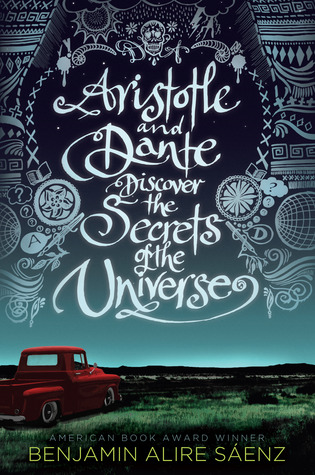
Aristotle and Dante Discover the Secrets of the Universe by Benjamin Alire Saenz


Benjamin Alire Saenz’s new YA book Aristotle and Dante Discover the Secrets of the Universe has one of my favorite titles, and I picked it up for that reason alone. The book is about two Mexican-American teenagers named Aristotle and Dante, although Aristotle tries to go by Ari (he notes, “I renamed myself Ari. If I switched the letter, my name was Air. I thought it might be a great thing to be air. I could be something and nothing at the same time. I could be necessary and also invisible. Everyone would need me and no one would be able to see me”) and Dante sometimes chooses Dan. They meet at the beginning of the summer Ari is fifteen, in 1987, when, for a lack of anything better to do, he goes to the local swimming pool. Dante is there, and he gets Ari’s attention with his nasally, allergy-ridden voice, and his offer to teach Ari how to swim. The two quickly become friends, something that Ari in particular is missing from his life. When he thinks about how he is typically alone (although not lonely), Ari says, “I got along okay. I had school friends. Sort of. I wasn’t wildly popular. How could I be? In order to be wildly popular you had to make people believe that you were fun and interesting. I just wasn’t that much of a con artist.”

The book is mainly driven by conversations, and several pages will go by in an almost screenplay-like format, with dialogue following dialogue following dialogue. For a YA novel, I found this really engaging, immediate, and fast moving. As a reader, I became wrapped up in the friendship between Ari and Dante, since the elaborate and drawn-out conversations meant that their relationship was happening right in front of me, almost in real time. For example, when they talk about their parents, the entirety of their conversation is laid out, almost nothing communicated by description:


Dante shook his head. “We’re too nice, you know that?”
“What do you mean?”
“Our parents turned us into nice boys. I hate that.”
“I don’t think I’m so nice.”
“Are you in a gang?”
“No.”
“Do you do drugs?”
“No.”
“Do you drink?”
“I’d like to.”
“Me too. But that wasn’t the question.”
“No, I don’t drink.”
“Do you have sex?”
“Sex?”
“Sex, Ari.”
“No, never had sex, Dante. But I’d like to.”
“Me too. See what I mean? We’re nice.”
“Nice,” I said. “Shit.”
“Shit,” he said.
And then we busted out laughing.

Ari and Dante’s parents are actually a great addition to this book. Although they are not in the picture too much (Ari and Dante are really at the center of the story), when they are, they are sympathetic, caring, and understanding of their sons. Ari’s father is back after serving in Vietnam, and his much older brother Bernardo is in jail (and has been for several years). Dante’s father is an English professor, and his mother is writing a book about teens and addiction. Parents can never really be at the heart of a young adult story, but here, they fit in at the periphery in just the right way.

There are several parts to this book: one that examines the summer Ari and Dante meet, one that details the accident that changes their friendship (reminiscent of what happens in A Separate Peace by John Knowles), Dante’s move with his parents to Chicago, and his return a year later. But it is always their friendship and relationship that makes the story work. Although Ari and Dante are exceptional characters on their own, Saenz’s writing is at its best when the two are together, and luckily, it is that way for most of the novel. 

Monday, May 27, 2013

The Statistical Probability of Love at First Sight by Jennifer E. Smith


I first found out about The Statistical Probability of Love at First Sight by Jennifer E. Smith from an article in The Horn Book Magazine. The article was called “What Makes a Good YA Love Story?” and included books by authors John Green, Daniel Handler, and Sarah Dessen (who all do write excellent YA love stories). Smith’s novel was also highlighted, and it sounded like a really cute love story. The cover looked really familiar, and after a bit of digging around I found an old ARC copy that I had (the book was published in 2012) and read it right away.

Seventeen-year-old Hadley Sullivan is four minutes late for her flight to London. Her dress needs adjusting, she fights with her mom, she loses her cell phone charger, and there’s traffic on the way to the airport. Those four minutes mean that she’s placed on a slightly later flight and has to spend an additional three hours at JFK. While she’s waiting at her gate, she meets Oliver, just a few years older than her and heading to London, too. They find out that they’re in the same row of seats for the flight, and they spend the few hours before their flight getting dinner at the airport and getting to know one another.

When they get on the flight, the kind old lady who mistakes them for a couple gives up her middle seat so that they can sit together, and from there, Hadley and Oliver have nothing else to do but get to know each other over the course of the flight to London.

Smith paces the story well through their conversations, revealing just enough about both Hadley and Oliver at a time. Hadley is going to London for her father’s wedding to a new woman, one that he met while taking a temporary position as a professor in Oxford. She is still angry about the fact that her father left her mother to be with a new woman, one she has not even met, and as a result, Hadley has planned her trip to London to arrive only a few hours before the wedding, and to leave immediately after (even though she is going to be a bridesmaid in the wedding party). Hadley suspects that Oliver is traveling for a wedding as well. He’s a university student in the United States, although his family still lives in England.

The entire story only takes place over the course of about twenty-four hours, as Hadley and Oliver meet at the airport in New York, lose each other in London, and find each other again. It's very self-contained, with only a handful of characters (even with the flashbacks). The only thing that I stumbled over while reading this story was the fact that it’s told in the present tense. I understand that the present tense makes the story much more immediate, and gives the impression of actually happening in real time. However, it’s third person and present tense (“Hadley shrugs” “When he catches up to her”), which really threw me! If it had been present tense and first person, I think there would have been no problem at all, but every once and a while the way the story was told took away from the story for me.

I really enjoyed Smith’s book and was sorry that I took so long in finally getting around to reading it. Hadley and Oliver are such likeable characters, and it was fun to inhabit their twenty-four-hour world together. The book would make such a great movie, and the immediacy and conversation seemed written for adaptation to that form exactly.