Tuesday, September 3, 2013

Bluefish by Pat Schmatz


I love reading “first day of school” books at the beginning of September, and found Bluefish by Pat Schmatz just in time. Bluefish begins with Travis’s first day at a new school navigating his locker combination: “slowly spinning the dial. Seventeen…back to the left…” Over the summer, Travis has had to abruptly relocate from the small farmhouse that he shared with his grandfather and their dog Roscoe to a new town, a new house, and a new school. And the biggest change of all is that Roscoe isn’t with them any more; Travis couldn’t find him before they had to move, and he holds onto the hope that Roscoe is like one of those dogs he’s read about in the newspaper, those dogs who wander hundreds of miles from an old house to a new one to find their owners. Travis even attempts to speed up the process by leaving school early and walking in the direction of the old farmhouse to resume his search.

Travis’s story is interwoven with Velveeta’s. Velveeta (her real name is Vida) is in Travis’s class, and her journal entries give a first-person account of how she’s dealing with starting a new year of school after a tumultuous summer. She spends most of her time in an abandoned trailer in the trailer park she lives in that once belonged to an older man named Calvin, a place that is “the safest and best place I know.” Velveeta takes refuge from her absent mom and drug dealer brother, and writes, “Everything’s exactly the same except for how much you’re not here. The empty air in this trailer weighs eighty trillion tons, and it’s jumping up and down on my lungs like an elephant on a trampoline. But that beats my creepy brother’s wide-alive air any day. I’m going to stay here until he leaves.”

Both Travis and Velveeta have a secret, and both are trying to come to terms with important events that happened to each of them the summer before. They become unlikely friends at school, and start to ask the right questions of one another. Velveeta learns that Travis can’t read, and with the help of a teacher named Mr. McQueen and Markus Zusak’s The Book Thief, they begin to change this. Travis takes much longer to get at the heart of Velveeta’s story, and it isn’t until near the end of the book that he gets a clearer picture of the reality of her life, which he has only seen glimpses of.

Travis and Velveeta are exceptional characters, and both points of view are equally entertaining and interesting. I really enjoyed Bluefish for the way that it explored reading, and especially Travis’s experience with learning how to read as an adolescent. 

Thursday, August 29, 2013

Me and Earl and the Dying Girl by Jesse Andrews


The title of Me and Earl and the Dying Girl by Jesse Andrews introduces the three main characters of this 2012 YA novel: 17-year-old protagonist Greg Gaines, who makes a point of being an acquaintance to everyone but a friend to almost no one; Earl Jackson, Greg’s best friend and movie-making partner; and Rachel, who is diagnosed with leukemia at the beginning of the story.

Greg is insistent that his account of his re-acquaintance with Rachel (although they were briefly childhood friends, his mom pushes him to keep Rachel company after she is diagnosed with cancer) is not going to provide any life lessons, or touching moments, or one-liners written in italics (“The cancer had taken her eyeballs, yet she saw the world with more clarity than ever before”). Greg looks out for himself and he has learned the correct way to navigate the many social groups in his inner city Pittsburgh high school. He says,

“I didn’t join any group outright, you understand. But I had access to all of them. The smart kids, the rich kids, the jocks, the stoners. The band kids, the theater kids, the church kids, the gothy dorks. I could walk into any group of kids, and not one of them would bat an eye. Everyone used to look at me and think ‘Greg! He’s one of us.’ Or maybe something more like: ‘That guy’s on our side.’ Or at the very least: ‘Greg is a guy who I am not going to flick ketchup at.’ This was a brutally difficult thing to accomplish.”

Becoming friends with Rachel again compromises all of his work, as it aligns himself with just one person (from one group).

Greg talks about the year in a straightforward first-person style that is broken up by his personalized lists and movie scripts. Many of the conversations in the book are presented as dialogue in a movie, which makes the story move purposefully towards the end.

One of the highlights of the story is Greg and Earl’s own interest in movies, and especially classic and canonical movies. Greg’s father, a professor, has a collection that they start borrowing from when they are still pretty young, and one of their first finds is Werner Herzog’s Aguirre: The Wrath of God. Greg provides a good synopsis of the movie, and an excellent description of his first viewing of it with Earl, and the movie follows them throughout the book. Greg and Earl have even attempted to remake the film under the title Earl: The Wrath of God II. It was so much fun following the references to this movie throughout the book, and especially to note Greg’s coverage of the filming process, Klaus Kinski’s onset behavior, critical reception, and his own reaction to the film. It is a different kind of canonical text to appear in a YA novel, and it was a very effective one.

Although Greg resists any attempts to make his story into something meaningful and moving, it happens anyway. His friendship with Earl is at the heart of story, and the way that it unravels is much more affecting than Greg’s sort-of-friendship with Rachel. But the three of them – Greg, Earl, and Rachel – are integral to the story itself, as is the way they find each other under unconventional circumstances. 

Wednesday, July 3, 2013

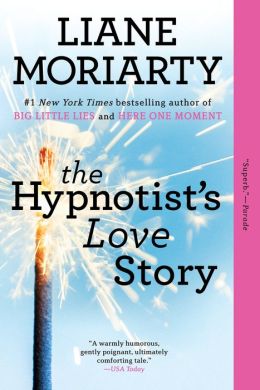
The Hypnotist's Love Story by Liane Moriarty


I have been reading Jaclyn Moriarty’s books since Feeling Sorry for Celia came out in the early 2000s, and I always check her blog for updates. Moriarty’s blog is as well written as her books, and reading a new post is almost like reading a short story, or a series of short stories, when she updates. I think it was through her blog that I found out that her sister, Liane Moriarty, writes for adults. Now I am always on the lookout for both a new Jaclyn Moriarty book, and a new Liane Moriarty book as well.

I haven’t written about Liane Moriarty’s book What Alice Forgot here, but I should have when it came out a year or so ago (it is so good). Instead, I picked up her newest publication, The Hypnotist’s Love Story, last year, and I think it’s more timely to write about it instead since it’s a little more recent!

The Hypnotist’s Love Story is about two women who have one man – Patrick – in common. Ellen O'Farrell is a hypnotherapist working out of the house that her grandparent’s left her. She takes clients in a room that overlooks the ocean and makes a comfortable living that way. When she meets Patrick, she is surprised that she might have found a lasting and meaningful relationship. But when Patrick reveals that he has a stalker – his ex-girlfriend Saskia – rather than worrying about the posed threat, Ellen is instead intrigued. Saskia has been following Patrick for the years since he left her: following him down the highway in her car, reserving a table for herself in the restaurants where she knows he’ll be, following him on foot from place to place. Patrick explains that Saskia is actually sitting in the restaurant with them on one of their dates (although Ellen doesn’t see her). Thinking he is breaking up with her (instead of worrying about Saskia’s presence in the restaurant), Ellen tries to talk herself out of what she at first believed was a very promising relationship (it lasts for the first few pages of the books, and is pretty funny in full. At one point Ellen even admits, “She didn’t really like the name Patrick anyway. It was a namby-pamby sort of name. You could imagine your hairdresser being called Patrick. Also, his male friends apparently called him ‘Scottie,’ which was…well, perfectly acceptable really in that Aussie blokey way”).

Saskia is the other character in this novel, and Moriarty frequently defers to her perspective as it alternates with Ellen’s. Saskia has been posing as one of Ellen’s patients since the day she found out Ellen was dating Patrick, although Ellen does not have any idea that she has been meeting the woman she is so curious about on a weekly basis (Saskia changes her name for the appointments, and as a reader, you are right there with Ellen as she tries to guess which one of her clients is Saskia). Moriarty’s sympathy for Saskia is tempered by the way she outlines every action Saskia takes, rational or irrational (and mostly irrational). She becomes an incredibly interesting character, not because of what she does, but because Moriarty explains why she does it.

As well, meeting Patrick does not immediately bring about the happy-ending Ellen is looking for. Patrick’s first wife died when their son, Jack, was born, and she is as much of a presence in his life as Ellen and Saskia are. Moriarty parallels these stories in order to show just how many participants there are in a relationship, as willing or as unwilling as they are.  Liane Moriarty is an exceptional writer, and in The Hypnotist’s Love Story she writes honestly and humorously about the relationships that Ellen, Saskia, and Patrick find themselves in. 

Friday, June 28, 2013

Life After Life by Kate Atkinson


I have been meaning to write about Kate Atkinson’s Life After Life since I picked up and read the book in April. In the few months before the book came out, a few early reviews compared the book to Emma Forrest’s Your Voice in My Head, not in terms of content or feel, but because of the way both books completely immerse a reader into their stories. I loved Forrest’s book (and can’t wait for the movie adaptation), and so Life After Life was on my radar for a few months before it came out, even though I actually haven’t read any of Atkinson’s books before.

Life After Life is about Ursula Todd, a woman with infinite lives and life choices, all of which play out in the nearly 500-page book. Ursula is born in 1910 in England, and then she is born again and again and again, always returned back to that same snowy night of her birth. I’m not sure exactly how many different threads of her life do eventually play out, but they are alternately long, sprawling stories and short, terse ones, all of them encapsulating a version of her life that stems from the different choices that she makes again and again. It took me a handful of stories to get the rhythm and routine of how life works for Ursula Todd: once she dies, she is returned right back to the night of her birth in 1910, and lives through it again. Her death comes at birth, in childhood, in adolescence, and in adulthood. Each time she gets just a little bit further, and the reader is give a longer glimpse of another version of her life. For example, when Ursula is an adolescent she relives the same event over and over again: the Spanish flu picks off various members of her family until her subconscious makes her find a way to life through it.

It is this idea of Ursula’s “subconscious” that I loved. As she lives through her lives, over and over again (yet separately), she does not acknowledge any remembrance for what has happened before. For example, she does not learn from a past event in order to make it happen differently the next time it comes around. However, there is a sense of déjà vu that pervades her several lives, a sense of something deep inside herself that causes her to make decisions that alter her course of life from how it was before. There is a great version of her life that places her in an insane asylum, as all of her many lives lived finally overwhelm her and lead to an incredibly exhaustion from living them all.

As well, her 1910 birth date places Ursula in a position to live through two world wars, which provides Atkinson with much material for writing while also examining just what it means to live life over and over again, if living it means a constant experience of WWI and WII. It is interesting to watch Ursula experience the wars, and to see how one small decision can lead to either her death, or to her life progressing further. At one point she is even transported to Germany because of one childhood decision, and rather than experiencing WWII on British soil, she lives through it in Germany.

Life After Life examines the way a life is lived, and the way choices can change that life completely. Atkinson’s secondary characters are also present in every iteration of Ursula’s life, and they change or don’t change in just as interesting ways (Ursula’s brother Maurice is always horrible, no matter what the situation). Atkinson builds a world for Ursula, and then sees her exploring every inch of that world, and every choice provided for her there, and any future available. 

Wednesday, June 26, 2013

The Scorpio Races by Maggie Stiefvater


Maggie Stiefvater was one of my favorite authors to see at a panel at NCTE last year, where she was talking with Shannon Hale about world building and fantasy (I think!). I really love Stiefvater’s books, but I haven’t put one up here yet. I recently re-read The Scorpio Races, one of my favorite of her books, and thought it was a good opportunity to write a review.

The Scorpio Races is set on the fictional island of Thisbe, and it is the island’s mythology that is central to the story. Every fall, mythical water horses (capall uisce) come out of the ocean, large, fast, and dangerous. Brave islanders (or those with something to prove) choose a water horse of their own, and begin the nearly month-long process of “training” it for the annual race on the first day of November. But the water horses can’t ever really be trained. They are always drawn back to the ocean, and many riders are either drowned or killed as the horses try to get back to where they are meant to be.

Sean Kendrick has participated in the races for years, and he has a tendency to win. He is as bound to the water horses as they are to the yearly ritual of coming ashore each fall, and he rides the red water horse that killed his father in the races nine years before the book begins. It is on this horse, Corr, that he wins.

Puck is a teenage girl who ends up in the races almost by accident, entering only as a way to keep her brother Gabe on the island for a few more weeks. Without the grace time of the races, his plans to head to the mainland for work would have gone into effect faster than Puck would have liked. Puck lives with her older brother Gabe and her younger brother Finn in an old house that they care for on their own. Their parents were killed in an accident with a water horse years before. Sean and Puck alternate perspectives throughout The Scorpio Races, and are drawn together as the races get closer.

The use of the water horse mythology is incredible, and reminded me a lot of Margo Lanagan’s recent The Brides of Rollrock Island, which examines selkie mythology on an isolated island. The island in The Scopio Races, Thisbe, is a magnificent character on its own, one that Stiefvater describes from end to end. The book also has a very timeless quality about it. I remember the first time that I read it, I thought it had an almost medieval-setting. There is something about the way the clothing is described, the hard way of life, and the hierarchal structure of the island that made it feel much older than it was. But out of this timelessness are references to very contemporary inventions, and the two (usually separate) portrayals of time came together in one book. It had the effect of making me believe so much in this story, and believing in particular that it could happen anywhere.

There are so many heartbreaking moments in The Scorpio Races, but they are all tied up by mythology and adventure, all of it rolling off the coast of one very small island.