Thursday, November 28, 2013

Forgive Me, Leonard Peacock by Matthew Quick

My introduction to writer Matthew Quick was through The Silver Linings Playbook, the Oscar Award-winning movie based on Quick’s novel of the same name. I knew the movie was an adaptation of the book, but I didn’t know Matthew Quick, or any of his work. The cover of Forgive Me, Leonard Peacock comes with a blurb that identifies Quick as the author of Silver Linings Playbook, and I was so incredibly excited for that connection. I recently saw Quick speak on a panel about “grit lit” along with Matt de la Pena, and had the opportunity to pick up his books. Forgive Me, Leonard Peacock has made my list of favorite books this year. I read it in one sitting, and did not want to put it down at any point in the story. It is that compelling, engaging, and beautifully written, and I wanted to start it again after closing the back cover.

On the morning of his eighteenth birthday, Leonard Peacock wraps his grandfather’s P-38 Nazi handgun in pink wrapping paper and puts it in his backpack. He is taking it to school with the intention of killing Asher Beal, the guy who used to be his best friend. He carries several other presents in his backpack, too, in order to pass them out to a few individuals in his life: the older man named Walt who lives next door (they watch Humphrey Bogart movies together), Baback (who plays the violin every day at lunch and lets Leonard listen at the back of the auditorium), his teacher Herr Silverman (who teaches a history class about the Holocaust), and a teenage girl who passes out religious propaganda. The format of the book is mostly concerned with Leonard’s day, but intricate footnotes appear on almost every page, as well as “letters from the future” that are addressed to Leonard from who he imagines as his future wife, daughter, and friend.

Leonard’s depression is tactile and devastating, and even though he jokes about his day and his intention, the reality of his mental state is never far from the surface. The day that Leonard details is actually his eighteenth birthday, and the repercussions from the fact that everyone has forgotten about it are much more realistic here than in something like Sixteen Candles. Leonard is truly alone in his small world, and he does not have any intention of going gently into adulthood. Killing Asher Beal will be, for him, a murder-suicide. Leonard reveals how he used to take days off of school to put on a suit and carry a briefcase onto the train, following unsuspecting adults and trying to find one who was happy with their life. He can’t identify even one, and his “practice-adulthood days” only contribute to his depression.

The moments where Leonard identifies small truths about high school on his last day there are some of the most brilliant in the novel. Leonard knows Hamlet and Macbeth inside and out, and quotes Macbeth in a footnote. He says, “I gleaned that little nugget of anti-life-affirming wisdom from last year’s English class, when I had to memorize Macbeth’s soliloquy. Public school can be a real shot of lithium, let me tell you. It’s crazy the pessimistic shit we’re made to memorize in school and then carry around in our skulls for the rest of our lives.” Herr Silverman, the only teacher at Leonard’s school who actually sees and believes in his students, is one of the highlights of the book, and his conversations with Leonard show off some of Quick’s best and most affecting writing.

Forgive Me, Leonard Peacock was one of the best books I’ve read this year, with exceptional writing and a story that stands head and shoulders above so many others. I have a few of Quick’s other books to read next, but I also know that this one will certainly get a second or third read. It’s certainly a story that sticks around well after the book is over.

Thursday, November 21, 2013

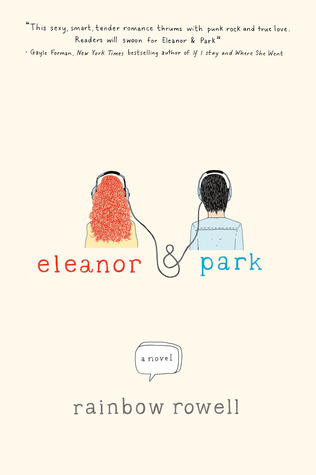
Eleanor and Park by Rainbow Rowell

I received an ARC of Rainbow Rowell’s Eleanor and Park last winter, but my sister ended up reading it months before I did. I didn’t get to it until about a month ago, when I started seeing Rowell’s newest publication Fangirl, out in stores. It was like a reminder to get to the other one, the one I already had, as my sister had been telling me how good Eleanor and Park is since she read it.

Eleanor and Park bounces back and forth between the perspectives of the main characters, tenth graders Eleanor and Park. Set in the mid-1980s in Nebraska, the two share a seat on the bus together and are inextricably tied together from that moment on. Eleanor is new to town. She lives with her mother, her mother’s new husband, and her younger siblings in a small house. Her home life is on shaky ground. She hasn’t seen her family in almost a year, since her now stepfather kicked her out of their old house and wouldn’t let her move back in until now. Park lives with his Korean mother, American father, and younger brother Josh, where he reads comic books and listens to music on his Walkman.

Their love story is a quiet, slow meandering through their grade ten year, where cool and nerdy Park falls for incredibly unique Eleanor on their bus rides to and from school. The development is so incredibly lovely, and punctuated by their sharing of everything that they love, especially comics and music. Before the two begin talking to one another, Eleanor reads issues of Watchman over Park’s shoulder, and he turns the pages slowly knowing that she is following along with him.

The heartbreak and frustration of being a teenager is so wonderfully written. Eleanor’s own self-consciousness about her appearance is detailed carefully through the book, her anxiety about her out of control curly red hair and her weight. When she meets Park’s tiny mother, she notes,

“When Eleanor was around girls like that – like Park’s mom, like Tina, like most of the girls in the neighborhood – she wondered where they put their organs. Like, how could you have a stomach and intestines and kidneys, and still wear such tiny jeans? Eleanor knew that she was fat, but she didn’t feel that fat. She could feel her bones and muscles just underneath all the chub, and they were big, too. Park’s mom could wear Eleanor’s rib cage like a roomy vest.”

Eleanor and Park is an excellent teenage romance, and I’m looking forward to picking up Fangirl soon, and Rowell’s adult novel Attachments.

Wednesday, November 20, 2013

Nation by Terry Pratchett

Terry Pratchett’s Nation is a little different from his Discworld series, in that, in terms of geography and history, it resembles our world just a bit more than the Discworld does (although in Nation there are still multiple universes, and a bending of reality just a little). Set in an alternate history of the mid-1800s, it begins with a ship setting off into the Great Southern Pelagic Ocean in search of the heir (way down the list of heirs to the throne, almost 138 down) to the throne in England. A plague has swept through England, and the only thing that has saved the next king is that he is far enough away to avoid the sickness.

Meanwhile, on an island called the Nation, a boy named Mau is hit by a tsunami during a rite of passage from boyhood to manhood. He is the only remaining person on the island: everyone he has ever known has been killed or swept out to sea. But the tsunami has also brought a visitor to the island. A young girl named Ermintrude (who goes by Daphne on the island) washes up in a schooner called Sweet Judy. Soon, more people come to the island, as their own homes and families have been washed away on neighboring islands.

Mau’s own sense of identity is unclear, as his rite of passage was interrupted by the tsunami. He has become the reluctant chief of the Nation, even though he is not sure if he is a boy, or a man, or a demon. Just like Pratchett uses Death as a character in the Discworld series, he has a similar character in Nation, taking from another mythology. At one point, Daphne has to journey to a place in between life and death in order to save Mau. Pratchett’s wit and humor are so evident in passages like this, where Daphne realizes that she has to die in order to reach the place that Mau is:

‘She says there is no time to teach you, but she knows another way, and when you come back from the shadows you will be able to chew much meat for her with your wonderful white teeth.’
The little old woman gave her a smile so wide that her ears nearly fell into it.
‘I certainly will!’
‘So now she will poison you to death,’ Cahle went on.
Daphne looked at Mrs Gurgle, who nodded encouragingly.
‘She will? Er…really? Er, thank you,’ said Daphne. ‘Thank you very much.’

Pratchett’s novel is also about nation and nationhood, and examines England’s expansion and colonization. Daphne doesn’t want the Nation to be claimed by England, and the idea of flags and guns claiming nations is a theme that follows throughout the story. Both Daphne and Mau are interesting and dynamic characters, and both have extremely complicated character arcs as they develop from the beginning to the end.

The book is also about religion, science, and belief, and in terms of wit and humor, Pratchett’s writing really shines when it comes to those topics. The following exchange between Mau, Daphne, and a bishop was of one my favorites:

‘And someone, please, to teach us doctrine,’ Mau added.
The bishop, who had been feeling a bit left out by now, brightened up at this point and stepped forward smartly. ‘If I can help in any way –’ he began, his voice full of hope.
‘Doctrine to make us better,’ said Mau, giving Daphne an imploring look.
‘Yes, indeed,’ said the bishop. ‘I feel that – ’
Daphne sighed. ‘I’m sorry, Your Grace, but he means doctoring,’ she said.
‘Ah, yes,’ said the bishop sadly. ‘Silly me.’

Nation came out a few years ago, and is one of the only books by Pratchett that I hadn’t read yet. I love his Discworld books so much, that I almost forget to pick up his books that are set outside of that universe. Daphne reminded me so much of the Discworld’s Tiffany Aching, who is one of my favorite characters in literature ever. Nation was a great read, like all of Pratchett’s books (and was a Michael L. Prinz Honor Book when it came out!). 

Monday, November 18, 2013

Horns by Joe Hill

I have been on kind of a Joe Hill kick lately, with Locke and Key, N0S4A2, and Heart-Shaped Box. The Lethbridge Chapters hasn’t had Hill’s Horns stocked for a few months, which might mean it’s going to get a movie tie-in cover and re-release shortly (the film adaptation stars Daniel Radcliffe), but I hadn’t been able to find it at a store to buy in the last little while. I finally took it out of the library to read yesterday.

When Ig Perrish wakes up the morning after a night “drunk and doing terrible things,” he finds two protrusions growing from his forehead. On closer examination, he finds that he has grown a pair of horns, “each of them about as long as his ring finger, thick at the base but soon narrowing to a point as they hooked upward.” Ig tries to remember what he did the night before, believing that he did something so awful that he caused the horns to grow by themselves. He only remembers visiting the foundry, the place that his girlfriend Merrin Williams had been killed the year before. Ig is still suspected in her murder, even though he didn’t do it. The foundry becomes a central location in Horns, and Ig returns there periodically as the story progresses. Beneath a black cherry tree, the inhabitants of the small New Hampshire town that he lives in have left flowers and photos in her memory. Ig can’t stand what other people have turned the place that she died into: “A cross with yellow roses…It was like an electric chair with flora-print cushions, a bad joke.”

As Ig’s day goes on, he discovers that the horns are more powerful than he at first realized. Anyone who sees them tells Ig their deep and dark secrets, horrifying things that they would do if they could. When Ig and his horns are gone, everyone forgets about him and the conversation that they had, and Ig walks away knowing more than he should. When he visits his parents, they tell him that they secretly believe that he did kill his girlfriend Merrin, and that they can’t stand that he is still alive. But it is Ig’s brother Terry who reveals the biggest secret. He tells Ig who really killed Merrin.

The narrative jumps back and forth between the present and the past, creating a picture of Ig’s adolescence with Merrin, his brother Terry, his current girlfriend Glenna, and his best friend Lee, and the decisions and choices that eventually lead to Merrin’s murder. I loved Hill’s character Glenna, “With her tattoos and her paste-on nails, her bookshelf full of Dean Koontz novels, her cigarettes and her rap sheet, Glenna was the un-Merrin.” Even after Hill flushes out her character through flashbacks and through the present story, she continues to be a genuinely surprising and endearing character.

Horns is a revenge novel more than it is a horror story, one that makes Ig’s journey towards the end of the story that much easier to invest in. It’s full of references to TV shows, movies, and music, always tying the story to a very real world even when the fantastical aspects are clear from the start. Judas Coyne, the protagonist of Heart-Shaped Box, even gets a mention, making Hill’s story universe grow even more elaborate and layered.

Thursday, November 14, 2013

Mr. Penumbra's 24-Hour Bookstore by Robin Sloan

Robin Sloan’s Mr. Penumbra’s 24-Hour Bookstore is another book that I think I looked at and read the first three chapters of about fifty billion times before I finally bought a copy (it just came out in trade paperback, and the difference in cover was finally the thing that made me buy it, even though I liked the hardcover cover art better). I love books about bookstores. I used to work at a secondhand bookstore, and coming across a character who works in a bookstore, or a scene in a book that happens in a bookstore was always my favorite thing. Books about books and books about bookstores are always so good. Instead of finding a reference to a story that you like in a book that you’re reading, you find numerous references that just fill up the background of the setting, and it’s always fun to recognize things that you know in fiction.

Mr. Penumbra’s 24-Hour Bookstore follows Clay Jannon, a character in his mid-twenties who is unemployed and running out of options for work. He remarks, “My standards were sliding swiftly. At first I had insisted I would only work at a company with a mission I believed in. Then I thought maybe it would be fine as long as I was learning something new. After that I decided it just couldn’t be evil. Now I was carefully delineating my personal definition of evil.” His job hunt eventually brings him to the bookstore, as it has a “Help Wanted” sign hanging in the window. He signs on for the late shift at the 24-hour bookstore, covering the hours between 10 p.m. and 6 a.m.

The shelves in the bookstore are close together and they stack all the way up to the ceiling. Clay describes Mr. Penumbra’s as disorienting, and compares it to other bookstores:

Let me be candid. If I had to rank book-acquisition experiences in order of comfort, ease, and satisfaction, the list would go like this:
1. The perfect independent bookstore, like Pygmalion in Berkeley.
2. A big, bright Barnes & Noble. I know they’re corporate, but let’s face it – those stores are nice. Especially the ones with big couches.
3. The book aisle at Walmart. (It’s next to the potting soil.)
4. The lending library aboard the U.S.S. West Virginia, a nuclear submarine deep beneath the surface of the Pacific.
5. Mr. Penumbra’s 24-Hour Bookstore.

Although Mr. Penumbra’s starts out invested in the physical book, the musty bookstore with its teetering shelves, it very slowly accounts for the influence of digital technologies on printed text. Clay begins to advertise the bookstore online, and then makes an electronic model of the bookstore on his laptop. He soon sees a pattern to the books on the upper shelf, and unlocking this secret marks his initiation into a book history mystery that has been worked on for hundreds of years by hundreds of individuals. Rather than using print-based methods of uncovering the mystery, he uses electronic ones, and the Google campus becomes a secondary setting of the novel. The image of the Google campus I had when reading largely came from the Owen Wilson/Vince Vaughn movie The Internship, but it actually came in really handy in visualizing where Clay was and what he was doing.

It’s interesting to watch play out, the conversation between print books and non-print books, and the way Sloan raises this discussion through a fun, creative, and intriguing story is wonderful. His writing shines throughout, especially when Clay remarks on aspects of books, mysteries, and history. For example, when he finds a huge warehouse that stores all kinds of historical items, he notes, “You know, I’m really starting to think the whole world is just a patchwork quilt of crazy little cults, all with their own secret spaces, their own records, their own rules.”

I loved the way that Mr. Penumbra’s 24-Hour Bookstore used print and electronic texts, canonical and contemporary references, and bookstores and Google Books to explore the way that texts are changing, and have been changing, in the twenty-first century.