Sunday, December 15, 2013

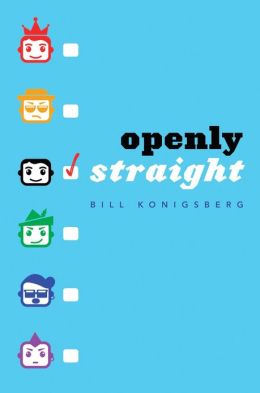
Openly Straight by Bill Konigsberg

I’ve seen Bill Konigsberg’s Openly Straight at bookstores over the past few months (it was released in June 2013), but didn’t have an opportunity to pick it up until this last weekend. Openly Straight is about protagonist Rafe’s decision to move from Boulder, Colorado to Natick, Massachusetts to attend an all-boys school. He goes with the goal of reinvention: while he is out and openly gay in Colorado, he plans to keep his sexual orientation a secret in Natick, where he can be “just Rafe. Not crazy Gavin and Opal’s colorful son. Not the ‘different’ guy on the soccer team. Not the openly gay kid who had it all figured out.”

I read an article recently by Bill Konigsberg for ESPN, where he talked about his own experience of being a gay man who worked as a sports writer. He wrote,

My way of dealing with this has been a personal "Don't ask, don't tell" policy, for the most part. Since I am nonstereotypical, people seem not to know, and people don't ask about my private life. That works for me, since I'd prefer not to talk about it at work. Unfortunately, people also then assume that I am heterosexual. So what does an honest person do? I'm an honest man, I do not lie about it, yet ironically by not saying anything I sometimes feel dishonest. Basically, my choice is either to correct people, or simply say nothing. I've done the latter. Until now.”

This same intent is the subject of Openly Straight. Rafe goes to his new school without saying much about his orientation. He goes in with the intention of not lying, exactly, but when he is asked a direct question about having a girlfriend, he finds himself concealing who he is. In this way, Rafe finds that he has the ability to reinvent himself. He befriends the popular jocks and gets on the soccer team. He is pleasantly surprised, remarking, “Here I was, two hours into my Natick adventure, and I was already in that entirely new skin I had fantasized about. Jock Rafe.”

When Rafe begins to form meaningful relationships with new friends, he sees the inherent difficulty with neglecting to share something as integral as his identity. Especially as he gets close to another teenager named Ben, he finds that what he has been withholding is a major part of who he is, and although he is not directly lying about his identity, he feels like he is being incredibly dishonest. The book follows his fall semester in Natick, as he reinvents himself and tries to evaluate what has been lost in the process.

The supporting cast in Openly Straight is just as compelling and dynamic as Rafe. A highlight of the book is Rafe’s parents, Opal and Gavin, who are so supportive of Rafe’s coming out that his mother becomes the president of the Boulder chapter of PFLAG. They throw him a party at Hamburger Mary’s where “there were Grandma Chloe and the rest of my extended family, and Claire Olivia, and her parents, and they were all wearing tack cone-shaped birthday hats. On the hats it said: Yay! Rafe is Gay!” Rafe describes the experience as appalling and says to his mom, “You’re trying to kill me.” When Rafe returns home for Thanksgiving, his parents have set up a “mountain luau surprise party” complete with a tofu pig: “I don’t know how they’d made a whole pig out of tofu, but it looked frightening real: the burnt pink faux animal appeared to be swallowing and shitting a metal pole at the same time.” Rafe’s best friend Clara Olivia and his English teacher Mr. Scarborough are equally inventive characters, and the book benefits from a reader’s interest in not just the protagonist, but almost everyone in the story.

Monday, December 2, 2013

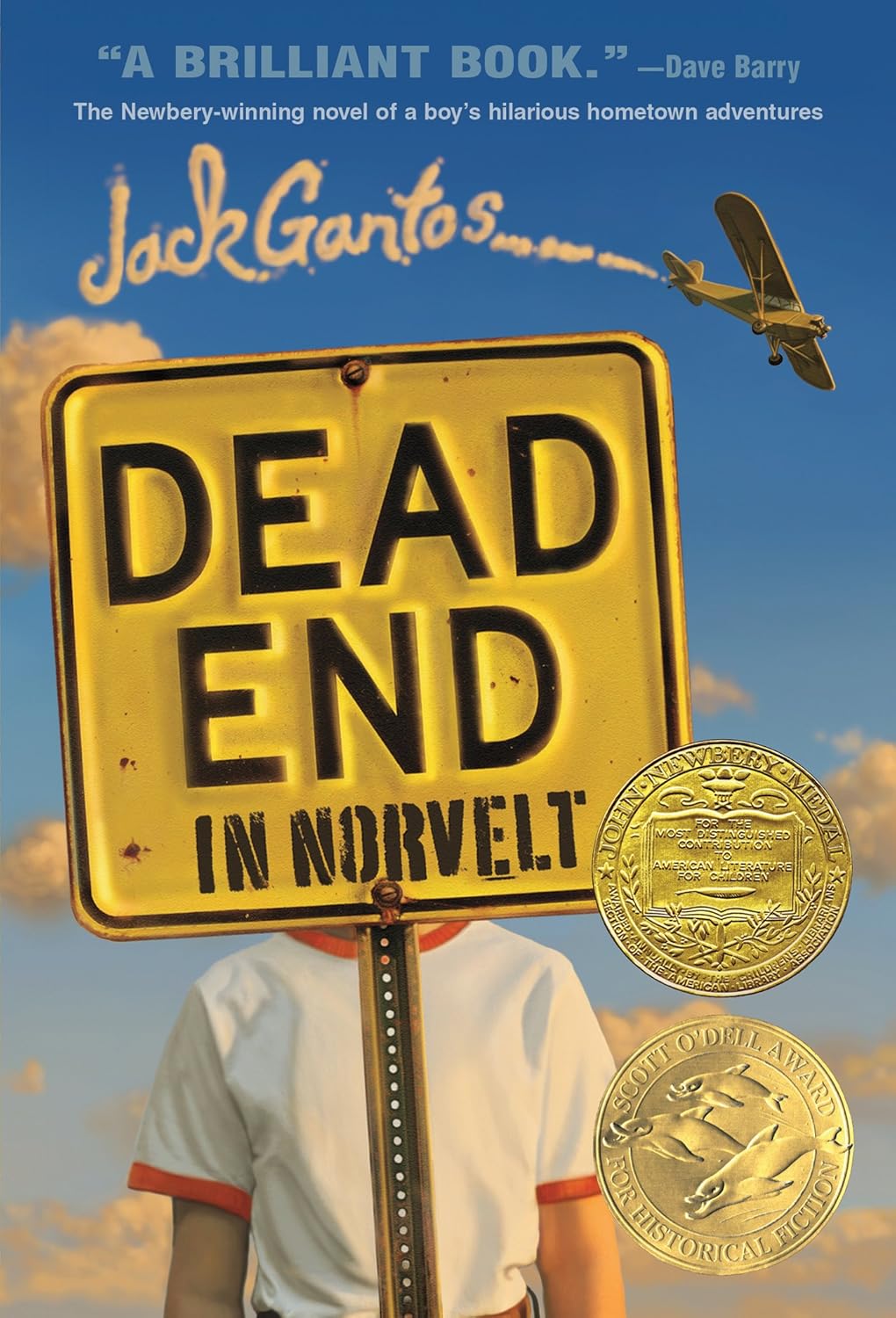
Dead End in Norvelt by Jack Gantos

Jack Gantos has been one of my favorite authors, and I have been reading his books fairly consistently since elementary school. Joey Pigza Swallows the Key was a read-aloud book in my elementary or middle school Language Arts class, which led me to reading the rest of the series. I read Hole in My Life and The LoveCurse of the Rumbaughs around the same time, two incredibly different novels both in terms of style and content. However, I completely missed the Norvelt books (even though I looked at them in Chapters all the time, but didn’t actually get around to buying them), the first of which was published in 2011 and won the Newberry Medal in 2012.

Dead End in Norvelt mixes the autobiographical with the fictional, as main character Jack Gantos starts off the summer on the wrong foot. He says, “School was finally out and I was standing on a picnic table in our backyard getting ready for a great summer vacation when my mother walked up to me and ruined it.” Jack accidentally fires his father’s Japanese WWII rifle, mows down his mom’s recently planted rows of corn, and is grounded for the summer. The only reprieve he’s given is to go over to his neighbor Miss Volker’s house to help her write up obituaries for the town of Norvelt’s original residents who are now in their late seventies and eighties. Miss Volker’s arthritis prevents her from transcribing and then typing up the obituaries on her ancient typewriter, and she has to routinely warm up her hands in hot wax to get them working for about fifteen minutes at a time.

Jack becomes a staple at her house, as the original Norvelt residents begin passing away at a record rate. He learns how to drive her car to visit the houses of the dead (so Miss Volker can get there before the funeral director), even though he doesn’t really know how:

“I’ve only driven a tractor,” I said nervously. “I don’t know if I can really drive a car.”
“It’s the same,” she said. “Just go slow and it won’t matter if you hit anything.”
“But what if I slowly drive off a cliff?” I asked.
“You’ll have more time to pray before you hit the bottom,” she said impatiently. “Now try to be a man and let’s get going.”

Set in 1962, Gantos’s book is a work of historical fiction, but the voice always feels contemporary and relatable. The town of Norvelt where Jack grows up was a New Deal town created by Eleanor Roosevelt (the town is named by combining parts of her first and last name) in order to help poor and impoverished Americans create a self-sustaining community. This, and other parcels of American history, are constantly inserted into the story. Miss Volker peppers her obituaries with narratives of American History that have been misrepresented or forgotten, and Jack reads the Landmark History series throughout the summer.

I have a copy of From Norvelt to Nowhere to read next for the continuation of Jack’s story, an excellent combination of history, mystery, autobiography, and fiction.

Thursday, November 28, 2013

Forgive Me, Leonard Peacock by Matthew Quick

My introduction to writer Matthew Quick was through The Silver Linings Playbook, the Oscar Award-winning movie based on Quick’s novel of the same name. I knew the movie was an adaptation of the book, but I didn’t know Matthew Quick, or any of his work. The cover of Forgive Me, Leonard Peacock comes with a blurb that identifies Quick as the author of Silver Linings Playbook, and I was so incredibly excited for that connection. I recently saw Quick speak on a panel about “grit lit” along with Matt de la Pena, and had the opportunity to pick up his books. Forgive Me, Leonard Peacock has made my list of favorite books this year. I read it in one sitting, and did not want to put it down at any point in the story. It is that compelling, engaging, and beautifully written, and I wanted to start it again after closing the back cover.

On the morning of his eighteenth birthday, Leonard Peacock wraps his grandfather’s P-38 Nazi handgun in pink wrapping paper and puts it in his backpack. He is taking it to school with the intention of killing Asher Beal, the guy who used to be his best friend. He carries several other presents in his backpack, too, in order to pass them out to a few individuals in his life: the older man named Walt who lives next door (they watch Humphrey Bogart movies together), Baback (who plays the violin every day at lunch and lets Leonard listen at the back of the auditorium), his teacher Herr Silverman (who teaches a history class about the Holocaust), and a teenage girl who passes out religious propaganda. The format of the book is mostly concerned with Leonard’s day, but intricate footnotes appear on almost every page, as well as “letters from the future” that are addressed to Leonard from who he imagines as his future wife, daughter, and friend.

Leonard’s depression is tactile and devastating, and even though he jokes about his day and his intention, the reality of his mental state is never far from the surface. The day that Leonard details is actually his eighteenth birthday, and the repercussions from the fact that everyone has forgotten about it are much more realistic here than in something like Sixteen Candles. Leonard is truly alone in his small world, and he does not have any intention of going gently into adulthood. Killing Asher Beal will be, for him, a murder-suicide. Leonard reveals how he used to take days off of school to put on a suit and carry a briefcase onto the train, following unsuspecting adults and trying to find one who was happy with their life. He can’t identify even one, and his “practice-adulthood days” only contribute to his depression.

The moments where Leonard identifies small truths about high school on his last day there are some of the most brilliant in the novel. Leonard knows Hamlet and Macbeth inside and out, and quotes Macbeth in a footnote. He says, “I gleaned that little nugget of anti-life-affirming wisdom from last year’s English class, when I had to memorize Macbeth’s soliloquy. Public school can be a real shot of lithium, let me tell you. It’s crazy the pessimistic shit we’re made to memorize in school and then carry around in our skulls for the rest of our lives.” Herr Silverman, the only teacher at Leonard’s school who actually sees and believes in his students, is one of the highlights of the book, and his conversations with Leonard show off some of Quick’s best and most affecting writing.

Forgive Me, Leonard Peacock was one of the best books I’ve read this year, with exceptional writing and a story that stands head and shoulders above so many others. I have a few of Quick’s other books to read next, but I also know that this one will certainly get a second or third read. It’s certainly a story that sticks around well after the book is over.

Thursday, November 21, 2013

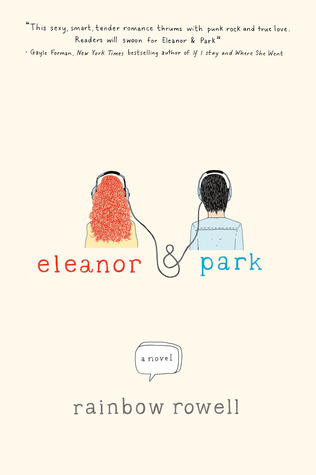
Eleanor and Park by Rainbow Rowell

I received an ARC of Rainbow Rowell’s Eleanor and Park last winter, but my sister ended up reading it months before I did. I didn’t get to it until about a month ago, when I started seeing Rowell’s newest publication Fangirl, out in stores. It was like a reminder to get to the other one, the one I already had, as my sister had been telling me how good Eleanor and Park is since she read it.

Eleanor and Park bounces back and forth between the perspectives of the main characters, tenth graders Eleanor and Park. Set in the mid-1980s in Nebraska, the two share a seat on the bus together and are inextricably tied together from that moment on. Eleanor is new to town. She lives with her mother, her mother’s new husband, and her younger siblings in a small house. Her home life is on shaky ground. She hasn’t seen her family in almost a year, since her now stepfather kicked her out of their old house and wouldn’t let her move back in until now. Park lives with his Korean mother, American father, and younger brother Josh, where he reads comic books and listens to music on his Walkman.

Their love story is a quiet, slow meandering through their grade ten year, where cool and nerdy Park falls for incredibly unique Eleanor on their bus rides to and from school. The development is so incredibly lovely, and punctuated by their sharing of everything that they love, especially comics and music. Before the two begin talking to one another, Eleanor reads issues of Watchman over Park’s shoulder, and he turns the pages slowly knowing that she is following along with him.

The heartbreak and frustration of being a teenager is so wonderfully written. Eleanor’s own self-consciousness about her appearance is detailed carefully through the book, her anxiety about her out of control curly red hair and her weight. When she meets Park’s tiny mother, she notes,

“When Eleanor was around girls like that – like Park’s mom, like Tina, like most of the girls in the neighborhood – she wondered where they put their organs. Like, how could you have a stomach and intestines and kidneys, and still wear such tiny jeans? Eleanor knew that she was fat, but she didn’t feel that fat. She could feel her bones and muscles just underneath all the chub, and they were big, too. Park’s mom could wear Eleanor’s rib cage like a roomy vest.”

Eleanor and Park is an excellent teenage romance, and I’m looking forward to picking up Fangirl soon, and Rowell’s adult novel Attachments.

Wednesday, November 20, 2013

Nation by Terry Pratchett

Terry Pratchett’s Nation is a little different from his Discworld series, in that, in terms of geography and history, it resembles our world just a bit more than the Discworld does (although in Nation there are still multiple universes, and a bending of reality just a little). Set in an alternate history of the mid-1800s, it begins with a ship setting off into the Great Southern Pelagic Ocean in search of the heir (way down the list of heirs to the throne, almost 138 down) to the throne in England. A plague has swept through England, and the only thing that has saved the next king is that he is far enough away to avoid the sickness.

Meanwhile, on an island called the Nation, a boy named Mau is hit by a tsunami during a rite of passage from boyhood to manhood. He is the only remaining person on the island: everyone he has ever known has been killed or swept out to sea. But the tsunami has also brought a visitor to the island. A young girl named Ermintrude (who goes by Daphne on the island) washes up in a schooner called Sweet Judy. Soon, more people come to the island, as their own homes and families have been washed away on neighboring islands.

Mau’s own sense of identity is unclear, as his rite of passage was interrupted by the tsunami. He has become the reluctant chief of the Nation, even though he is not sure if he is a boy, or a man, or a demon. Just like Pratchett uses Death as a character in the Discworld series, he has a similar character in Nation, taking from another mythology. At one point, Daphne has to journey to a place in between life and death in order to save Mau. Pratchett’s wit and humor are so evident in passages like this, where Daphne realizes that she has to die in order to reach the place that Mau is:

‘She says there is no time to teach you, but she knows another way, and when you come back from the shadows you will be able to chew much meat for her with your wonderful white teeth.’
The little old woman gave her a smile so wide that her ears nearly fell into it.
‘I certainly will!’
‘So now she will poison you to death,’ Cahle went on.
Daphne looked at Mrs Gurgle, who nodded encouragingly.
‘She will? Er…really? Er, thank you,’ said Daphne. ‘Thank you very much.’

Pratchett’s novel is also about nation and nationhood, and examines England’s expansion and colonization. Daphne doesn’t want the Nation to be claimed by England, and the idea of flags and guns claiming nations is a theme that follows throughout the story. Both Daphne and Mau are interesting and dynamic characters, and both have extremely complicated character arcs as they develop from the beginning to the end.

The book is also about religion, science, and belief, and in terms of wit and humor, Pratchett’s writing really shines when it comes to those topics. The following exchange between Mau, Daphne, and a bishop was of one my favorites:

‘And someone, please, to teach us doctrine,’ Mau added.
The bishop, who had been feeling a bit left out by now, brightened up at this point and stepped forward smartly. ‘If I can help in any way –’ he began, his voice full of hope.
‘Doctrine to make us better,’ said Mau, giving Daphne an imploring look.
‘Yes, indeed,’ said the bishop. ‘I feel that – ’
Daphne sighed. ‘I’m sorry, Your Grace, but he means doctoring,’ she said.
‘Ah, yes,’ said the bishop sadly. ‘Silly me.’

Nation came out a few years ago, and is one of the only books by Pratchett that I hadn’t read yet. I love his Discworld books so much, that I almost forget to pick up his books that are set outside of that universe. Daphne reminded me so much of the Discworld’s Tiffany Aching, who is one of my favorite characters in literature ever. Nation was a great read, like all of Pratchett’s books (and was a Michael L. Prinz Honor Book when it came out!).