Monday, June 30, 2014

Far Far Away by Tom McNeal

Laura and Tom McNeal's Crooked is one of my favorite YA books of all time. I looked back through my book reviews and was so surprised that I haven't written about it yet here. Crooked is about Amos and Clara, and their perspectives duet in a complementary back-and-forth to tell the story. But after I read Crooked, I didn't really search out any other books by Laura and Tom McNeal. I think I read Zipped, but missed Crushed. Tom McNeal writes several books on his own, without his wife Laura, and Far Far Away is his latest. I had heard about it, and had seen the striking cover on display a few times at Chapters. It was a reminder of how much I had liked Crooked and I thought I would give it a try.

Far Far Away follows young teenage protagonist Jeremy Johnson Johnson, who lives in the strange and quiet town of Never Better. He lives with his father over a bookshop opened by his grandfather, which only stocks his grandfather's autobiography. Jeremy's attic room is filled with books, especially the fairy tale stories that his mother loved. In fact, his mother's fate is straight out of a fairy tale: when she takes a bite of a fabled cake, she falls in love with the first person she sees and leaves Jeremy and his father in Never Better while she takes off to Canada. The fairy tale theme makes fitting the narrator of this novel: the ghost of Jacob Grimm, who talks to Jeremy and tries to figure out what will help him to move on to where his brother is. He dedicates himself to Jeremy, helping him write tests and answer questions, and also keeping an eye out for the Finder of Occasions, a mysterious individuals who is searching for the right occasion to bring harm to Jeremy. 

For me, the tone just never felt right for this book. I've seen it described as "timeless" by several reviewers, but it was that attempt at "timelessness" that was so frustrating to me. It is very keenly set in a contemporary time and place, yet there are aspects of the language, characters, and plot that are so clearly not contemporary, and I found that those two forces continuously tug-of-warred. I like fairy tales and I like unconventional narrators, but not in the way that they were presented here. 

But reading Far Far Away reminded me of just how much I loved Crooked, and once I dig my old copy out, I'm going to give it a re-read and post a review here instead. 

Sunday, June 29, 2014

Since You've Been Gone by Morgan Matson

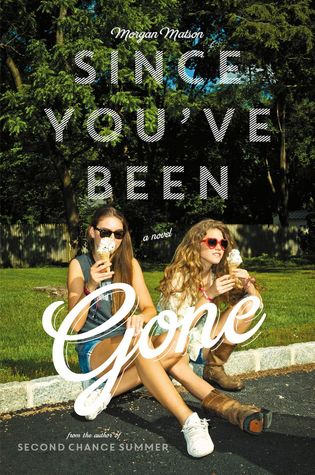
Morgan Matson's Since You've Been Gone has my favorite cover art of any spring or summer publications I've seen out this year, and was the reason I picked it up at the bookstore a few days ago. I didn't think I knew anything about Matson when I bought the book - really, it was all about the cover art. But I started to fill in the pieces in a coincidental way, before I'd even started reading. 

My sister actually got to Since You've Been Gone before I did, because unlike me, she was actually quite familiar with Matson. Matson's second book, Second Chance Summer, is one of my sister's favorite books, and as soon as she saw Matson's name on the cover of this new book, she wanted to read it right away. Meanwhile, I had been doing some research on road trip YA books - Paper Towns, Going Bovine, Lost at Sea, and As Easy as Falling Off the Face of the Earth - when I came across the recommendation of Matson's first novel, Amy and Roger's Epic Detour. Matson's identity as a YA author came together in fairly short order, and all through this new publication, Since You've Been Gone. Since finishing the book, I've also learned that Matson also writes under the name "Katie Finn," so that the new publication Broken Hearts, Fences and Other Things to Mend is actually another one of Matson's books. I've seen the cover all over the place in different bookstores, and added it to my Amazon wishlist a few days ago (Matson's books have really good cover art). 

Since You've Been Gone was a perfect book to read at the beginning of the summer, because it's really a summer book. It takes place between June and August, neatly wrapped up in that hot handful of months. Emily is excited about the summer she's going to have with her best friend Sloane, a teenage girl who moved to town a few years ago and yanked Emily out of her shy, quiet routine. Now the two of them are a package deal, making sure that they get summer jobs at the same place and making plans for parties at the Orchard. But this year, Sloane isn't going to be spending the summer with Emily. She disappears suddenly in June, leaving Emily with a list of thirteen things to do without her. They include straightforward instructions ("go skinny-dipping" "steal something") and also quizzical imperatives ("55 S. Ave. Ask for Mona" "Penelope"). Unable to do anything else about Sloane's disappearance, Emily dutifully begins making her way through the list, hoping that by the time she gets to the end she will have her best friend back. 

But the list does something that Emily isn't expecting. Instead of closing off her world - she feels like she'll be lost without Sloane - it actually opens it up again. She becomes friends with several unlikely candidates, including Frank Porter, the A+ student at her school who is working at an indoor climbing wall for the summer, despite the fact that he's terrified of heights. Slowly, Emily's new friends help her work her way through the list. But will Sloane be waiting at the end of it?

I loved Since You've Been Gone. It had the feeling of a Deb Caletti or a Sarah Dessen book, something you know is going to be a good read by the author name alone. And you know it's going to be at least a little bit of a romance, and a little bit of a find-yourself book, and a little bit of a summer adventure. I'll be reading Second Chance Summer next (which I know my sister has), and then I'm going to get to Amy and Roger and the new Broken Hearts. Matson will be one of the authors whose new publications I will watch out for year after year. 

Saturday, June 28, 2014

Feed by M.T. Anderson

M.T. Anderson was another of the many authors at the NCTE conference in Boston this past November. I always feel like I read a fair amount every year, but that doesn't really do anything to diminish the books on my wishlist, where three of Anderson's books have been hanging out for the past few years: the two volumes of Octavian Nothing and Feed. One of my favorite aspects of the NCTE conference is that fact that for any author speaking at the conference, their publisher brings in a selection of their books to sell. I met M.T. Anderson after his panel discussion, and picked up all three books that I'd been wanting to read, and have slowly been reading them over the last few months. 

Feed was one of those books that I'd heard a lot about (buzz, recommendations, good things!), but didn't know much about (plot, setting, content!). I zipped through it once the story got going, a mix between dystopian and sci-fi with a teenage twist. The book is set in a future where citizens are implanted with a chip that consistently feeds in entertainment, music, news, others' memories, information, and advertising. When protagonist Titus and his friends head to the Moon for a night of partying, their feeds are compromised and they end up in the hospital to recover. For the first time in their lives, their feeds go quiet as the hack into the digital system is investigated by doctors and other agents. When they are in the hospital, Titus connects with Violet, a teenage girl who hasn't had her feed for as long as Titus and his friends have. And when she leaves the hospital, she discovers that her feed hasn't been fixed. Not entirely. It continues to malfunction and compromise her health and her life. 

For all of the opulence and expense described in Feed, the technological improvements and development are not at all benign. There is mass pollution happening, and Titus describes the way that he and his friends have developed lesions all over their bodies from the atmosphere. But rather than seeing the lesions as a mark of the poisonous environment, Titus's friends instead wear their lesions like accessories, even cutting fake ones in across their necks and shoulders. Consumerism and advertising (and Anderson's critique of both) are at the heart of the novel, heightened by the feed, the perfect tool for the dissemination of product placement. 

Anderson's representations of Titus and his friends are outstanding and inventive, especially Titus's best friend Link, who is a clone of Abraham Lincoln.There is also Quendy, a teenage girl who competes with Calista (Link's girlfriend) throughout the novel, plastering herself with lesions when Calista cuts extras into her skin. The teenage characters are products of their situation, and they do not change or grow from the beginning to the end of the novel. Titus lets Violet down utterly. Their consumption only increases as the environment fades, and the economy starts to crumble. It's the futuristic version of The Great Gatsby, a replication of the 1920s before the crash of the 1930s. 

The writing in this book is vivid, adopting a futuristic slang and structure. And it comes with one of the best opening lines in YA literature: "We went to the moon to have fun, but the moon turned out to completely suck" (3). And the chapters titles are pretty great, too. 

Friday, June 27, 2014

Boy21 by Matthew Quick

I unexpectedly took a short hiatus from updating this blog at the beginning of the year. I was on a roll with book reviews after NCTE in November. It's hard not to be. You pick up so many new books that are really some of the best being published for teenagers and you don't want to do anything else except for write about them and share information about them as much as you can. But I sort of hoarded my NCTE haul this year. By which I mean instead of reviewing the books I read, I just read them. And I know I made some sort of justification for just reading: "Think about the time you'll save by just reading and not writing a review! That's like an extra eighth of a book!" It was kind of ridiculous. And, as a result, I have a huge backlog of books that I've read over the last few months that haven't ended up on this blog, but instead have just been shelved or shared person-to-person. 

Boy 21 by Matthew Quick is one of those books that I should have written about here right away, but because it was sandwiched between my reading of two of Quick's newer publications - Forgive Me, Leonard Peacock and The Good Luck of Right Now - I didn't get to writing about it. But it is an incredible book, one that I still think about off and on, even though I read it last December. When I was standing in line at NCTE waiting to purchase Boy 21, I talked to a teacher who told me it was the most oft-stolen book in her high school English classroom. Her students loved the book so much that they would just keep it after she lent it to them. So she was replenishing her supply at NCTE, buying a few extra copies for her classroom. It's really that kind of book, one you want to keep your own copy of because even the physicality of the book is meaningful. 

Boy 21 is about Finley, nicknamed White Rabbit for being the only white kid on his high school basketball team. He wears the number 21 - it's his number, the one on the back of the jersey that gives him some way to identify who he is and what he cares about. He's in his last year of high school, and then he plans to escape Belmont, the run-down neighborhood controlled by the Irish mob, where drugs, violence, and rivalries define most of day-to-day life. But all of his plans change with the arrival of Russ, a basketball phenom who moves to Belmont after his parents are murdered. Russ only answers to the name Boy21 (21 was his former jersey number), and he's more than a little affected by his family tragedy. Finley's coach asks him to befriend Russ and help him to adjust to life in Belmont, and Finley agrees. He knows to do what his coach tells him to, and he knows that a player like Russ will help their team immensely. His friendship grows with Russ - as much as it can - but Russ is also a threat: will he take Finley's place on the team? Worse than that, will he take his number?

Quick's writing is impeccable, and the story is heartbreaking. The violence in the community is palpable, and both Finley and his girlfriend Erin are drawn into it daily, even though they don't want anything to do with it. The Irish mob is more than just background noise in this coming-of-age story. It inches its way into Finley and Erin's lives, and threatens to break them apart. Russ - Boy21 - is an amazingly conceived of character, and Finley's sense of responsibility to him (even when it means losing his place on the team) speaks so much to the type of characters Quick can write. And the small revelation at the end reverberates through everything that came before, reshaping the story. Matthew Quick continues to be one of my favorite contemporary authors, and his young adult and adult books consistently end up on my own best of lists.

Thursday, June 26, 2014

Mexican Whiteboy by Matt de la Pena

I have been lucky to enough to see YA author Matt de la Pena speak twice now: once at the 2013 NCTE conference in Boston and then recently at the beginning of the month at the YA Lit conference at Louisiana State University. de la Pena was publicizing his newest YA novel The Living at NCTE, and I wasn't able to make it to the exhibition hall when he was selling and signing his other books. So I picked up The Living, and read The Living, but apparently did not review The Living here (I will!). Luckily, his other books were available for sale at Louisiana State University, and I was finally able to pick up a copy of Mexican Whiteboy, which had been on my book wishlist for years

Mexican Whiteboy focuses primarily on protagonist Danny, although the perspective routinely changes to examine the community in National City, where Danny moves to live with his Dad's family for the summer. Danny's dad is Mexican and his mom is white. Danny's identity is split between both of them, and, as a result, he feels too Mexican for the private school that he attends in San Diego, and too white for National City. de la Pena writes,
And Danny's brown. Half-Mexican brown. A shade darker than all the white kids at his private high school, Leucadia Prep. Up there, Mexican people do under-the-table yard work and hide out in the hills because they're in San Diego illegally. Only other people on Leucadia's campus who share his shade are the lunch-line ladies, the gardeners, the custodians. But whenever Danny comes down here, to National City - where his dad grew up, where all his aunts and uncles and cousins still live - he feels pale. A full shade lighter. Albino almost. (2)
But Danny has something special. He can pitch like no one else can, his long arms giving his pitch a ninety-five-mile-an-hour power. He disrupts the hierarchy of the neighborhood when he shows off what he can do when he's playing baseball, seriously pissing off Uno, who's partly in love with Danny's cousin Sofia. But Danny's not consistent. Sometimes his pitch will fly straight and do just exactly what he wants it to. But other times it's unpredictable, and he can't control what happens to the baseball as it flies towards home base. 

Part of the reason Danny's moved to National City for summer is to be closer to Mexico, where his dad is. Danny wants to save up money over the summer and book a flight down there, and show his father just how much he's turning into the kind of man he'd be proud of. We see glimpses of what Danny believes his father wants to see through the letters Danny puts in the mail, exaggerating aspects of his life in National City with his family and making up stories that he thinks will impress his dad. 

Mexican Whiteboy is a powerful book. The writing is hopeful and poetic - I underlined more phrases in this book than in any other I've read recently. The language shines; it's tactile and real and repeats itself inside your head, vocalizing the dialogue. And the characters are so likable, even when they're not doing likable things, even when they're doing the last thing that you want them to. The book is about a community as much as it's about Danny and his family, and about place and language and connection.